
Smart Roads, Smarter Future: How Green Tech is Revolutionizing Traffic

"Discover how eco-friendly, self-powered networks are making our roads safer, more reliable, and paving the way for sustainable transportation."
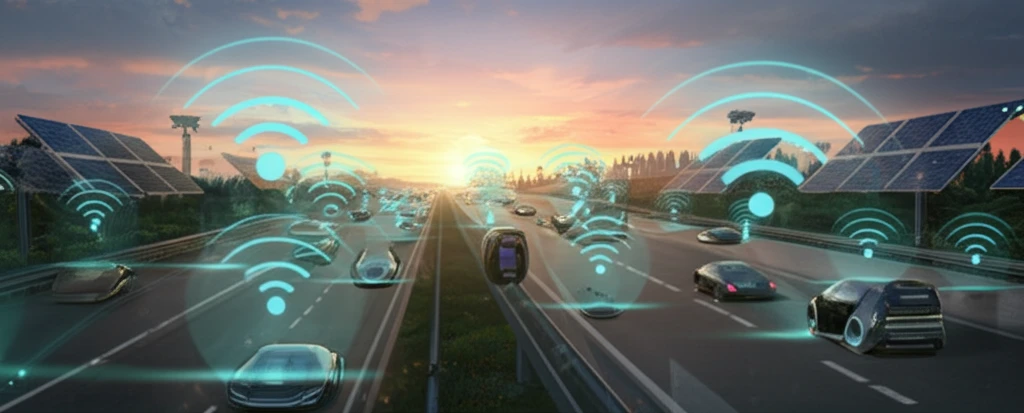
Imagine a world where traffic flows seamlessly, accidents are minimized, and our roads are powered by the sun. This vision is becoming a reality thanks to innovative projects like the Green Vehicular Ad Hoc Network (GVANET). GVANET is not just about improving transportation; it's about creating a sustainable and intelligent infrastructure for our cities.
Vehicular Ad Hoc Networks (VANETs) are a groundbreaking framework that supports a range of applications, from enhancing road safety to delivering multimedia content. By enabling vehicles to communicate with each other (V2V) and with the infrastructure around them (V2I), VANETs pave the way for smarter and more responsive transportation systems.
At the heart of GVANET is the concept of self-powered Road Side Units (RSUs). Traditionally, RSUs were tethered to wired electricity sources, limiting their placement and coverage. GVANET overcomes this limitation by utilizing renewable energy sources, primarily solar power, allowing RSUs to be deployed anywhere and creating a truly ubiquitous communication network.
GVANET: Building a Greener, More Reliable Road Network
The GVANET project, initiated in 2009, focuses on creating a self-powered communication infrastructure that is cost-effective, reliable, secure, and easy to install. This involves a two-level design approach: device level and system level.
- Choosing the Right Platform: Selecting low-power, high-performance hardware like the Ubicom IP2022 Network Processor, powered by solar panels.
- Solar Energy Harvesting Module: Implementing efficient power adaptation and routing circuits using units like the TPS63000 Texas Instrument DC-DC converter.
- Power Management Strategies: Employing strategies like Duty Cycle Estimation (DCE) and Centralized Green Scheduler (CGS) to manage energy consumption.
- Embedded Security: Protecting RSUs with an embedded cooperative-hybrid intrusion detection system (ECHIDS) to ensure service availability.
The Road Ahead: Future Innovations for GVANET
While GVANET has achieved significant milestones, there's still room for growth and innovation. Future developments include integrating modern multipath routing protocols to enhance reliability, incorporating Quality of Service (QoS) concepts to improve data delivery, and proposing security models to protect the VANET infrastructure during network recovery. As technology evolves, GVANET promises to pave the way for a smarter, greener, and more connected transportation future.