
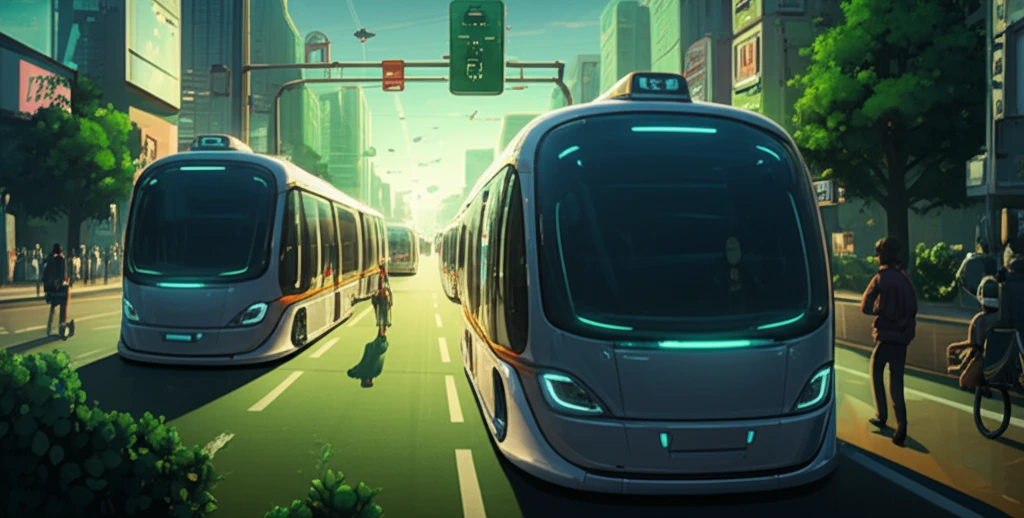
Ditch the Driver, Keep the Freedom: How Transit Leaps Can Revolutionize Your City

"Imagine a city where getting around is effortless, eco-friendly, and affordable. Transit leap theory offers a staged approach to driverless public transport that could transform our urban lives. Is this the future of mobility?"
Are you tired of traffic jams, expensive gas, and the endless search for parking? Imagine a world where getting around your city is seamless, affordable, and environmentally friendly. This vision might seem like a distant dream, but a compelling theory called 'transit leap' offers a practical roadmap for transforming our urban transportation systems.
Transit leap theory, detailed in academic research, proposes a staged introduction of driverless passenger systems into public transit. The core idea? Instead of trying to overhaul everything at once, cities can gradually integrate autonomous vehicles into specific applications, starting with underserved areas and slowly expanding the network. This approach promises to revolutionize how we move, offering benefits for individuals, communities, and the planet.
This article breaks down the key concepts of transit leap theory, exploring its potential benefits and addressing potential challenges. We will examine real-world examples of cities and communities already experimenting with this approach, and consider how transit leap can shape a more sustainable and equitable future for urban mobility. Get ready to explore a future where your daily commute could be transformed.
Transit Leap: A Vision for San Diego and Beyond
Transit Leap is one of the five big moves guiding SANDAG's regional plan, aiming to provide high-speed, high-frequency transit to get people moving faster and more conveniently. The concept envisions a complete network of fast, high-capacity, high-frequency transit services that connect major residential areas with employment centers and attractions throughout the San Diego region. Transit Leap helps bypass the interim challenges of semi-autonomous and mixed-autonomy scenarios, and supports equity in mobility, environmental quality, and the financial viability of public transit networks.
The Transit Leap Deployment Framework
Transit Leap is introduced as a deployment path for robotic, shared-use, multi-passenger vehicle applications that start small, expand by demand, merge, and spread. This approach to deploying automated vehicles is designed to blunt the long-established challenges of conventional transit deployment. Transit Leaps 1 and 2 can commence immediately, using Level 5 automated minibuses to carry six to 12 passengers at slow speeds along carefully prepared routes—a model already demonstrated in several countries.
From Private Buses to Public Transit Innovation
On July 10, 2019, SANDAG hosted a webinar to unpack Transit Leap with industry experts, including Katie Chalmers from King County Metro and Ben Porritt from Virgin Trains, marking a significant step in regional planning engagement. Separately, Leap Transit emerged as a private bus service based in San Francisco, though it ultimately did not comply with San Francisco regulations and was forced to halt its operations. These developments illustrate both the institutional momentum and the regulatory pitfalls that have shaped the transit innovation landscape.
The Vision: Staged Automation for Urban Mobility
The traditional approach to transportation often focuses on personal vehicles, leading to congestion, pollution, and reliance on fossil fuels. Transit leap theory offers a compelling alternative: a carefully planned transition to shared, autonomous public transportation.
- First-and-last-mile connections: Providing efficient transportation between residential areas and public transit hubs.
- Low-density environments: Serving areas where traditional bus routes are inefficient.
- Traffic-calmed zones: Deploying autonomous shuttles in areas with slower speeds and pedestrian-friendly design.
- Gradual Expansion: Expanding and linking service areas as technology improves and public acceptance grows.
Autonomous Vehicles as Transit Ridership Drivers
Recent research explores how cities can use autonomous vehicles to increase transit ridership and reduce household vehicle ownership. Transit Leap helps bypass the interim challenges of semi-autonomous and mixed-autonomy scenarios, and supports equity in mobility, environmental quality, and the financial viability of public transit networks. The framework positions shared autonomous vehicles not as replacements for transit but as complementary tools that strengthen the broader public transportation ecosystem.
Leap Transit: A Cautionary Tale in San Francisco
Leap Transit launched in San Francisco with overhauled buses featuring black leather seats, individual USB ports, and high-end snacks, charging riders $6—nearly three times the price of a city bus ticket. The service was ultimately shut down by the state Public Utilities Commission for operating illegally, despite having been approved by the commission and awaiting its license. Leap's failure highlights how luxury-oriented positioning and regulatory non-compliance can derail even well-funded transit startups, offering a stark counterpoint to more equity-focused Transit Leap models.
Transit Leap in the Competitive Landscape
Transit Leap exists within a broader ecosystem of transportation innovations, with competitors and alternatives including services like Uber Transit, Tickey, and Embark appearing in market comparisons. The original Transit Leap academic framework, published in 2015, proposed an environmentally sustainable deployment path for autonomous vehicles as an alternative to conventional private vehicle ownership models. The concept has been studied alongside other shared mobility solutions, positioning it as part of a diverse portfolio of approaches to urban transportation challenges.
Real-World Examples: The Future is Now
While transit leap theory might sound futuristic, elements of it are already being implemented in communities around the world. These early adopters provide valuable insights and demonstrate the feasibility of this approach. By embracing transit leap, cities can pave the way for a future where mobility is more efficient, sustainable, and accessible for all.
Industry Perspectives on Transit Leap's Viability
TechCrunch reported on Andreessen Horowitz-backed Leap buses hitting the streets in San Francisco, with the startup launching completely overhauled buses and a route from the Marina to the downtown area. The Transit Leap concept has been explored in practice through academic work, examining how the theoretical deployment framework translates into real-world transit operations. These developments demonstrate both the venture capital interest and the scholarly rigor being applied to shared autonomous transit models.
Market Segmentation and Growth Opportunities
The transit and ground passenger transportation market is segmented by type, application, end-user industry, distribution channel, and geography, providing a detailed outlook on diverse growth opportunities. This segmentation framework suggests that Transit Leap-style innovations can target specific niches within the broader public transport market rather than competing across all segments simultaneously. Understanding these market divisions will be critical for deploying shared autonomous transit solutions in contexts where they can achieve the greatest impact.
Nigeria's Transit Leap in Bus Technology
In the face of ongoing challenges, Nigeria's government and transportation authorities are committed to enhancing the public transportation system through active implementation of Bus Rapid Transit systems and expansion of rail networks. These efforts aim to provide efficient travel options for a rapidly growing urban population, representing a developing-world interpretation of the Transit Leap concept. The Nigerian example illustrates how the principles of leapfrogging traditional infrastructure can apply in contexts where conventional transit systems are still being built from the ground up.
Pilot Programs and Human-Centered Testing
CityMobil2 stands as the most extensive pilot completed to date for automated road transport systems, representing Transit Leap Phase 1 in practice. This case study provides critical evidence for whether Transit Leap will contribute to or compete against evident trends in urban mobility, including shrinking travel distances. The pilot's findings are essential for understanding how automated transit systems interact with human behavior and existing transportation patterns in real-world conditions.