
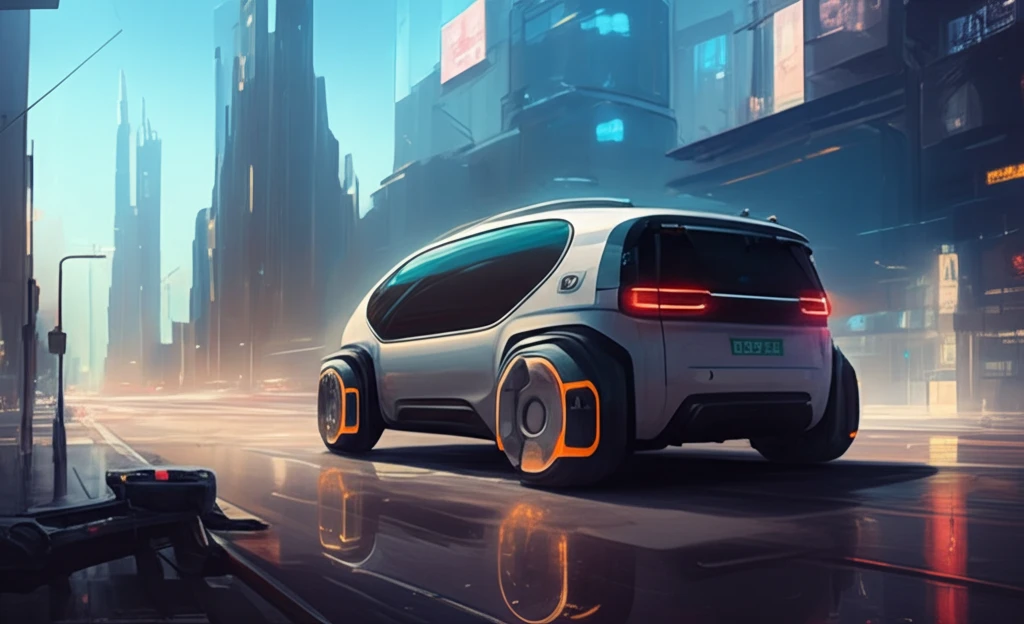
Reinventing the Wheel: How Autonomous Vehicles Like the ROboMObil Are Shaping the Future of Driving

"Discover how innovations in electric and robotic vehicle technology are paving the way for self-driving cars and revolutionizing transportation."
The automotive industry is on the cusp of a massive transformation, driven by advancements in electric vehicles (EVs) and autonomous driving technology. While the idea of self-driving cars might still seem like a futuristic fantasy to some, the reality is that researchers and engineers have been diligently working for years to bring this vision to life.
One such project pushing the boundaries of what's possible is the ROboMObil (ROMO), an innovative electric vehicle conceptualized and developed by the German Aerospace Center. More than just a car, the ROboMObil serves as a robotic system and a test platform for evaluating new approaches to autonomous driving. This article dives into the design and capabilities of the ROboMObil, exploring its unique features and the research it enables.
Imagine a vehicle that can navigate complex environments, park itself with precision, and even adapt to different driving modes based on the situation. That's the promise of the ROboMObil. By examining its architecture, sensor systems, and control mechanisms, we can gain valuable insights into the future of transportation.
The Growing Footprint of Autonomous Vehicle Technology
Autonomous vehicle AI platforms span applications across passenger cars, commercial vehicles, and defense vehicles, with the market geographically segmented across North America, Europe, Asia-Pacific, the Middle East and Africa, and South America. In the robotic sense, a vehicle travels autonomously when it is controlled by the vehicle itself, with neither the vehicle nor its surroundings monitored by a person who can intervene. European research efforts such as the L3Pilot project have brought together 34 partners from manufacturers, suppliers, and research institutions to pilot level 3 automation through systematic analysis of road-test data.
Sensor Fusion and the Limits of Single-Modality Perception
Current autonomous vehicle systems rely on multiple complementary sensor modalities, as no single sensor type is sufficient to ensure reliability under all driving conditions. Redundancy across sensors is essential for robust perception, localization, and safety. Beyond the engineering challenges, the field continues to debate terminology itself, with some researchers arguing that 'highly automated vehicles' or 'fully automated vehicles' better describes the technology than 'autonomous,' which in the standard robotic sense refers simply to the ability to operate without direct human control. The claimed benefits of AVs include improved road safety, reduced traffic congestion, increased mobility for people with disabilities, enhanced fuel efficiency, and reduced environmental impact.
From Early Trials to Commercial Milestones
The development of autonomous vehicles has accelerated as companies worldwide invest heavily in self-driving technology. A significant milestone was reached when Renault commenced a public trial of autonomous shared car services in Paris, allowing approximately 100 users to hail self-driving vehicles via smartphone on public roads. Studies indicate that the majority of autonomous vehicle accidents involve conventionally driven cars colliding with autonomous vehicles, suggesting that increasing the density of AVs on the road could improve overall safety if vehicles communicate effectively with one another.
The ROboMObil: A Research Platform for the Future
At first glance, the ROboMObil might resemble a conventional car, but beneath the surface lies a world of difference. Instead of a traditional chassis and steering system, the ROboMObil features four independently controlled wheel robots. Each wheel integrates an electric drive for steering, an electric motor for traction, and a hydraulic brake. This unique design gives the ROboMObil an exceptional level of maneuverability.
- Enhanced maneuverability with independent wheel control.
- Over-actuation for precise dynamics management.
- Unique steering capabilities for complex movements.
- Versatile platform for autonomous driving research.
Advancing Perception, Prediction, and Safety Standards
Recent research on autonomous vehicles encompasses a broad range of technical challenges, from traffic flow prediction methods to object detection performance, sensor control, and decision-making systems. Safety and reliability reviews reference established standards such as ISO 26262, alongside emerging concerns around computing infrastructure, service protection, and data privacy. The underlying technology draws on sensors, cameras, and artificial intelligence to navigate and operate without human intervention. The most recent industry technology reports, such as Wevolver's 2023 Autonomous Vehicle Technology Report, examine autonomy specifically from the perspective of passenger vehicles.
The 'See and Avoid' Problem and Legislative Lag
A fundamental limitation of current autonomous technology is the 'see and avoid' principle, which remains the primary bottleneck for autonomous dreams despite years of development. Part of the problem stems from a legislative system that has not kept pace with rapid developments in vehicle autonomy, creating regulatory grey areas. Ethical discussions often fixate on the Trolley Problem, which experts argue actually detracts from understanding how autonomous cars genuinely work and the real ethical issues facing the technology's advancement. The more productive ethical conversations focus on transparency, accountability, and the practical moral decisions embedded in autonomous driving algorithms rather than hypothetical crash scenarios.
Comparison Frameworks for the Automotive Sector
Established comparison platforms such as Versus.com, Cars.com, and VehicleSizes.com offer side-by-side evaluation tools for conventional vehicles, covering specifications like MSRP, fuel economy, drivetrain specs, crash test results, and physical dimensions. However, these tools were designed for traditional consumer vehicle comparisons and do not yet incorporate standardized metrics for evaluating autonomous capabilities, sensor suites, or self-driving performance levels. As autonomous vehicles continue to differentiate themselves from conventional cars, the industry may need dedicated comparison frameworks that account for autonomy levels, safety records, and technological maturity rather than relying solely on legacy automotive benchmarks.
Navigating Public Trust and Regulatory Hurdles
Waymo autonomous vehicles have become commonplace in San Francisco but continue to face regulatory hurdles in other markets, including New York City. Waymo's own safety data presents a remarkable safety record, though critics frequently cite a Hunter College analysis to argue that autonomous vehicles are less safe than advertised. The 2026 AV Trust Consumer Survey underscores a critical reality: no industry scales on innovation alone, and success ultimately depends on whether people are willing to use the product. Experts emphasize that the U.S. should scale autonomous vehicles thoughtfully rather than slam the brakes, balancing the technology's potential to save lives with legitimate public concerns.
AI, Urban Mobility, and the Self-Driving Ecosystem
Autonomous vehicles are leveraging artificial intelligence, advanced sensors, and machine learning to navigate without human intervention, with the technology increasingly extending into ride-sharing and urban transportation networks. Self-driving services like autonomous Uber are positioned to reshape urban mobility and contribute to the development of smart cities. Key unresolved challenges for the future include decision-making in unavoidable accident scenarios, data privacy protections, and ensuring accessibility across diverse populations. The automotive industry's trajectory suggests AI will continue to transform transport well beyond private car ownership into shared and integrated mobility platforms.
Smart City Integration and the Road Ahead
Autonomous vehicle development has roots in competitive research events such as the DARPA Grand Challenge, where autonomous cars were required to navigate grueling desert tracks in the Mojave Desert. Today, AV pilots have been running for years in cities like Atlanta, Phoenix, and San Francisco, yet none have achieved full integration with their broader smart city systems. The economic and employment impacts of autonomous vehicles are substantial, creating new opportunities in technology development, vehicle maintenance, urban planning, AI, and cybersecurity, even as the transition presents workforce challenges.
Design Shifts, Congestion Trade-offs, and the Talent Race
As autonomous vehicles shift focus from driving performance to passenger experience, interior automotive design is poised to take centre stage, prioritizing comfort and in-cabin experience over traditional driver-centric layouts. However, research from Arthur D. Little found that introducing autonomous vehicles may initially worsen congestion rather than alleviate it; a mixed fleet of human and autonomous drivers dropped throughput by 16% to 36 vehicles, largely because AVs fully obey traffic laws and do not take the lane-changing risks that human drivers routinely do. Meanwhile, the push toward vehicular autonomy has ignited a fierce talent war across the automotive industry, with demand for AI expertise extending well beyond traditional software skills.
The Road Ahead: What the ROboMObil Teaches Us About the Future of Driving
The ROboMObil represents a significant step forward in autonomous vehicle technology. By serving as a testing ground for new concepts and algorithms, it helps researchers tackle the challenges of creating truly self-driving cars. While widespread adoption of autonomous vehicles may still be some years away, projects like the ROboMObil are paving the way for a future where transportation is safer, more efficient, and more accessible.