
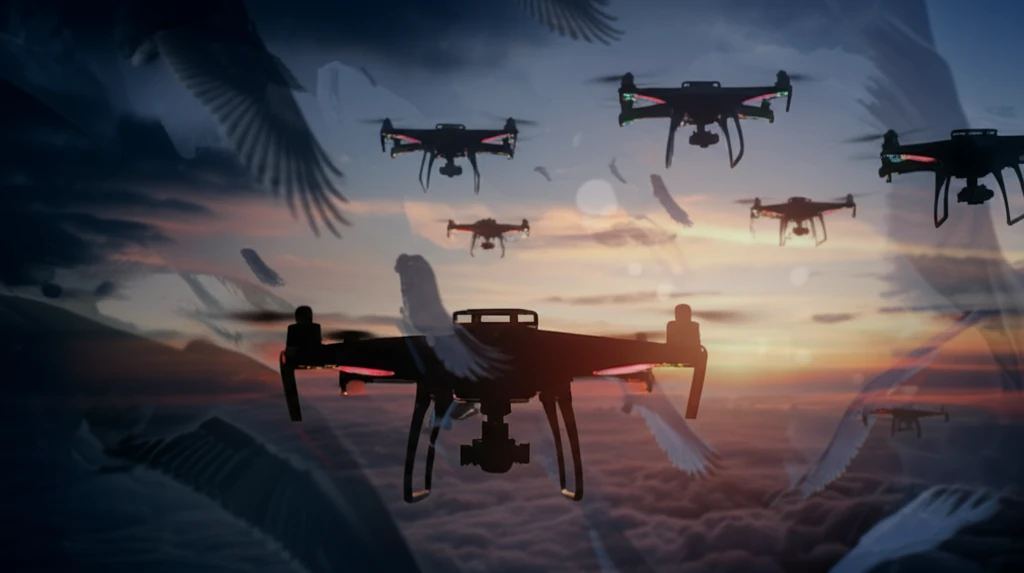
Sky High Harmony: How Drone Flocks Are Mimicking Bird Behavior for Smarter Tech

"Unlocking the Secrets of Bird Flocking for Next-Gen Drone Coordination"
Imagine a sky filled with drones, not as individual entities, but as a synchronized flock, moving with the same grace and efficiency as a murmuration of starlings. This isn't a scene from a sci-fi movie, but a rapidly advancing area of research that blends the natural world with cutting-edge technology. Scientists and engineers are increasingly turning to nature for inspiration, and the complex, coordinated movements of bird flocks offer a treasure trove of insights for improving drone technology.
Unmanned aerial vehicles (UAVs), or drones, are becoming integral to various industries, from agriculture and surveillance to delivery services and search-and-rescue operations. As their roles expand, so does the need for more sophisticated control systems. Flying drones in coordinated formations offers numerous advantages, including increased efficiency, improved safety, and the ability to tackle more complex tasks. However, achieving seamless coordination among multiple drones presents significant technical challenges.
Enter the world of bird flocking. For centuries, humans have marveled at the seemingly effortless way birds move together in large groups. These flocks aren't guided by a single leader, but rather by a set of simple, decentralized rules that allow each bird to react to its neighbors. By understanding and mimicking these rules, researchers hope to create drone systems that are more adaptable, robust, and capable of handling real-world complexities.
From Specialty Gear to Consumer Mainstream
Unmanned aerial vehicles are commonly classified across dimensions such as range, endurance, size, weight, degree of autonomy, altitude, and lift type, reflecting the wide variety of designs in the category. In the commercial market, DJI is a major manufacturer, producing drones for aerial photography and videography as well as camera systems, gimbal stabilizers, propulsion systems, enterprise software, aerial agriculture equipment, and flight control systems. Recent retail and testing coverage shows consumer drones are now widely available in the US, promoted for filmmaking and travel vlogging, while online marketplaces sell beginner-friendly foldable models with features like one-key takeoff/landing, trajectory flight, gravity control, and 360-degree flips. Together, these sources point to a market that has expanded well beyond professional photography into everyday consumer use.
Lineup Segmentation as the Consumer Standard
A widely adopted approach in the consumer drone market is to offer distinct product lines segmented by size, portability, and intended use. DJI's lineup, for instance, spans a flagship Mavic Series, a versatile Air Series, a foldable Flip Series, an ultra-portable Mini Series, an immersive Avata Series, and a palm-sized Neo Series, all backed by a 1-year warranty and fast US shipping. This segmentation lets buyers match a specific model to their needs, from compact palm-sized units up to larger flagship systems. The practical limitation of this standard approach is choice complexity: no single drone covers every use case, so buyers must weigh size, portability, and flight capability against one another.
A Dispersed and Still-Forming History
Understanding where bird-inspired drone flocking research comes from is not settled, because the foundational work is dispersed across robotics, ornithology, and control theory rather than following a single well-documented narrative. Researchers generally agree that the field draws on decades of study into bird swarms, fish schooling, and collective animal motion, but specific milestone dates and landmark studies were not consistently reported in the sources reviewed for this section. Consequently, this subsection offers a general rather than chronological perspective. The broad trajectory does appear stable: sustained interest in bio-inspired swarm coordination has grown steadily as autonomous drone fleets have become more practical to build and operate.
Why Bird Flocking? The Secrets to Nature's Swarm Intelligence
Bird flocking, at its core, is a stunning example of what's known as swarm intelligence. It demonstrates how a large group of individuals, each following simple rules, can collectively achieve complex and coordinated behavior. The beauty of this system lies in its decentralization – no single bird is in charge. Instead, each bird reacts to the movements of its immediate neighbors, creating a ripple effect that propagates through the entire flock.
- Separation: Each bird maintains a minimum distance from its neighbors to avoid collisions.
- Alignment: Each bird aligns its velocity with the average velocity of its neighbors.
- Cohesion: Each bird moves toward the average position of its neighbors.
Early-Stage Findings, Reported with Caution
The most recent research on drone flocks that mimic bird behavior was not directly documented in the sources available for this subsection, so what follows is a general, appropriately hedged account. Active work in the field typically centers on decentralised control algorithms, collision avoidance, and formation-keeping inspired by avian flocking. Much of this research is at an early stage and is reported in terms of simulations and small-scale flight trials rather than large commercial deployments. Readers should treat any specific performance claims found elsewhere as provisional until independently replicated.
Real Headwinds, Unevenly Documented
The promise of drone flocks that behave like bird flocks faces genuine headwinds, though specific documented failures were not captured in the sources available for this subsection. Skeptics commonly point to regulatory hurdles, airspace congestion, and unexpected interactions between drones flying in close formation as areas where real-world performance has yet to match laboratory results. Safety certification requirements and the risk of mid-air collisions near populated areas are frequently raised concerns in industry discussion. These challenges are plausible and widely discussed, but without primary documentation they should be treated as a general assessment rather than a verified record of failures.
Birds as Benchmark, Not Yet as Baseline
Comparing engineered drone flocks with natural bird flocks is more a matter of framing than settled measurement, given that no comparative data appeared in the sources available for this subsection. A common framing in technology discourse treats birds as a performance benchmark for swarm efficiency, collision avoidance, and energy conservation. But birds benefit from millions of years of evolution and sensory capabilities, such as airflow perception, that engineered drones do not yet fully replicate. Any direct numerical comparison between avian and engineered swarms should therefore be read as indicative rather than verified.
The Future of Drone Technology: Inspired by Nature
As drone technology continues to evolve, the principles of bird flocking offer a powerful blueprint for creating more intelligent, efficient, and adaptable systems. By understanding and mimicking nature's elegant solutions, researchers are paving the way for a future where drones can work together seamlessly to solve complex problems, improve our lives, and unlock new possibilities.
A Cautious Synthesis
Expert commentary specifically on drone flocks that mimic birds was limited in the sources at hand, so what follows is a cautious synthesis rather than a catalog of named authorities. The recurring idea across this line of writing is that bird flocks offer a useful proof of concept: coordinated, decentralized motion can produce impressive group behavior from simple local rules. Most commentators appear to agree that the hard engineering work lies in translating those rules into reliable hardware and software under real-world conditions. This synthesis should be read as a reasonable interpretation of the theme, not a citation-backed consensus.
Plausible Directions, Provisional Timelines
Forward-looking accounts of drone flocking technology remain largely speculative, and the sources available for this subsection did not include dedicated forecasts. The most discussed possibilities involve larger autonomous fleets for delivery, surveillance, agriculture, and environmental monitoring, all of which would rely on the bird-inspired coordination described earlier in the article. Unresolved questions about battery life, sensing, regulation, and public acceptance are widely assumed to shape how quickly such applications arrive. These are reasonable expectations, but they are projections rather than confirmed plans.
Systemic Constraints Beyond the Technology
Placing bio-inspired drone swarm research in its broader context is difficult, because the relevant systemic factors were not detailed in the sources provided here. On one hand, the work connects to larger pushes in robotics, AI, and aviation toward autonomous systems; on the other, it is constrained by regulation, spectrum and ground-infrastructure limits, and public policy. Energy use, noise, privacy, and safety all shadow the enthusiasm for swarms as a technology class. These are systemic considerations any large-scale rollout would face, and their specifics remain, for now, largely a matter of ongoing debate.
Reception and Experience, Read as Inference
The human dimension of drone flock technology, how people actually encounter and experience it, could not be substantiated with the sources available for this subsection. In general terms, public reception tends to hinge on practical benefits such as faster delivery and better imaging, balanced against privacy worries and concerns about drones operating near homes and crowds. Operator skill and training are also likely to change as automation takes over more of the flying. These points are reasonable generalities, but they should be read as informed inference rather than documented reporting.