
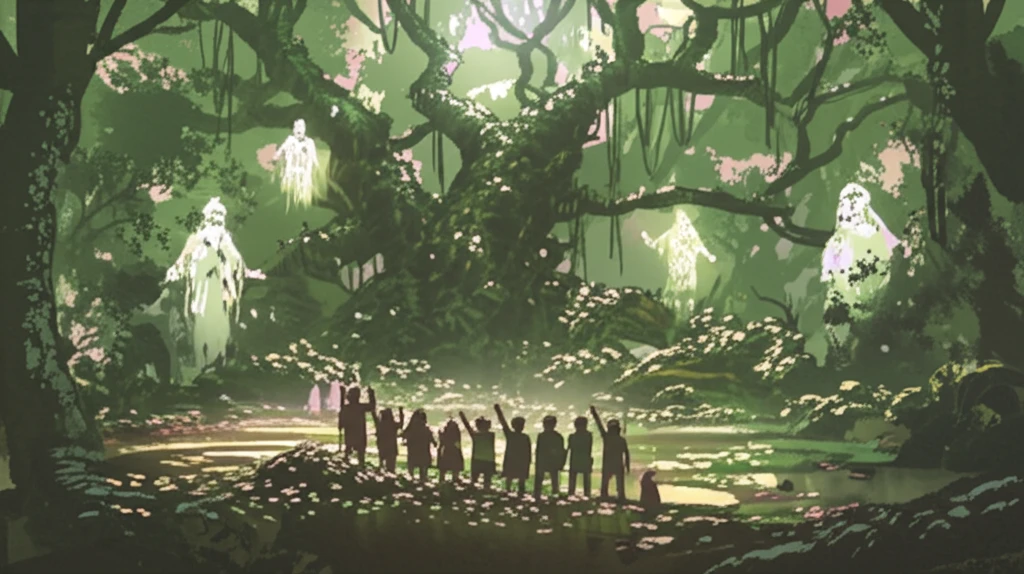
Sacred Sanctuaries: How Traditional African Religions Impact Forest Conservation

"Exploring the unexpected link between African Traditional Religions and environmental stewardship in Benin, West Africa"
In an era dominated by discussions of climate change and environmental degradation, it's easy to overlook the role that cultural and religious beliefs play in shaping our interactions with the natural world. While policy and technology often take center stage, the values and worldviews embedded within societies can profoundly influence how resources are managed and ecosystems are protected. Recent research sheds light on a fascinating and often underestimated aspect of environmental conservation: the positive impact of African Traditional Religions (ATR) on preserving forest cover in Benin, West Africa.
African Traditional Religions, deeply rooted in the continent's diverse cultures, emphasize a sacred connection between humanity and nature. Unlike more structured, globally spread religions, ATR is interwoven with specific landscapes, communities, and historical experiences. Forests, in particular, hold significant spiritual value, often seen as the dwelling places of spirits, ancestors, and powerful deities. This reverence translates into practices and taboos that protect these vital ecosystems, often more effectively than modern conservation efforts alone.
This article delves into the groundbreaking work of researchers who have uncovered a compelling link between ATR adherence and forest conservation in Benin. By combining theoretical models with empirical evidence, they demonstrate how traditional beliefs can act as a powerful force for environmental stewardship. Understanding this connection offers valuable insights for developing more holistic and culturally sensitive approaches to conservation, acknowledging the importance of local traditions in addressing global environmental challenges.
The Forest as a Sacred Space: Understanding ATR's Environmental Ethos
At the heart of ATR lies a profound respect for the natural world, viewing it as intrinsically connected to the spiritual realm. This perspective is vividly expressed through the veneration of forests, which are not simply seen as collections of trees, but as sacred spaces teeming with life, energy, and ancestral presence. For many communities, forests serve as places of worship, healing, and initiation, governed by traditional rules that promote sustainability.
- Sacred Groves: Many ATR communities designate specific areas of forests as sacred groves, where resource extraction is strictly prohibited. These groves serve as biodiversity hotspots and act as refuges for endangered species.
- Rituals and Taboos: Traditional practices often incorporate rituals and taboos that regulate the use of forest resources. For example, certain trees may be considered sacred and cannot be felled, or specific periods may be designated for harvesting to allow for regeneration.
- Ancestral Connection: The belief that forests are inhabited by ancestral spirits fosters a sense of responsibility and stewardship. Communities feel a moral obligation to protect these spaces for future generations and to honor their ancestors.
A Future Rooted in Tradition: Integrating ATR into Conservation Strategies
The research on the impact of ATR in Benin offers a compelling case for recognizing the vital role of traditional knowledge and belief systems in environmental conservation. By understanding and respecting these cultural values, conservation efforts can become more effective, equitable, and sustainable. This involves: