
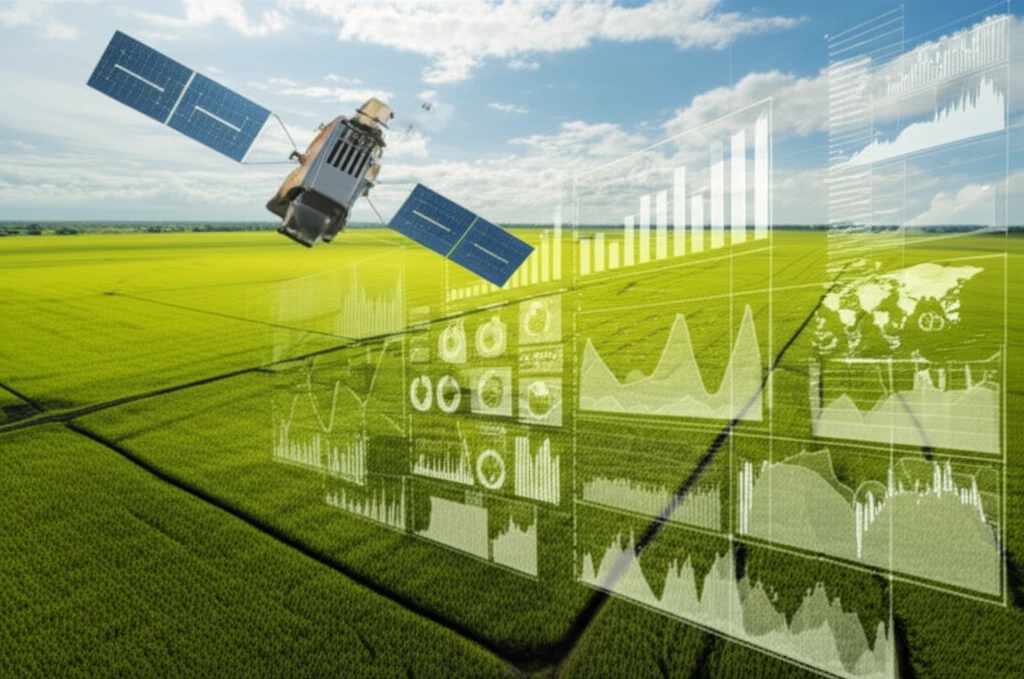
Satellite monitoring rice fields in Rio Grande do Sul, Brazil

Precision Farming: How Tech is Boosting Rice Yields in Brazil

"A new study reveals how an agrometeorological-spectral model is helping Rio Grande do Sul farmers optimize rice production through data-driven insights."


Rice is a staple crop for billions worldwide, and ensuring its sustainable production is a global priority. In Brazil, the state of Rio Grande do Sul plays a crucial role in the nation's rice supply. However, unpredictable weather patterns can significantly impact crop yields, making it essential for farmers to adopt innovative strategies to mitigate these risks.

Traditional methods of crop monitoring often rely on manual surveys and historical data, which can be time-consuming and subjective. To address these limitations, researchers have been exploring the potential of agrometeorological-spectral models, which integrate weather data with remote sensing information to provide more accurate and timely yield estimates.

A recent study published in Bragantia journal delves into the development and application of such a model for irrigated rice in Rio Grande do Sul. By combining meteorological data, satellite imagery, and crop information, this model offers valuable insights for farmers seeking to optimize their yields and adapt to changing environmental conditions.

Decoding the Agrometeorological-Spectral Model: A Farmer's Toolkit

Satellite monitoring rice fields in Rio Grande do Sul, Brazil

The agrometeorological-spectral model developed in this study leverages a combination of data sources to estimate rice grain yield. Here's a breakdown of the key components:

The model was tested across six rice-growing regions in Rio Grande do Sul, utilizing data from the 2000/2001 to 2009/2010 crop seasons. Here's what went into the model:

  • Crop Data: Information on cultivated area and rice grain yield.
  • Weather Data: Meteorological data (temperature) collected from various stations in the region.
  • Satellite Imagery: Normalized Difference Vegetation Index (NDVI) data from the MODIS sensor, capturing vegetation health and density.
Researchers analyzed the relationships between these factors and found that minimum air temperature and NDVI values during specific crop development stages were strongly correlated with final grain yield. This information was then used to calibrate the model, allowing it to estimate yields based on real-time data.

Empowering Farmers with Data-Driven Decisions

This study demonstrates the potential of agrometeorological-spectral models to provide accurate and timely rice yield estimates. By integrating weather data, satellite imagery, and crop information, the model offers farmers a valuable tool for optimizing their practices, mitigating risks, and promoting sustainable rice production.

About this Article -

This article was crafted using a human-AI hybrid and collaborative approach. AI assisted our team with initial drafting, research insights, identifying key questions, and image generation. Our human editors guided topic selection, defined the angle, structured the content, ensured factual accuracy and relevance, refined the tone, and conducted thorough editing to deliver helpful, high-quality information.See our About page for more information.

Everything You Need To Know

1

What is the primary focus of the agrometeorological-spectral model discussed?

The primary focus of the agrometeorological-spectral model is to estimate rice grain yield for farmers in Rio Grande do Sul. It uses a combination of weather data, satellite imagery, and crop information to provide accurate and timely yield estimates, helping farmers optimize their practices and adapt to changing environmental conditions. This model is a tool for making data-driven decisions in rice farming.

2

What specific data sources does the agrometeorological-spectral model integrate to estimate rice yield?

The agrometeorological-spectral model integrates three main data sources: crop data, weather data, and satellite imagery. Crop data includes information on cultivated area and rice grain yield. Weather data incorporates meteorological information, like temperature, collected from various stations in the Rio Grande do Sul region. Satellite imagery utilizes the Normalized Difference Vegetation Index (NDVI) data from the MODIS sensor to capture vegetation health and density. These data points are analyzed together to provide yield estimates.

3

How does the model use Normalized Difference Vegetation Index (NDVI) data from the MODIS sensor?

The model uses the NDVI data from the MODIS sensor to assess the health and density of the rice vegetation. The NDVI data correlates to the crop development and overall health of the rice plants. The agrometeorological-spectral model analyzes the relationship between the NDVI values during specific crop development stages and final grain yield, allowing it to calibrate the model for real-time yield estimations based on the current vegetation health.

4

What are the benefits for farmers in Rio Grande do Sul using this agrometeorological-spectral model?

The agrometeorological-spectral model offers several benefits for rice farmers in Rio Grande do Sul. It provides accurate and timely rice yield estimates, allowing farmers to optimize their practices based on real-time data. This includes making informed decisions about irrigation, fertilization, and other critical farming activities. By mitigating risks associated with unpredictable weather patterns and promoting sustainable rice production, the model supports farmers in achieving higher yields and adapting to changing environmental conditions, which ultimately increases their efficiency and profitability.

5

In what ways can this technology contribute to sustainable agriculture practices?

This agrometeorological-spectral model directly contributes to sustainable agriculture practices by enabling precision farming. By providing accurate yield estimates and insights into crop health, farmers can optimize their resource use, such as water, fertilizers, and pesticides. This targeted approach minimizes waste and reduces the environmental impact of rice cultivation. The model supports more informed decision-making, helping farmers to adapt to climate variability and improve resource efficiency, thus promoting a more sustainable and resilient rice production system in Rio Grande do Sul and beyond.

Newsletter Subscribe

Subscribe to get the latest articles and insights directly in your inbox.