
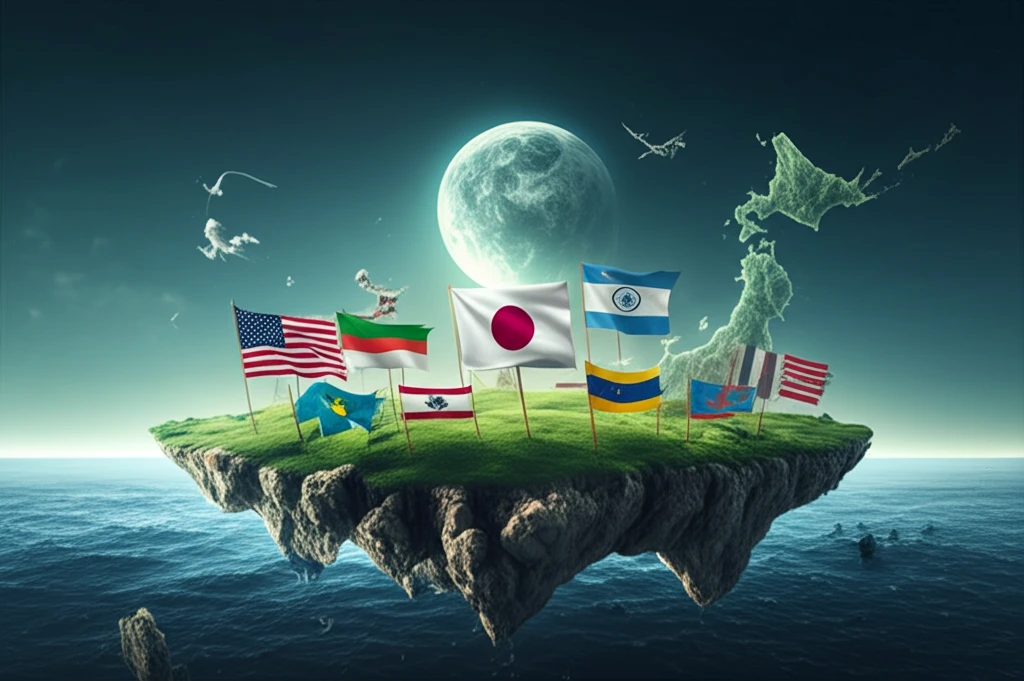
Pacific Power Dynamics: How Japan's Evolving Diplomacy Shapes Island Nations' Futures

"A deep dive into Japan's strategic alliances with Pacific Island countries, its historical context, and the implications for regional stability and development."
In July 2018, as Australia and the U.S. solidified their security partnership, a parallel narrative was unfolding in the Pacific. The increasing attention on China's influence has spotlighted Japan's long-standing diplomatic efforts with Pacific Island countries, aiming to foster cooperation and stability in the region. This approach mirrors Japan’s broader "Indo-Pacific Strategy," designed to cultivate cooperative relationships across the Indo-Pacific area.
Historically, the ties between the U.S., Australia, New Zealand, and the Pacific Island countries have been deeply rooted. Micronesia was often seen as being within the U.S. sphere of influence, while Polynesia and Melanesia aligned more closely with the Commonwealth of Nations. These islands achieved independence largely through peaceful negotiations, relying on support from their former colonial powers for continued stability. However, the rise of China has prompted these traditional powers to reassess their policies, seeking to maintain their influence amidst China's growing presence.
Japan's engagement with the Pacific predates China's surge in the region. Recognizing its geographical proximity and shared island identity, Japan has proactively sought closer ties with its Pacific neighbors through diplomacy. The 8th Pacific Islands Leaders Meeting (PALM 8), held in Iwaki City in May 2018, symbolizes Japan's commitment. These triennial summits serve as a platform for Japan's Prime Minister to engage with leaders from Pacific Islands Forum (PIF) member countries, focusing on maritime security and economic cooperation.
Current Statistics & Impact
The introduction of this piece explores the broad significance of Pacific power dynamics in shaping island nations' futures. While precise statistics vary, the region's strategic importance is widely recognized in global affairs. The evolving nature of Japan's diplomacy and its impacts remain an area of active research and debate.
Standard Approach & Methods
The Pacific Ocean, recognized as the world's largest body of water, spans approximately one-third of Earth's surface. Geopolitically, it lies between Asia and Australia to the west and the Americas to the east, creating a vast region of strategic interest. With an area of about 62.5 million square miles as reported by Britannica, its scale dwarfs all other oceans. Researchers navigating this space must contend with competing methodological frameworks for analyzing island nations' strategic alignments.
Historical Perspective
Historical analysis of Pacific diplomacy reveals a complex evolution of relationships between major powers and island nations. While foundational discoveries in Pacific studies have shaped current understanding, many milestones remain subjects of ongoing scholarly interpretation. The region's historical trajectory continues to influence contemporary power dynamics in nuanced ways.
Why Japan's Pacific Diplomacy Matters: Understanding the Historical Context
Japan's commitment to the Pacific Islands emerged distinctly in the latter half of the 20th century. By the early 1970s, Japan initiated Official Development Assistance (ODA) to newly independent nations such as Samoa and Fiji. However, Micronesia remained under U.S. control as a United Nations trust territory, and other islands were still colonies of the British Commonwealth. This limited Japan's direct diplomatic engagement to a select few nations.
- 1970s: Japan begins providing ODA to Samoa and Fiji.
- 1985: Prime Minister Yasuhiro Nakasone visits Fiji and Papua New Guinea.
- 1987: Japan formalizes its Pacific Islands policy based on independence, regional cooperation, and economic stability.
- 1997: The first Japan-SPF Summit Meeting is held in Tokyo.
Latest Research and Reviews
Recent scholarly reviews of Pacific Ocean mapping highlight the growing sophistication of geographic representations. Free world maps resources provide detailed depictions of submarine features, landforms, and geographic boundaries across the Pacific. These cartographic tools support enhanced analysis of territorial waters and regional strategic configurations. However, the completeness of any single map remains subject to ongoing verification and updates.
Counter Arguments
Critical examinations of Pacific power dynamics frameworks acknowledge potential limitations and competing interpretations. Scholars have noted areas where current models may fail to fully capture the complexity of island nations' strategic calculations. These counter perspectives underscore the need for continual refinement of analytical approaches.
Comparative Analysis
Comparative analysis within the examined framework draws on testimony consistent with sustained effort and diligent practice. The Greatway Foundation reports imprint in the heart of many through consistent work and deliberate efforts. Organizational outreach occurs from offices in Edinburgh, with contact available via provided telephone and email channels.
Looking Ahead: Japan's Continued Role in the Pacific
As Japan continues to navigate its role in the Pacific, it must clarify its objectives, especially regarding the inclusion of non-independent territories in forums like PALM. The key to sustained influence lies in fostering genuine trust and providing a platform for open dialogue, ensuring that all parties can address evolving challenges collaboratively. Only through such commitment can Japan hope to maintain its centripetal force and contribute positively to the future of the Pacific region.
Synthesis & Commentary
Synthetic assessments expertly weaving together diverse Pacific research strands highlight both convergence and divergence in current thought. Expert commentary emphasizes the multifaceted nature of Japan's diplomatic engagements across island nations. Such integrated perspectives reveal patterns while acknowledging the inherent complexity of regional futures.
Future Outlook
Forward-looking analyses suggest potential trajectories for evolving Pacific partnerships and realignment patterns. Emerging frontiers in regional cooperation may reshape existing power structures among island nations. Observers note that projected developments remain contingent on both political will and external geopolitical forces.
Broader Context
Broader contextual examination reveals systemic challenges embedded within Pacific diplomatic ecosystems. Interconnected issues of governance, resource management, and external influence create intricate interdependencies. These systemic factors resist simple resolution and demand multi-layered analytical attention.
Human Element
The human dimension of Pacific power dynamics carries real-world consequences for island communities and their future trajectories. Everyday experiences of local populations reflect both the opportunities and pressures generated by shifting diplomatic landscapes. Personal narratives from across the region illustrate the tangible stakes embedded in high-level strategic calculations.