
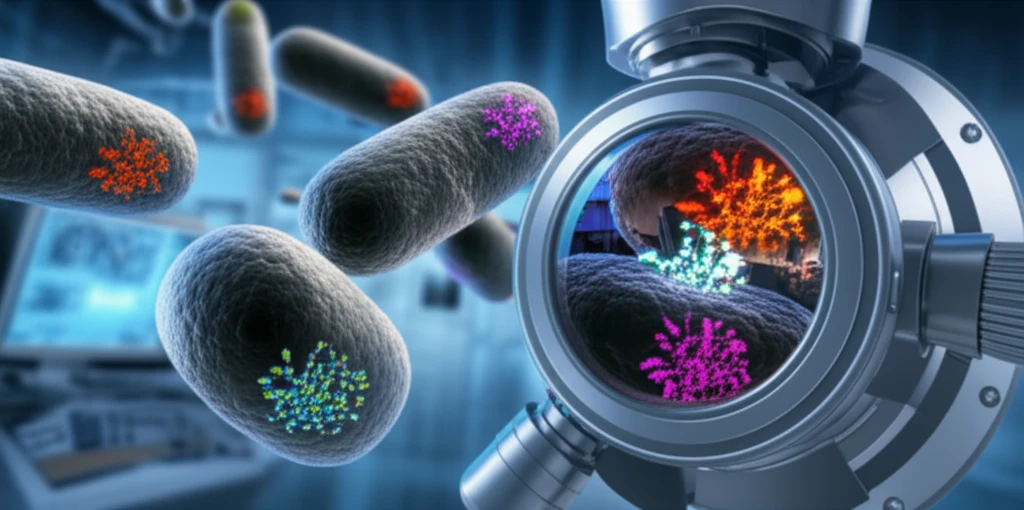
Nanotech's Tiny Triumph: How Electron Cryotomography is Revolutionizing Bacteria Research

"Unlocking bacterial secrets at the nanoscale: Electron Cryotomography's journey from groundbreaking tech to essential tool in understanding bacterial chemoreceptor arrays."
Understanding how cells work requires a detailed look at their structures, especially the tiny machines made of molecules that do the cell’s work. Electron microscopy (EM) helps us see these machines, but looking at living things is difficult because of their water content and sensitivity to electron beams. Traditional EM uses chemicals and other treatments to prepare samples, but this can damage the structures we want to see. Cryo-EM is a new technique that preserves the natural structure of samples by freezing them quickly and keeping them in a frozen, watery state.
Cryo-EM, short for cryogenic electron microscopy, has emerged as a game-changing method in structural biology, allowing scientists to visualize biological samples in a near-native state. Unlike traditional electron microscopy, which requires chemical fixation and dehydration, cryo-EM preserves the delicate structures of cells and molecules by rapidly freezing them in a thin layer of vitreous ice. This approach minimizes artifacts and provides a more accurate representation of the biological machinery at work.
Electron cryotomography (ECT) is one of the cryo-EM techniques. It is used to image individual and unique specimens such as cells. The specimen is tilted incrementally with respect to the electron beam in order to gain 3-D information. ECT has rapidly evolved over the last two decades, and one of its primary applications has been the study of bacterial chemoreceptor arrays.
Bacterial Chemoreceptor Arrays: Why They Matter
Bacteria, though tiny, are sophisticated navigators. They can sense their environment and move towards favorable conditions, a process known as chemotaxis. This ability is essential for bacteria to find nutrients, escape toxins, and even infect hosts. Understanding how bacteria achieve this directional movement is crucial for various reasons.
- Infection processes: Growing evidence suggests that chemotaxis is involved in the infection process of pathogens like Borrelia burgdorferi.
- Paradigm for cell signalling: The bacterial chemotaxis system is a model for cell signaling pathways in general.
- Ideal model: The bacterial chemotaxis system has only 11 characterized core components, and its easy manipulation makes it an ideal model to study general signal transduction principles.
The Future of ECT
Electron cryotomography has already transformed our view of bacterial chemoreceptor arrays, providing nanoscale resolution insights into their architecture and function. As technology continues to evolve, we can expect even higher resolution reconstructions that reveal the conformational changes involved in signal transduction and the structural basis for regulated cooperativity. With new capabilities to examine various organisms and states, ECT promises deeper insights into bacterial life and behavior.