
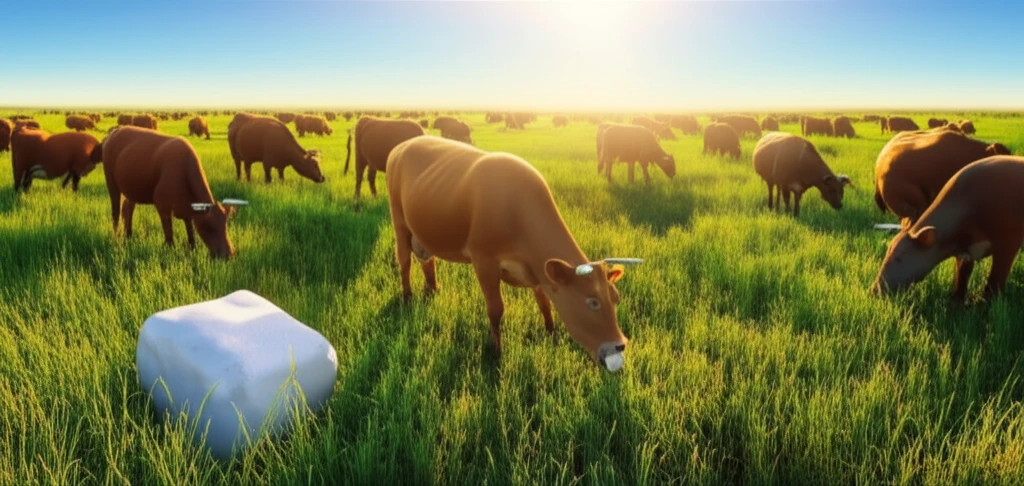
Beef heifers grazing in a lush green pasture with protein salt supplementation.

Is Protein Salt the Secret to Healthier Pastures? Unlocking Grazing Efficiency

"Discover how supplementing beef heifers with protein salt impacts grazing patterns and pasture health, offering insights for sustainable animal production."


Sustainable animal production hinges on understanding how grazing animals interact with pasture ecosystems. Techniques like monitoring marked tillers allow scientists to estimate grass leaf tissue flow, which helps in assessing pasture health at both tiller and area levels. By understanding these dynamics, farmers can better manage their land, ensuring efficient and sustainable animal production.

However, information on leaf blade flow for tropical forages remains limited despite their importance in Brazil, where they are the primary food source for grazing animals. Since leaf blades are the preferred forage selected by these animals, studying their dynamics can provide valuable insights into plant-animal interactions within tropical grazing systems.

One such forage is Alexandergrass (Urochloa plantaginea), often considered an undesirable species in cropping areas, yet it can be suitable for grazing management. Protein supplements are commonly given to grazing cattle to boost performance beyond what tropical forages alone can provide. This leads to the question: How does protein supplementation affect forage intake and leaf blade tissue flow in pastures like Alexandergrass?

Decoding the Impact: How Protein Salt Changes Grazing Habits

Beef heifers grazing in a lush green pasture with protein salt supplementation.

A study was conducted to evaluate how protein salt supplementation affects leaf biomass flow, defoliation intensity, and defoliation frequency in Alexandergrass pastures grazed by beef heifers. The experiment compared heifers that grazed exclusively on pasture to those that received protein salt supplementation (0.2% of their body weight daily). Researchers tracked various factors to understand the impact of the supplement.

The research design involved a completely randomized experiment with repeated measures over time. Two treatments were applied (with and without protein salt) across two area replications, each with three Angus test heifers per paddock. This setup allowed for careful observation and measurement of the effects of protein salt on grazing behavior and pasture dynamics.

  • Leaf Blade Intake: Heifers grazing exclusively on pasture showed an 18% higher leaf blade intake flow compared to those supplemented with protein salt.
  • Grazing Intensity: Grazing intensity remained consistent (59.8%) whether heifers received protein salt or not.
  • Defoliation Frequency: Heifers receiving protein salt exhibited a one-day reduction in the defoliation frequency of tillers.
These findings suggest that providing protein salt to beef heifers grazing Alexandergrass alters the herbivore-plant relationship. Specifically, it reduces both the intake flow and the frequency of leaf blade defoliation. This indicates that supplemented heifers may be more selective in their grazing, potentially optimizing their nutrient intake while also affecting pasture recovery rates.

Optimizing Pasture Management: Key Takeaways

In conclusion, strategic supplementation with protein salt can significantly influence grazing dynamics in Alexandergrass pastures. By understanding these interactions, farmers can make informed decisions to optimize pasture utilization, promote sustainable grazing practices, and improve overall animal health. Further research is needed to explore the long-term effects of protein salt supplementation on pasture composition and ecosystem health.

About this Article -

This article was crafted using a human-AI hybrid and collaborative approach. AI assisted our team with initial drafting, research insights, identifying key questions, and image generation. Our human editors guided topic selection, defined the angle, structured the content, ensured factual accuracy and relevance, refined the tone, and conducted thorough editing to deliver helpful, high-quality information.See our About page for more information.

Everything You Need To Know

1

What is protein salt and why is it given to grazing animals?

Protein salt is a supplement given to grazing livestock, like beef heifers, to enhance their nutritional intake beyond what they can obtain from pasture alone. It's significant because it can influence grazing behavior, potentially optimizing nutrient intake and affecting pasture recovery. The implications include changes in leaf blade intake, defoliation frequency, and overall pasture utilization.

2

What does 'leaf blade intake flow' mean, and why is it important?

Leaf blade intake flow refers to the rate at which grazing animals consume leaf blades from pasture grasses. It's important because leaf blades are the preferred forage for many animals, and understanding their intake dynamics provides insights into plant-animal interactions. Lower leaf blade intake flow can mean that animals are eating less. It is also an indicator of sustainable animal production.

3

What is 'defoliation frequency' and why should farmers pay attention to it?

Defoliation frequency refers to how often tillers (individual grass shoots) are grazed or cut back. Monitoring it is important because it affects pasture regrowth and overall health. A reduced defoliation frequency can impact pasture recovery rates and potentially lead to changes in pasture composition over time. Protein salt supplementation causes a one-day reduction in the defoliation frequency of tillers.

4

What is Alexandergrass, and why is it relevant to grazing?

Alexandergrass (Urochloa plantaginea) is a type of tropical forage grass that, while often considered undesirable in cropping areas, can be used for grazing management. It is important because it serves as a primary food source for grazing animals in regions like Brazil. Alexandergrass' interaction with grazing animals is a main point in sustainable animal production.

5

What is 'grazing intensity,' and why is it important for pasture management?

Grazing intensity refers to the degree to which animals graze or defoliate a pasture area. It's important because it directly impacts pasture health, regrowth, and overall productivity. Understanding and managing grazing intensity is essential for maintaining sustainable grazing practices and preventing overgrazing. The experiment found that protein salt does not impact grazing intensity.

Newsletter Subscribe

Subscribe to get the latest articles and insights directly in your inbox.