
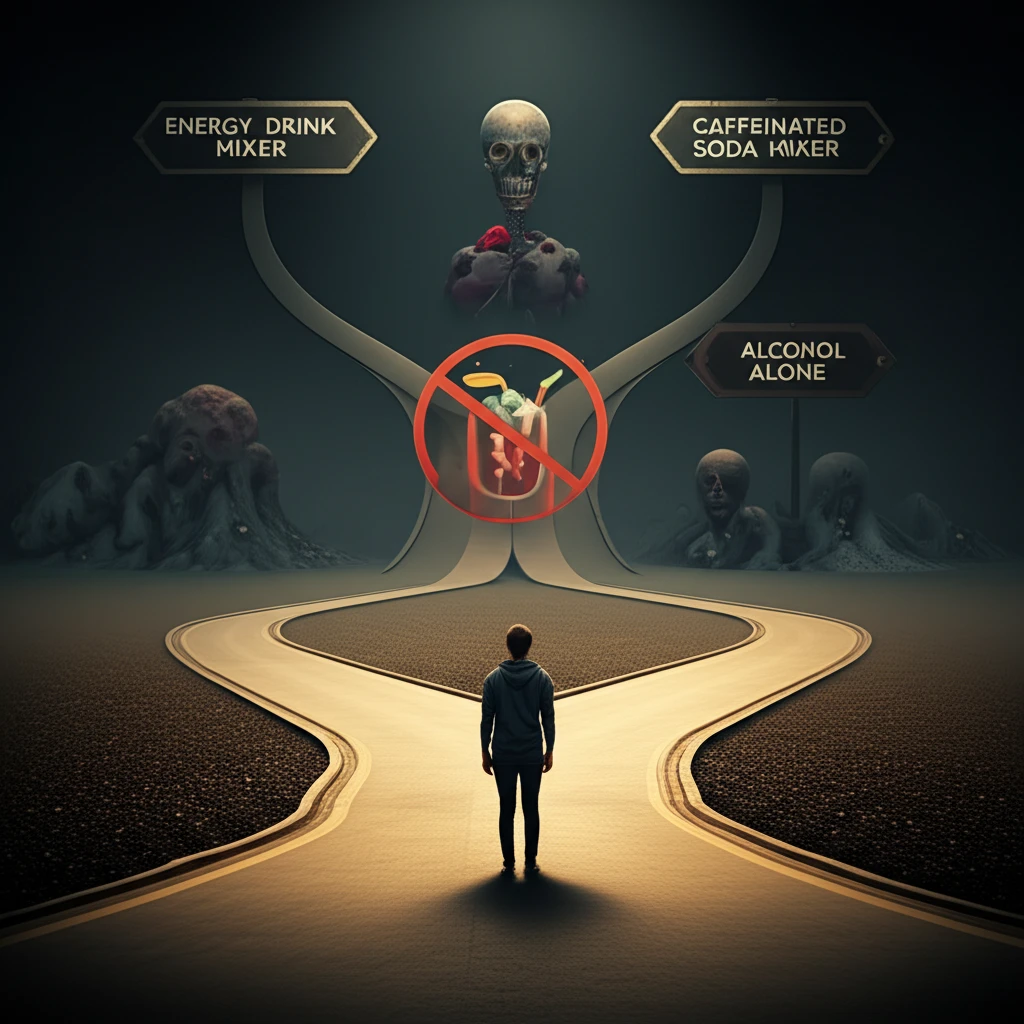
Energy Drinks vs. Caffeine Mixers: What's the Real Impact on Your Alcohol Consumption?

"New research reveals surprising insights into how energy drinks and other caffeinated beverages affect your drinking habits and health risks."
It's no secret that alcohol consumption, especially among young adults and university students, remains a significant public health issue. While recent reports suggest a decline in overall drinking, risky behaviors like binge drinking and intentionally getting drunk are still prevalent. This has led researchers to investigate factors driving excessive alcohol consumption, with the popularity of mixing alcohol with energy drinks (AMED) being a key area of focus.
Previous studies have indicated that those who mix alcohol with energy drinks tend to consume more alcohol, more often, and experience more negative consequences compared to those who drink alcohol alone. However, recent perspectives question whether energy drinks are uniquely responsible for this effect, considering that other caffeinated beverages like cola are also common mixers. The question then becomes: Are energy drinks truly different in their impact on alcohol consumption and related harms?
To investigate this further, a new study has directly compared the effects of alcohol consumption occasions involving AMED, alcohol mixed with other caffeinated mixers (AOCM), and alcohol consumed alone (AO). By examining the frequency and quantity of alcohol consumed, as well as the occurrence of negative alcohol-related consequences across these scenarios, the research aims to provide a clearer picture of the specific role energy drinks play in influencing drinking behaviors.
Energy Drink Market Snapshot
A 2026 WifiTalents report says only 23% of consumers read energy-drink labels before buying, leaving many unaware of caffeine and ingredient details. Another WifiTalents report states that Red Bull held 43% of the global energy-drink market in 2023. These figures describe label-reading and market share; the supplied snippets do not provide a statistic on how energy drinks affect alcohol consumption.
What Studies Examine
Research on alcohol mixed with energy drinks (AMED) has examined whether consumers drink more alcohol than people who drink alcohol alone, including through systematic review and meta-analysis. A 2022 review describes effects such as reduced fatigue and alcohol-related sedation alongside greater subjective alertness, and says these may contribute to binge drinking, reduced perception of intoxication, dehydration, or alcohol poisoning. A survey of Israeli youth examined energy-drink and AMED consumption as well as whether knowledge of risks related to consumption rates. The supplied summaries identify these approaches but do not provide enough detail to assess their methods or limitations.
Energy Drinks vs. Other Mixers: Unpacking the Consumption Data
The study, which involved a UK-wide online survey of students, collected data on drinking habits and negative consequences experienced during different alcohol consumption scenarios: alcohol alone (AO), alcohol mixed with energy drinks (AMED), and alcohol mixed with other caffeinated mixers (AOCM). The researchers analyzed the data from 250 participants who reported engaging in all three drinking patterns. This within-subjects approach allowed for a direct comparison of how each mixer type influenced individual drinking behaviors and consequences.
- Fewer Heavy Drinking Days: When consuming AMED, students reported significantly fewer days consuming five or more alcohol drinks.
- Less Mixing Overall: They also had fewer days mixing drinks in general.
- Reduced Instances of Drunkenness: Participants experienced fewer days of feeling drunk when consuming AMED compared to AOCM.
- Consequences: Importantly, the number of reported negative alcohol-related consequences did not significantly differ between AMED and AOCM occasions.
Session-Level Findings
The supplied summaries report findings that complicate the idea that energy-drink mixers always increase alcohol intake. One study found UK college students consumed less alcohol in AmED sessions or sessions with other mixers than in alcohol-only sessions, while Verster et al. (2014) found no difference in consumption patterns between energy-drink and other nonalcoholic mixers. A New Zealand study summary likewise reports a lower maximum number of drinks in AmED sessions than in alcohol-only sessions, citing earlier studies by deHaan et al. (2012) and Johnson et al. (2016, 2018). The provided animal-study summary says direct human evidence for caffeine increasing alcohol reinforcement is limited.
Mixed Evidence and Unresolved Questions
Evidence summarized in these sources does not point uniformly in one direction: a 2018 survey discussion says it is unclear why alcohol consumption was lower on caffeinated-mixer occasions, including AMED, than on alcohol-only occasions. By contrast, a systematic review reports that a meta-analysis found people mixing alcohol with energy drinks consumed significantly more alcohol than alcohol-only consumers. The review says this finding was consistent with Peacock et al. and Verster et al., while the supplied summary does not give their specific figures. This disagreement means the reported relationship depends on the evidence being considered and cannot be reduced here to a single settled intake effect.
Rethinking the Role of Energy Drinks in Alcohol Consumption
These results challenge earlier claims suggesting that energy drinks uniquely drive excessive alcohol consumption. In fact, the study indicates that heavy alcohol consumption occurs significantly less often on AMED occasions compared to AOCM occasions. The greatest overall alcohol consumption and associated negative consequences were clearly linked to occasions where alcohol was consumed alone.
Market Outlook and Forecasts
The supplied market-report summaries point to continued attention to energy-drink categories, consumer groups, distribution, technology, and regional trends. Future Market Insights reports that caffeinated energy drinks were projected to hold a 76.50% market share in 2024, describing their popularity among millennials and their non-alcoholic positioning. Growth Market Reports gives a 2025 global market size of USD 23.2 billion for alcoholic energy drinks and identifies 2026–2034 as its forecast period. These are market projections and estimates, not evidence about how mixers change an individual's alcohol consumption.
Use Patterns and Cardiovascular Concerns
A 2012 pilot study describes young people around the world increasingly combining alcohol with energy drinks, while noting that research on consumption patterns, social practices, and cultural context was limited. Separate work published in 2024 reported two local case reports and reviewed literature on cardiovascular events associated with energy-drink consumption. A 2024 review focused specifically on adverse cardiovascular events associated with simultaneous energy-drink and alcohol use and highlighted the need for further research into underlying mechanisms. The supplied summaries do not establish how common such events are or quantify an individual's risk.
The similarity in negative consequences between AMED and AOCM drinking occasions suggests that energy drinks are comparable to other caffeinated mixers in this regard. This highlights the need to avoid singling out energy drinks as the primary culprit in promoting risky drinking behaviors.
Ultimately, the research underscores the complexity of factors influencing alcohol consumption and its consequences. While the study provides valuable insights into the role of different mixers, it also calls for further investigation into the underlying biological, social, personal, and economic reasons that shape individual drinking patterns.