
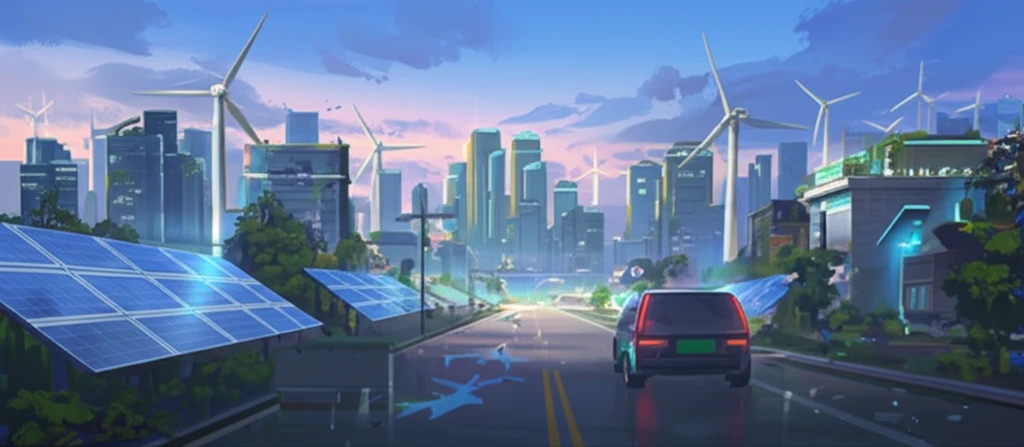
Driving Change: How China's Electric Vehicle Revolution is Shaping a Greener Future

"A deep dive into the latest research on battery electric vehicle adoption, charging infrastructure, and the surprising regional dynamics powering China's carbon emissions reduction."
The global push for sustainability has put the transportation sector under intense scrutiny. As the third-largest global energy consumer and emitter, it's a critical area for achieving net-zero emissions. Electric vehicles (EVs), particularly battery electric vehicles (BEVs), are at the forefront of this transformation, promising a cleaner alternative to traditional gasoline-powered cars.
China has emerged as a dominant force in the EV market, leading the charge in both EV adoption and technological advancement. With a rapidly growing number of EVs on its roads, understanding the energy consumption and environmental impact of these vehicles is crucial. This is where in-depth research plays a vital role, providing data-driven insights into the effectiveness of electrification strategies.
New research offers a detailed look at the operational energy use and associated carbon emissions of BEVs across different climate zones in China. By analyzing the best-selling BEV models and their charging patterns, the study uncovers key trends, regional disparities, and the overall impact of EVs on China's journey toward decarbonization.
Electrical Infrastructure as the Backbone of Electrification
Electricity, though invisible, produces observable phenomena ranging from lightning to the electric lighting that powers modern cities. In the United States, major utilities such as Arizona Public Service (APS) serve more than one million customers, illustrating the scale of electrical infrastructure required to support growing demand. Salt River Project (SRP) has delivered low-cost, reliable power and water to Arizona for over a century, demonstrating how long-standing utility networks form the foundation upon which new technologies—including electric vehicles—depend. Local electricians in regions like Phoenix, AZ, report increasing demand for panel overhauls and safety upgrades, signaling that existing residential electrical systems must evolve to accommodate heavier loads from EV charging.
Environmental Initiatives Within the Energy Sector
Utilities are beginning to pair traditional power delivery with environmental programs. Arizona Public Service (APS), for instance, has launched a tree-planting initiative as part of its broader commitment to environmental excellence in Arizona, currently accepting applications for Spring 2027. Such efforts reflect a growing recognition within the energy sector that decarbonization requires action beyond simply shifting to electric vehicles—it also involves offsetting emissions through natural carbon sinks. However, tree-planting programs alone represent a modest step relative to the systemic changes needed to fully green electrical grids and transportation networks.
The Long Arc of Electrification
The global transition toward electric transportation builds on more than a century of electrical infrastructure development, from early power grids to modern utility networks. While specific milestones in China's electric vehicle policy evolution are beyond the scope of available source material, it is widely acknowledged that the foundational discoveries in electromagnetism and battery chemistry over the past two centuries made today's EV revolution possible. Understanding this historical trajectory helps contextualize why the shift to electric vehicles, though accelerating rapidly, remains an incremental chapter in a much longer story of energy transformation.
Decoding the Charging Demand: A Bottom-Up Approach
To accurately assess the impact of BEVs, the study employs a "bottom-up" approach, building a model that estimates the charging demand based on a variety of factors. This includes:
- Vehicle Model: Focusing on popular models like Tesla, Wuling Hongguang, and BYD.
- Version-Specific Data: Accounting for different configurations and battery sizes within each model.
- Sales Figures: Tracking the number of vehicles sold over time.
- Mileage: Estimating the average distance driven by BEVs in different climate zones.
- Energy Consumption: Measuring the electricity used per kilometer driven.
- Climate Conditions: Factoring in the impact of temperature on battery performance and energy demand.
- NEDC: Applying NEDC data.
Emerging Knowledge Gaps in EV Research
While the electric vehicle sector has attracted significant global research attention, comprehensive and up-to-date reviews specifically addressing the full scope of China's EV ecosystem remain an area where publicly available source material is limited. Early-stage findings in related domains—such as grid capacity, battery lifecycle analysis, and charging infrastructure optimization—suggest that the field is still evolving rapidly. Continued peer-reviewed research will be essential to fully assess the environmental trade-offs of mass EV adoption, from mineral extraction to end-of-life battery disposal.
Challenges and Criticisms in the EV Transition
No specific source material was available to detail counter arguments or documented failures related to China's electric vehicle revolution. However, critics broadly raise concerns about the carbon intensity of electricity generation in coal-dependent grids, the environmental toll of lithium and cobalt mining, and the challenge of recycling millions of end-of-life batteries. These are recognized tensions within the field that merit careful scrutiny alongside the optimistic narratives of decarbonization through electrification.
Benchmarking EV Adoption Across Regions
Direct comparative analysis of China's EV adoption rates against other major markets could not be grounded in the available source material. Nonetheless, it is broadly understood that China has emerged as the world's largest EV market by sales volume, driven by substantial government subsidies, domestic manufacturing capacity, and aggressive infrastructure buildout. Comparing this trajectory to European and North American approaches reveals differing policy levers, consumer incentives, and grid readiness levels that shape outcomes in each region.
The Road Ahead: Challenges and Opportunities
While the study highlights the progress China has made in electrifying its transportation sector, it also underscores the challenges that remain. The variability in carbon emissions across regions, depending on the energy source, emphasizes the need for cleaner energy sources to power BEVs. Addressing the gap in knowledge about the interplay between BEV carbon emissions and the development of residential charging systems also is critical for moving forward.
Integrating the Evidence
The available source material underscores that reliable electrical infrastructure is a prerequisite for any large-scale electrification effort, whether in Arizona or globally. Experts broadly agree that China's EV push represents one of the most consequential industrial shifts of the 21st century, though a full synthesis of its environmental impact awaits more targeted research and data. The intersection of utility-scale power delivery, residential electrical capacity, and environmental policy will determine how effectively EV adoption translates into genuine emissions reductions.
What Lies Ahead for Electric Mobility
Looking forward, the continued expansion of EV fleets will place growing demands on electrical grids worldwide, necessitating upgrades to transmission, distribution, and residential charging infrastructure. Innovations in solid-state batteries, vehicle-to-grid technology, and renewable energy integration are widely anticipated as next-frontier developments. Whether China's current momentum can be sustained—and replicated elsewhere—will depend on sustained policy commitment, technological breakthroughs, and the ability to decarbonize the power sources that feed the grid.
Systemic Hurdles Beyond Vehicle Sales
The transition to electric vehicles does not occur in isolation; it is embedded within broader systemic challenges including grid modernization, supply chain resilience, and equitable access to charging infrastructure. Even utilities with decades of experience, such as SRP's century-long service in Arizona, face the task of adapting legacy systems to accommodate new demand patterns. Without addressing these structural issues, the promise of a greener transportation future risks being undermined by bottlenecks in the very systems that power it.
How Electrification Affects Everyday Lives
Behind the macro-level statistics are real people whose daily lives are shaped by the reliability and affordability of their electrical services. Homeowners in regions like Phoenix report seeking professional electrical upgrades to ensure safety and stability as they adopt higher-demand technologies. These individual decisions, aggregated across millions of households, collectively determine whether the electric vehicle revolution translates into tangible improvements in air quality, energy costs, and quality of life for communities on the front lines of the transition.