
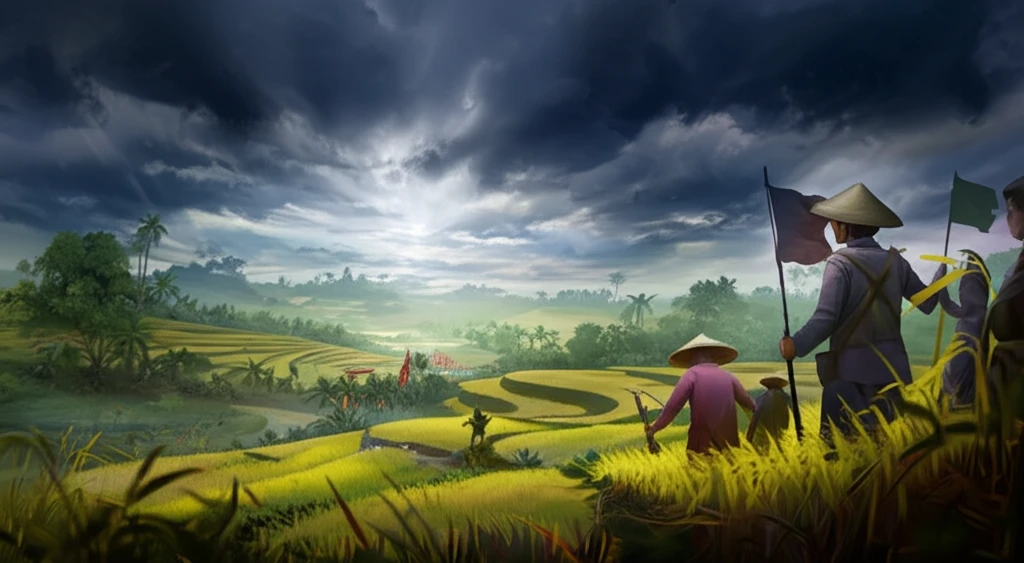
Does Harvest Time Impact Conflict? Unveiling Agricultural Roots of Social Unrest

"A deep dive into how shifts in employment and income during harvest seasons in Southeast Asia's rice-producing regions influence political violence and social dynamics."
In many low- to middle-income countries, even minor changes in income can significantly affect people’s behavior, sometimes leading to unlawful or violent actions. While we often think of these incidents happening in cities, where most people live and where government services are concentrated, it’s important to remember that rural areas also experience conflict due to changes in income and employment. Agriculture and conflict are closely linked, with agricultural output acting as a key factor in how climate affects conflict.
A pertinent question arises: Does conflict intensify during harvest seasons in agricultural areas? This isn’t a straightforward issue. Many different factors and motivations influence this relationship. A growing body of research links agricultural income to political violence and social unrest, often finding that conflict can lead to food insecurity and that agricultural shocks can change how often and how intensely conflicts occur.
To explore this question, we looked at over 86,000 incidents across eight Southeast Asian countries between 2010 and 2023. We distinguished between different types of conflict, such as organized armed groups involved in political violence and unorganized groups engaged in social unrest. Our analysis revealed that violence against civilians increases in areas with substantial rice production during harvest season. This finding remains consistent even when using different models and data subsets.
Evidence Limits
Available evidence for this subsection does not provide current statistics linking harvest timing to conflict or social unrest. Any assessment of agricultural timing and unrest would therefore require dedicated conflict, climate, and harvest datasets. Conclusions should remain appropriately cautious until such evidence is examined.
Methodological Caution
No source material is available here to establish a standard method for measuring whether harvest time affects conflict. A rigorous approach would need to define harvest timing, identify comparable conflict outcomes, and account for other social, economic, and environmental factors. Without such evidence, causal claims should be treated as provisional.
Historical Evidence Gap
The supplied material does not document historical milestones or foundational discoveries concerning harvest timing and social unrest. A historical account would need sources covering agricultural calendars, past conflicts, and changes in rural political economy. The relationship should therefore not be assigned a settled historical interpretation from the available evidence.
How Harvest Time Drives Conflict: Rapacity, Resentment, and Opportunity
Harvest time can exacerbate conflicts by creating opportunities for some to extort agricultural surpluses or inflict damage on their rivals. This dynamic is fueled by what we term the ‘rapacity channel.’ Additionally, the harvest period can temporarily alter the distribution of income among those involved in agricultural versus non-agricultural activities, igniting the ‘resentment channel.’ Typically, resentment leads to social unrest when there is a decrease in crop production and food supply, which can worsen existing inequalities. However, the logic of resentment can also apply when seasonal agricultural surpluses create disparities between those who have (agricultural producers) and those who do not (non-agricultural workers).
- Rapacity: The lure of agricultural spoils tempts groups to seize or destroy resources.
- Resentment: Income disparities between agricultural and non-agricultural groups flare during harvest periods.
- Opportunity Cost: The act of harvesting itself can deter individuals from participating in conflicts.
Unrelated Reference Landscape
The supplied sources do not present research or reviews on harvest time and conflict. The United States Social Security Administration provides online benefit-management services through my Social Security and identifies itself as the Social Security Administration, but neither source addresses agricultural unrest. A Wikipedia overview lists major social media platforms with more than 100 million registered users, including Facebook, Instagram, LinkedIn, and X, yet it likewise offers no evidence about harvest timing or conflict. These references therefore cannot substantiate a conclusion about the article's central question.
Unresolved Counterarguments
No source material is provided to identify counterarguments, failed studies, or limitations specific to the proposed relationship between harvest time and conflict. It would be premature to characterize the relationship as strong, weak, or unsupported without evidence testing alternative explanations. Any discussion of failures should be grounded in directly relevant empirical research.
Comparative Evidence Needed
The available material does not support comparisons across countries, regions, agricultural systems, or conflict types. Meaningful comparison would require consistently defined harvest periods and comparable measures of social unrest. Without those data, cross-case conclusions would be speculative.
Conclusion: The Seasonality of Strife
Our research underscores the critical role of the harvest season in understanding the agricultural roots of social conflict. By analyzing 14 years of monthly data on social conflict across 376 cells in Southeast Asia, we’ve shown how different forms of conflict—political violence and social unrest—are influenced by seasonal changes in agricultural output. Political violence, especially when targeted against civilians, can be better understood through the ‘rapacity channel,’ where organized armed groups target civilians when and where it matters most. Social unrest, on the other hand, is often driven by the ‘opportunity cost channel,’ as farmers are less likely to engage in protests when they are busy harvesting or have recently benefited from positive harvest-related income. The presence of a ‘resentment channel’ can reinforce the rapacity channel or mitigate the opportunity cost channel, depending on whether the income inequality is perceived as transient or persistent.
Cautious Synthesis
The supplied sources do not support an expert synthesis of how harvest timing affects conflict. The most defensible conclusion is that the question remains dependent on evidence not included here. Any interpretation should distinguish correlation from causation and acknowledge possible economic, political, and environmental confounders.
Research Priorities
No supplied source establishes a future research direction for studying harvest timing and unrest. Future work could focus on harmonizing agricultural calendars with conflict-event records and evaluating whether observed associations persist after accounting for broader shocks. Such priorities are methodological suggestions rather than findings supported by the listed sources.
Systemic Context
The available material does not document the systemic conditions that might connect agricultural cycles to social unrest. Issues such as market access, governance, inequality, and climate variability would need direct evidence before being incorporated into the analysis. The broader context therefore remains undefined by the supplied sources.
Human Consequences
No supplied source describes how harvest timing or conflict affects farmers, households, communities, or displaced people. Human-impact claims should be based on testimony, field research, or documented outcome data rather than inferred from unrelated administrative or social-media sources. The real-world consequences consequently cannot be specified from the available material.