
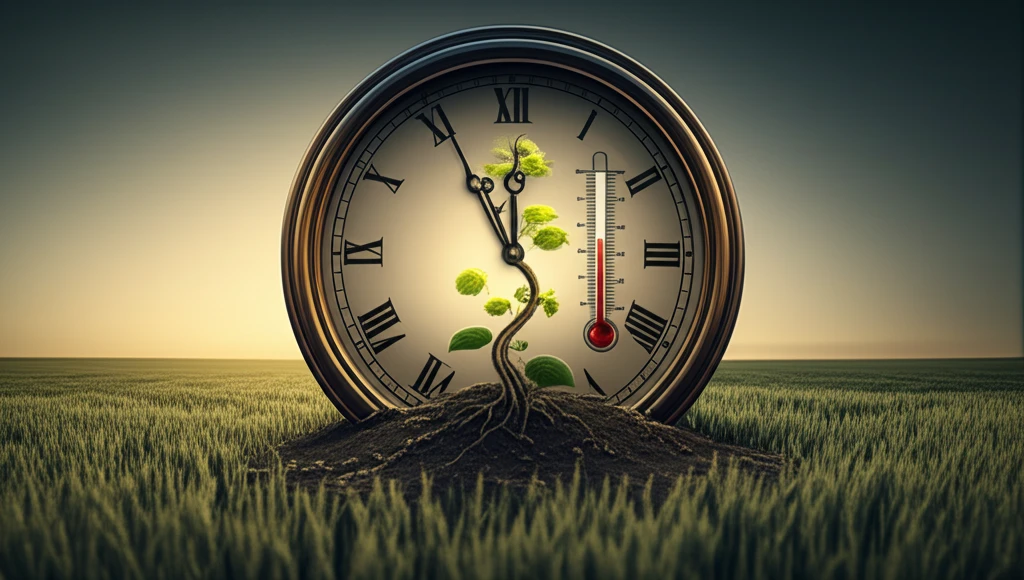
Decoding Thermal Time: A Simple Guide to Plant Development Prediction

"Unlock the secrets of how temperature drives plant growth and development with our easy-to-understand breakdown of thermal time."
For centuries, predicting how temperature affects plant development has been a key focus for scientists and farmers alike. Knowing when a plant will reach a specific stage is crucial for everything from planting schedules to anticipating crop yields. Early efforts in crop modeling accelerated this field, particularly as the need to predict the impact of climate change on agriculture became increasingly urgent.
Across various crops like wheat and maize, studies have revealed a common temperature response pattern in developmental processes. This led to the concept of 'thermal time,' a way to quantify the heat accumulation needed for a plant to reach a certain stage. Thermal time is considered a valid measure for all developmental processes of a plant and is widely used in crop models.
Thermal time is valuable because it allows researchers to analyze the effects of other environmental factors by accounting for temperature changes. This means understanding how plants grow in fluctuating temperatures as if the temperature were constant. However, the concept can seem complex due to the many ways it's calculated.
Why Thermal Time Matters
Thermal time offers a practical way to relate temperature exposure to the timing of plant development. It can help explain why plants reach developmental stages at different calendar dates when growing conditions vary. However, its usefulness depends on treating temperature as one influence within a broader biological and environmental system.
From Linear Sums to Better Models
Traditional growing degree-day methods generally assume that plant development responds linearly to temperature. The Nature study reports that this assumption cannot precisely account for delays in growth or development at temperatures above the optimal range. A modelling exercise involving nine maize case studies across three field sites also shows that ignoring confounding factors can affect estimates of the underlying development response.
From Plant History to Crop Timing
The fossil record places the emergence of embryophyte land plants in the middle Ordovician, about 470 million years ago, while by the middle Devonian, about 390 million years ago, fossils show roots and leaves. Thermal-time research later developed as a way to interpret developmental timing in plants and other organisms. In crop management, thermal time became useful for predicting development stages and scheduling herbicide, insecticide, and fertilizer applications across large farming areas.
What Exactly is Thermal Time and How Does It Work?
At its core, thermal time is a measure of the accumulated heat units required for a plant to progress through its development stages. It acknowledges that plant development doesn't simply follow a calendar; it's strongly influenced by temperature. Different plants need a certain amount of 'warmth' to trigger specific changes, such as germination, leaf growth, or flowering.
- Base Temperature: Every plant species has a base temperature, below which development stalls.
- Daily Accumulation: Thermal time is accumulated only when the average daily temperature is above the base temperature.
- Thresholds: Each developmental stage has a thermal time threshold that needs to be met.
A Refining Field
Recent work appears to focus on refining how thermal time is applied rather than treating it as a complete explanation of plant development. Current research directions include nonlinear calculations and closer examination of confounding factors. These developments suggest that thermal-time models remain useful, but their interpretation requires care.
The Confounding-Factor Problem
A major challenge is that an experimenter's treatment of confounding factors can change the inferred relationship between temperature and plant development. The cited modelling study tested this issue through nine maize case studies conducted at three field sites. Its design shows why a thermal-time result may not represent the underlying temperature response if other influences are ignored.
Useful Despite Its Limits
Thermal time is not a perfect description of biological development, but it has been useful in many practical situations. One cited analysis reports successful prediction of dates when maize reaches phenological stages including emergence (VE), tasseling (VT), and the milk stage (R3). This example illustrates its strength as a stage-timing model even when biological responses are more complex than a simple temperature accumulation rule.
Putting It All Together
Thermal time models can be powerful tools, but it’s essential to recognize their limitations and potential sources of error. By understanding the underlying principles and being mindful of factors like air vs. plant temperature, water availability, and the time step used for calculations, you can get the most accurate predictions and insights into plant development. Whether you're a seasoned farmer or a home gardener, mastering the concept of thermal time can lead to better planning and greater success in your growing endeavors.
A Conditional Tool
The evidence supports thermal time as a theoretically grounded tool for studying plant development, provided confounding effects are avoided. A modelling exercise of nine maize case studies across three field sites demonstrates why those conditions matter when estimating development responses. Its practical value therefore lies in disciplined application rather than in assuming that temperature alone determines every developmental outcome.
Beyond Temperature Alone
The supplied future-oriented sources primarily address thermal power, geothermal technology, cost trends, and energy-market activity rather than plant-development prediction. The 2025 U.S. Geothermal Market Report describes updates since 2020, while other sources discuss thermal power through 2034 or 2035. These materials do not provide a direct evidence base for forecasting the next generation of plant thermal-time models.
Thermal Questions in a Changing World
Thermal systems are also part of wider energy and climate debates. One review asks how emissions standards and climate policies affect thermal power plants and what strategies could help them adapt or remain in the market. MIT's discussion of five grand thermal challenges similarly frames thermal-energy innovation as important for stemming global warming, showing that temperature-related science extends beyond crop development into systemic climate concerns.
From Models to Decisions
Thermal-time research has practical implications because development predictions can support decisions about when crop-management actions should occur. The supplied case-study material describes modelling with maize plants grown at three field sites and emphasizes the effects of considering or ignoring confounding factors. This connects technical model design with the real-world need for predictions that remain meaningful under field conditions.