
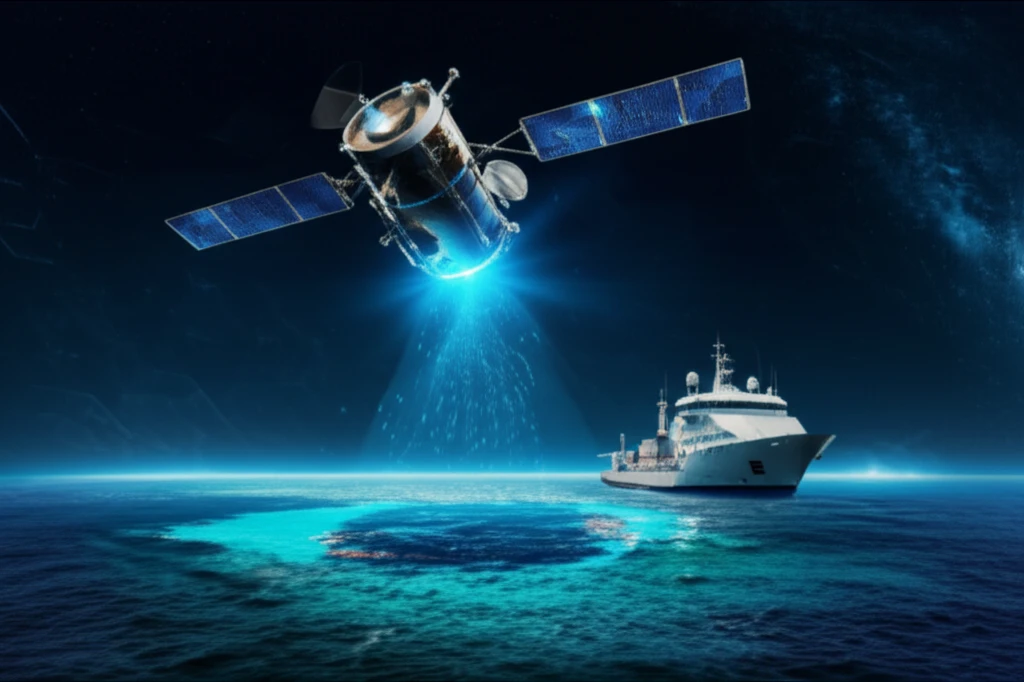
Decoding Ocean Color: How Satellites Help Us Understand Marine Ecosystems

"Unveiling the secrets of the Mediterranean Sea through satellite data and advanced oceanography techniques."
Our planet's oceans are essential to global economies and social activities, but they face mounting threats from human activities and natural disasters. Ensuring the sustainable use of marine resources requires a comprehensive understanding of ocean conditions and their variability. This is where operational oceanography steps in, using real-time data to monitor and predict the state of our seas.
Since the 1990s, international organizations and research communities have recognized the importance of developing worldwide networks for the real-time exchange and use of ocean data. This effort has led to advancements in predictive models for marine environments, spanning physical fields and marine ecosystem variables. Central to these advancements is the ability to observe the global ocean in near real-time with high spatial and temporal resolution.
Satellite technology has revolutionized ocean observation, supplementing traditional in-situ analysis methods. Earth-orbiting satellites equipped with sensors provide essential data on ocean properties, becoming a cornerstone of 21st-century oceanography. Among the critical data gathered is ocean color (OC), which offers unique insights into the biological components of marine environments. Even with ongoing refinements in data assimilation techniques, ocean color measurements, particularly chlorophyll concentration, are invaluable for validating marine ecosystem models.
How Does Satellite Ocean Color Monitoring Work?
Satellite ocean color monitoring relies on specialized sensors aboard satellites to measure the light reflecting from the ocean's surface. This reflected light carries valuable information about the substances present in the water, particularly phytoplankton pigments. Phytoplankton, like plants on land, contain chlorophyll, which absorbs sunlight for photosynthesis. By analyzing the specific wavelengths of light reflected, scientists can estimate the concentration of chlorophyll and, consequently, the abundance of phytoplankton.
- Data Acquisition: Satellites capture raw data (Level 1A or L0) from sensors like SeaWiFS, MODIS, and MERIS, covering specific regions such as the Mediterranean and Black Seas.
- Data Processing: The raw data undergoes atmospheric correction and calibration to remove distortions and account for atmospheric effects. Algorithms, often regional, are applied to derive geophysical parameters such as chlorophyll concentration.
- Product Generation: Processed data is used to create various products, including chlorophyll maps, water-leaving radiance, and diffuse attenuation coefficients. These products are generated at different levels (L3 and L4) with varying spatial and temporal resolutions.
- Data Validation: The accuracy of satellite-derived products is assessed by comparing them with in-situ measurements collected from research vessels and fixed stations. This step ensures the reliability of the satellite data for scientific and operational use.
- Data Dissemination: Final data products are archived and made accessible to users through various platforms, including FTP, THREDDS, and MOTU. These interfaces allow users to discover, browse, preview, and download data based on their specific needs.
The Future of Ocean Color Monitoring
Continued advancements in satellite technology, data processing techniques, and validation methods will further enhance the accuracy and reliability of ocean color data. These improvements will lead to a better understanding of marine ecosystems, more effective management of marine resources, and improved predictions of the impacts of climate change on our oceans. By investing in and supporting these efforts, we can ensure the health and sustainability of our oceans for future generations.