
Decoding Global Conflict: Can Ancient Philosophy Help Us Understand Modern Warfare?

"Hobbes vs. Locke: Unpacking the Philosophical Battle Over International Anarchy"
The specter of conflict looms large in our contemporary world. From the ongoing tensions in Iraq and Afghanistan to the simmering conflicts in Eastern Europe, violence seems perpetually woven into the fabric of international relations. But is this perpetual state of conflict inevitable? Are we doomed to a Hobbesian world of constant struggle, or is there a path towards a more Lockean vision of peace and cooperation?
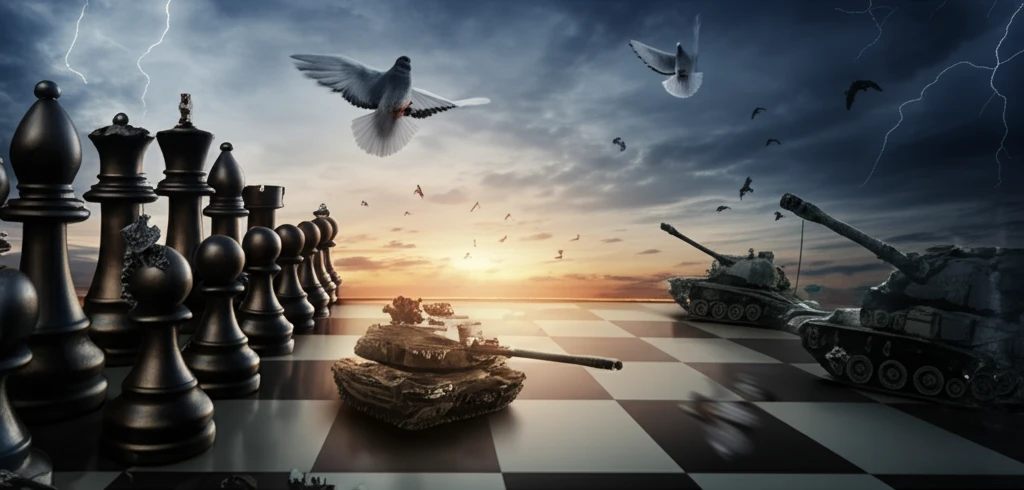
To understand the roots of global conflict, we must turn to the foundational thinkers who shaped Western political thought. Thomas Hobbes, with his grim vision of a state of nature characterized by a "war of all against all," stands in stark contrast to John Locke, who believed in the possibility of a society governed by reason and natural law. Their contrasting perspectives offer powerful lenses through which to analyze the chaotic state of the contemporary world system.
This exploration will delve into the core arguments of Hobbes' Leviathan and Locke's Second Treatise of Civil Government, examining their relevance to modern conflicts like the Iraq War and the Russia-Georgia conflict. By comparing and contrasting these philosophical frameworks, we can gain deeper insights into the enduring challenges of international relations and the elusive quest for global order.
Intrastate Conflict and the Civilian Toll
Most conflicts today are intrastate, driven by grievances such as resources, identity, and repression, with civilians bearing the heaviest cost, according to aggregated market data on conflict. Statistic aggregators draw on peer-reviewed journals, government agencies, and professional bodies, with each figure independently verified through reproduction analysis and cross-referencing against independent databases. Statista tracks the number of conflicts worldwide from 2005 to 2024 by conflict intensity, charting both the prevalence and severity of these disputes. The scale of the institutional response is also striking: more than 1,000 UN Security Council resolutions since 1990 have referenced conflict prevention and the protection of civilians.
Legal Definitions and the Limits of Method
The standard legal approach defines international armed conflict as occurring when one or more States have recourse to armed force against another State, regardless of the reasons or intensity of the confrontation, with no formal declaration of war required. Practitioners track hotspots through tools such as the Council on Foreign Relations' Global Conflict Tracker, which maps the world's top security flashpoints. Yet scholars note that many contemporary conflicts are internationalized, which complicates these neat legal categories. In political science, the rediscovery of qualitative methods reflects ongoing debate about how best to study such messy, multi-actor conflicts.
From World War to Conflict Theory
World War I stands as one of the deadliest conflicts in history, with an estimated 15 to 22 million deaths, including victims of war crimes and genocides, and the war also helped spread the Spanish flu pandemic. Post-war diplomacy reshaped alliances, as reflected in milestones such as the creation of the Southeast Asia Treaty Organization (SEATO) in the history of U.S. foreign relations. On the theoretical side, conflict theory offers a lens for understanding how societal divisions drive disputes, with its definition, founder, and examples laid out in economic and social commentary.
The Enduring Anarchy: A Hobbesian Perspective
Hobbes argued that in the absence of a common power to enforce order, human life would be a constant state of war, driven by self-interest and fear. In this "state of nature," there is no morality, no justice, and no security. Each individual is driven by a relentless pursuit of self-preservation, leading to a chaotic and violent existence. The international system, according to this view, mirrors this state of nature, with sovereign states constantly vying for power and security in a world without a true overarching authority.
- Self-Interest: Nations prioritize their own security and advantage.
- Lack of Authority: No global power can truly enforce international law.
- Moral Distance: Reduced empathy for those affected by conflict.
- Constant Competition: States are always vying for power.
Proxy Wars and the Internationalization of Civil Conflict
Recent research documents how non-international conflicts are increasingly turned into 'battlefields' for foreign powers, transforming civil wars into 'wars with multiple proxies,' with some UN mediation efforts remaining stuck in the draft phase. Studies of regional and international conflict regulation find that the international community - defined as international and regional organizations and their powerful member states - holds a deeply ambivalent attitude toward tackling the complexity of frequently internationalized intra-state conflicts. Humanitarian law, based on the concept of jus in bello, is meant to govern conduct during armed conflict. Ongoing coverage of the Israel-Palestine conflict illustrates how such dynamics unfold on the ground.
Where Realism and Conflict Theory Fall Short
Critical theorists argue that realism fails to adequately account for the profound role of ideas, norms, and identities in shaping international politics, and that the international system itself is socially constructed. Conflict theory faces its own criticisms, including an overemphasis on conflict, determinism, and a lack of clear solutions for social change. Together these critiques suggest that dominant frameworks can obscure as much as they illuminate when applied to contemporary warfare.
Comparing Conflicts Across Cases
Comparative analysis of ethnic conflicts finds that oppositions and deadly conflicts among ethnic collectivities are important worldwide, and that ethnies also strongly affect interstate relations, with both interethnic and ethnic-state conflicts tending to be severe, protracted, and intractable. Dedicated comparison platforms enable side-by-side examination of states and issues across many categories. One illustrative case rates the international relationship between Andorra and Germany as NEUTRAL, with an overall score of 5.0 out of 10 and an assessment that the chances of conflict between the two are extremely rare.
Beyond Idealism: Reconciling Philosophy and Reality
While Locke's vision of a world governed by reason and natural law remains a compelling ideal, the realities of international relations often fall far short. The enduring influence of Hobbesian thinking reminds us that power, self-interest, and the ever-present threat of conflict continue to shape the global landscape. Understanding these competing philosophical perspectives is crucial for navigating the complexities of international relations and striving for a more peaceful and just world, even if that goal remains perpetually elusive.
Experts Versus Analysts
Experts delve into treaties, legal precedents, and historical agreements that define borders, grounding their opinions in international law and making their views authoritative in boundary disputes. Analysts, by contrast, tend to track ongoing developments using tools such as interactive conflict maps and real-time monitoring of troop movements and strategic developments. Practitioners add a conflict-sensitivity lens, training teams on conflict analysis and gender sensitivity and supporting conflict-sensitive project design and implementation in affected communities.
Projecting Risk in a Fragile World
The death toll from global conflicts is at its highest this century, and the report warns that a potential Chinese blockade of Taiwan would cause a drop in global economic output equivalent to double the loss from the 2008 global financial crisis. The IMF's World Economic Outlook presents analyses and projections of the world economy in the near and medium term, framing security and economic risk together. Two months into the Iran conflict, an energy-security brief confirmed that all five risks it had identified for European energy security had materialized. Looking ahead, governments are likely to keep the focus on weaponry high as they respond to emerging global risks.
Geopolitics, Health, and Systemic Threats
Geopolitics shapes modern conflict, as illustrated by the 2022 escalation in Ukraine, which involves territorial disputes, historical grievances, and broader geopolitical ambitions, drawing in international actors through Western military aid to Ukraine and sanctions on Russia. NATO, for the first time, issued a communique describing China's military ambitions as presenting 'systemic challenges' to the transatlantic security alliance. Research on conflict-affected Gaza links housing conditions to health inequities, calling for resilient housing systems and immediate, systemic changes to mitigate conflict's health impact. Live trackers meanwhile monitor major global conflicts, potential nuclear confrontations, and their catastrophic humanitarian and economic consequences.
The Invisible Human Cost
Conflict has measurable effects on food security, with case studies from Somalia and Ethiopia analyzing the subnational effects of violence on anthropometric indicators of malnutrition. Mediation practice shows the human stakes of peacemaking, as Kenya's role in the Sudan North-South peace process demonstrates that multiple mediation does work in some cases. Yet the majority of young people most affected by conflict remain invisible to policymakers, as seen in Kenya where a climate-action project offered small grants for youth initiatives submitted in any format, from spoken word to proposals translated from a local language to performed skits.