
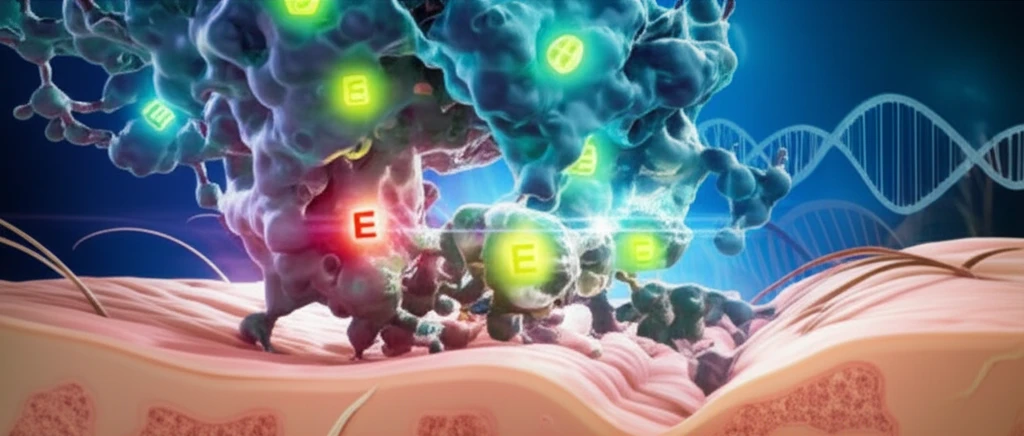
Enzyme dissecting chondroitin sulfate for health benefits

Decoding Chondroitin Sulfate: A New Enzyme's Impact on Health and Supplements

"Discover how a newly identified enzyme, HCLase Er, is changing our understanding of chondroitin sulfate's complex structures and potential health benefits."


Chondroitin sulfate (CS) has garnered significant attention in health and wellness, with promises ranging from joint pain relief to improved skin health. However, the complexity of CS structures—varying arrangements of molecules with different sulfate patterns—has presented challenges in fully understanding its effects. Imagine CS as a Lego castle; each block represents a different structural unit, and the castle's function depends on how these blocks are assembled.

Recent research has focused on isolating specific CS structural domains to better understand their biological roles. One such domain, rich in GlcUAβ1-3GalNAc(4S,6S) units (referred to as E units), is believed to play a critical role in various biological functions. Until now, selectively isolating these E unit-rich domains without disrupting their structure has proven difficult.

A new study published in the Journal of Biological Chemistry introduces a novel enzyme, HCLase Er, sourced from a marine bacterium. This enzyme exhibits a unique selectivity, efficiently digesting hyaluronic acid (HA) and certain CS variants while showing resistance to E unit-rich CS domains. This discovery marks a significant step forward, offering a new tool to dissect and analyze the complex structures of CS, potentially leading to more effective and targeted health applications.

What Makes HCLase Er Unique?

Enzyme dissecting chondroitin sulfate for health benefits

HCLase Er's uniqueness lies in its ability to differentiate between the various sulfation patterns found in CS. Unlike other enzymes that indiscriminately break down CS chains, HCLase Er selectively targets specific structures while leaving others intact. This selectivity is primarily due to its resistance to the E unit, a disaccharide containing both 4-O- and 6-O-sulfation on N-acetylgalactosamine. This is a game-changer because it allows scientists to isolate and study E unit-rich CS fragments, which are believed to have unique biological activities.

Researchers conducted extensive enzymatic characterization, confirming HCLase Er's specificity through various experiments:

  • Substrate Specificity: HCLase Er efficiently degrades hyaluronic acid (HA) and CS variants (CS-A, CS-C, CS-D) but shows poor activity against CS-E.
  • Inhibition by E Units: The enzyme's activity is significantly reduced in the presence of E units, particularly consecutive E units in CS chains.
  • Site-Directed Mutagenesis: Mutating key amino acid residues (His-243, Tyr-252, Arg-306, and Arg-310) abolished the enzyme's activity, confirming their crucial roles in its catalytic mechanism.
  • Domain Analysis: Deletion experiments revealed that an extra domain (Gly739-Gln796) is essential for HCLase Er activity.
These findings highlight that HCLase Er's activity is finely tuned to the sulfation patterns of its substrates, making it an invaluable tool for studying CS structure-function relationships.

The Future of Chondroitin Sulfate Research

The discovery of HCLase Er provides a critical tool for researchers and supplement manufacturers alike. By enabling the precise dissection of CS molecules, this enzyme can help identify the exact structural components responsible for specific health benefits. This opens the door to developing more targeted and effective CS-based therapies and supplements, potentially revolutionizing how we approach joint health, skin care, and other related conditions.

About this Article -

This article was crafted using a human-AI hybrid and collaborative approach. AI assisted our team with initial drafting, research insights, identifying key questions, and image generation. Our human editors guided topic selection, defined the angle, structured the content, ensured factual accuracy and relevance, refined the tone, and conducted thorough editing to deliver helpful, high-quality information.See our About page for more information.

This article is based on research published under:

DOI-LINK: 10.1074/jbc.ra117.001238, Alternate LINK

Title: A Chondroitin Sulfate And Hyaluronic Acid Lyase With Poor Activity To Glucuronyl 4,6-O-Disulfated N-Acetylgalactosamine (E-Type)–Containing Structures

Subject: Cell Biology

Journal: Journal of Biological Chemistry

Publisher: Elsevier BV

Authors: Chune Peng, Qingbin Wang, Shumin Wang, Wenshuang Wang, Runmiao Jiao, Wenjun Han, Fuchuan Li

Published: 2018-03-01

Everything You Need To Know

1

What is chondroitin sulfate, and why has it been difficult to fully understand its health effects?

Chondroitin sulfate (CS) is a molecule studied for its potential health benefits, such as joint pain relief and improved skin health. However, the complexity of CS structures, with varying arrangements of molecules and different sulfate patterns, has made it challenging to fully understand and harness its effects. Different arrangements of GlcUAβ1-3GalNAc(4S,6S) units, or E units, affect the function of Chondroitin Sulfate. Until recently selectively isolating the E unit-rich domains has proven difficult.

2

How does the newly discovered enzyme, HCLase Er, differ from other enzymes that break down chondroitin sulfate?

HCLase Er exhibits unique selectivity in digesting chondroitin sulfate (CS). Unlike other enzymes that indiscriminately break down CS chains, HCLase Er selectively targets specific structures while leaving others, like the E unit-rich domains, intact. This specificity is due to its resistance to the E unit, a disaccharide containing both 4-O- and 6-O-sulfation on N-acetylgalactosamine. HCLase Er efficiently degrades hyaluronic acid (HA) and CS variants (CS-A, CS-C, CS-D) but shows poor activity against CS-E.

3

What is the significance of HCLase Er's resistance to E unit-rich domains of chondroitin sulfate?

HCLase Er's resistance to E unit-rich domains of chondroitin sulfate is significant because it allows scientists to isolate and study these specific fragments. E unit-rich CS fragments are believed to have unique biological activities. By using HCLase Er to selectively digest other CS variants, researchers can obtain pure E unit-rich fragments, which can then be studied to determine their precise effects on health. Identifying the health effects of E unit-rich domains may help with the development of therapies and supplements.

4

Could you elaborate on how the researchers confirmed the specificity of HCLase Er?

Researchers conducted extensive enzymatic characterization to confirm HCLase Er's specificity. This included demonstrating that HCLase Er efficiently degrades hyaluronic acid (HA) and CS variants (CS-A, CS-C, CS-D) but shows poor activity against CS-E. They also showed that the enzyme's activity is significantly reduced in the presence of E units, particularly consecutive E units in CS chains. Additionally, site-directed mutagenesis of key amino acid residues (His-243, Tyr-252, Arg-306, and Arg-310) abolished the enzyme's activity, confirming their crucial roles in its catalytic mechanism. Finally, domain analysis revealed that an extra domain (Gly739-Gln796) is essential for HCLase Er activity.

5

What are the potential implications of the HCLase Er discovery for the future of chondroitin sulfate-based therapies and supplements?

The discovery of HCLase Er provides a critical tool for researchers and supplement manufacturers, offering ways to develop more targeted and effective CS-based therapies and supplements. By enabling the precise dissection of CS molecules, this enzyme can help identify the exact structural components, like E unit-rich domains, responsible for specific health benefits. This could revolutionize how we approach joint health, skin care, and other related conditions. This could lead to the production of highly specific supplements that contain only the most beneficial structural components of CS.

Newsletter Subscribe

Subscribe to get the latest articles and insights directly in your inbox.