
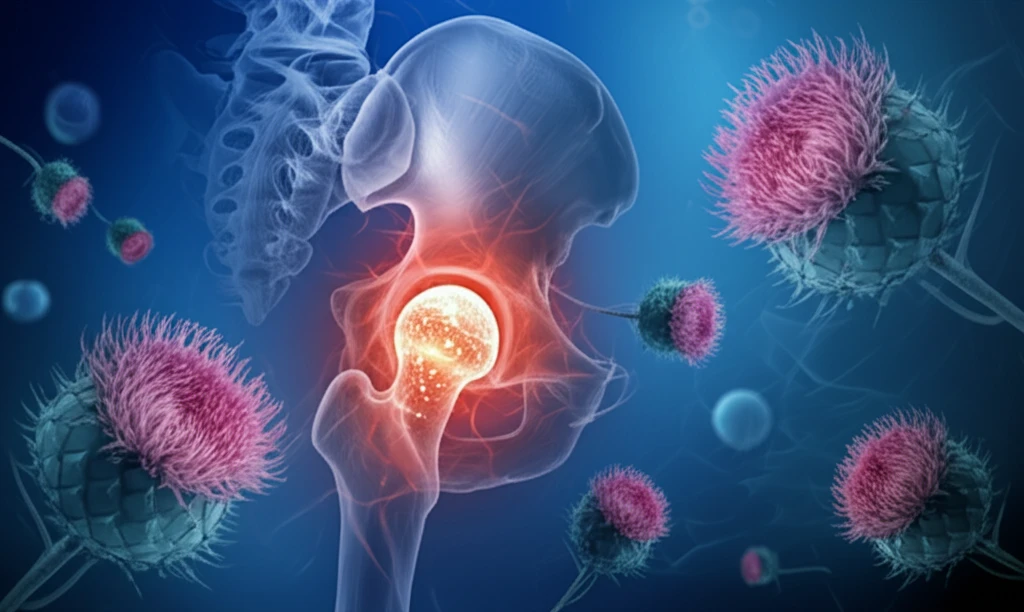
Safflower's Sweet Secret: How This Natural Polysaccharide Could Revolutionize Joint Health

"Unlock the potential of safflower in preventing steroid-induced avascular necrosis and promoting better joint health."
Joint health is a cornerstone of overall well-being, enabling us to move freely and participate fully in life. However, conditions like avascular necrosis—particularly in the femoral head, the top of the thighbone that fits into the hip socket—can severely compromise mobility and quality of life. This condition, often linked to steroid use, occurs when blood supply to the bone is disrupted, leading to bone tissue death.
The quest for effective treatments and preventative measures against avascular necrosis has led researchers to explore natural compounds with promising therapeutic properties. Among these, a polysaccharide derived from safflower (Carthamus tinctorius L.) has emerged as a potential game-changer. Polysaccharides, complex carbohydrates found in plants, have diverse biological activities, including anti-inflammatory and antioxidant effects.
In recent studies, scientists have been diving deep into understanding how safflower-derived polysaccharides can combat steroid-induced avascular necrosis of the femoral head. This research is particularly relevant for individuals undergoing long-term steroid treatments, who face an elevated risk of developing this debilitating condition.
The Scope of Avascular Necrosis
Avascular necrosis (AVN) of the femoral head is a condition in which bone tissue dies due to disrupted blood supply, affecting multiple joints including the hip, shoulder, and ankle. While AVN is classified using the Ficat and Arlet system—originally proposed before the advent of MRI—the condition remains a significant orthopedic concern. AVN can occur as a complication in patients with other conditions, such as multiple sclerosis, where it has been reported as an unusual complaint potentially linked to interferon-beta treatments.
Current Treatment Landscape and Challenges
The underlying cause of avascular necrosis is insufficient blood flow to the bones, which can result from trauma such as fractures or dislocations that damage blood vessels supplying the bone. AVN of the femoral head is described as a pressing orthopedic issue that significantly affects patients' quality of life through bone tissue death. The condition is further characterized as a debilitating, progressive pathology involving ischemic osteocyte loss and impaired osseous remodeling, frequently resulting in early osteoarthritis among younger patients.
Early Detection and Clinical Milestones
Avascular necrosis may be asymptomatic and is occasionally discovered incidentally on radiographs, with symptoms depending on the affected joint. Medullary infarcts are usually silent, whereas infarcts of the small bones of the hands and feet are often symptomatic. The earliest attempt at classifying AVN of the femoral head was proposed by Ficat and Arlet in 1964, before the advent of MRI, to provide prognostic insight and compare treatment options.
The Science Behind Safflower's Joint-Saving Potential
A recent study published in the International Journal of Biological Macromolecules sheds light on the beneficial effects of a safflower polysaccharide on steroid-induced avascular necrosis in rats. The researchers isolated and purified a water-soluble polysaccharide (SPS) from dried safflower and rigorously analyzed its structure using chemical and instrumental methods. This SPS features a repeating backbone of 1,4,6-β-Glcp, a specific type of glucose molecule, which is believed to contribute to its therapeutic effects.
- Improved Bone Density: SPS treatment notably mitigated the reduction in bone mineral density typically associated with steroid-induced necrosis.
- Reduced Histopathological Changes: The abnormal changes in bone structure and tissue, characteristic of avascular necrosis, were significantly lessened with SPS administration.
- Lower Apoptosis Rate: SPS helped to decrease the rate of osteocyte apoptosis, preserving bone cells and supporting overall bone health.
- Balanced Serum Levels: SPS positively influenced serum hydroxyproline (HOP) and hexosamine (HOM) levels, crucial indicators of bone metabolism.
Advances in Understanding AVN Pathology
The Ficat and Arlet classification, proposed in 1964, was the earliest formal attempt to categorize avascular necrosis of the femoral head and remains a reference point in the literature. Modern morphometric studies continue to refine our understanding of AVN of the femoral head, building on these foundational frameworks. While case reports document unusual presentations—such as scaphocapitate syndrome where capitate proximal pole avascular necrosis did not develop even after decades—the broader research community continues to explore the mechanisms and progression of AVN.
When Treatments Fall Short
Patient experiences reveal the real-world limitations of current AVN management. Tanisha Moore, a 46-year-old patient, underwent two total right knee replacements as part of her battle with avascular necrosis, illustrating that even major surgical interventions may not fully resolve the condition. Her story underscores the persistent challenges patients face when standard treatments fail to restore normal joint function.
Evaluating Treatment Approaches
Comparative analysis of avascular necrosis treatments remains an evolving area, with no single approach universally accepted as superior. Current options range from conservative management involving physiotherapy and medication to more invasive surgical procedures, though direct head-to-head comparisons across these modalities are limited in the published literature. Further research is needed to establish clear comparative effectiveness data for the range of interventions available to AVN patients.
Embracing Natural Solutions for Joint Wellness
As research continues to unfold, the potential of safflower polysaccharide in preventing and treating avascular necrosis offers a promising avenue for those at risk, especially individuals undergoing long-term steroid treatments. Incorporating natural remedies and exploring innovative therapeutic options can pave the way for enhanced joint health and improved quality of life. The findings from this study encourage further investigation into the broader applications of safflower polysaccharide, potentially revolutionizing how we approach joint wellness and bone health in the future.
Expert Perspectives on Treatment Efficacy
Clinical studies on Iloprost suggest that this vasodilator has limited effect in advanced stages of avascular necrosis, highlighting the difficulty of treating the condition once significant bone damage has occurred. Conservative treatment approaches involving medications and physiotherapy have been reviewed in the literature, though their effectiveness appears to vary by disease stage. Experts emphasize that the current evidence base supports the need for early intervention and continued investigation into more effective therapeutic options.
Market Growth and Emerging Research
The avascular necrosis market is projected to grow from approximately USD 0.6 billion in 2025 to USD 1.04 billion by 2035, reflecting a compound annual growth rate of 5.72% during the forecast period. Research pipelines for new AVN drugs and treatments are expanding, with comprehensive reports being published on current clinical development scenarios and growth prospects. Market research firms are analyzing global AVN status, growth opportunities, and key players to understand the trajectory of this therapeutic area.
Beyond the Clinic: Systemic Issues
Avascular necrosis describes a process through which bony tissue dies due to not receiving an adequate blood supply, and hip replacement remains the most definitive treatment option available. Alternative approaches such as Ayurvedic management have been explored, but the consensus remains that physiotherapy and NSAIDs serve only as supportive measures rather than curative solutions. The absence of a permanent non-surgical treatment for AVN represents a significant gap in orthopedic care that drives ongoing research into regenerative and pharmacological alternatives.
Patient Lives and the Impact of Early Diagnosis
Avascular necrosis of the femur head is described as the most typical type of bone necrosis, and when left undiagnosed or untreated, it can result in significant functional disability. A case study documented a 25-year-old male who required total hip replacement after prior core decompression surgery for AVN of the left hip, demonstrating how the condition can affect young patients. Experts have noted that the increase in AVN cases during the COVID-19 era has been linked to steroid use in treatment, emphasizing that early diagnosis is key to slowing the disease's progression.