
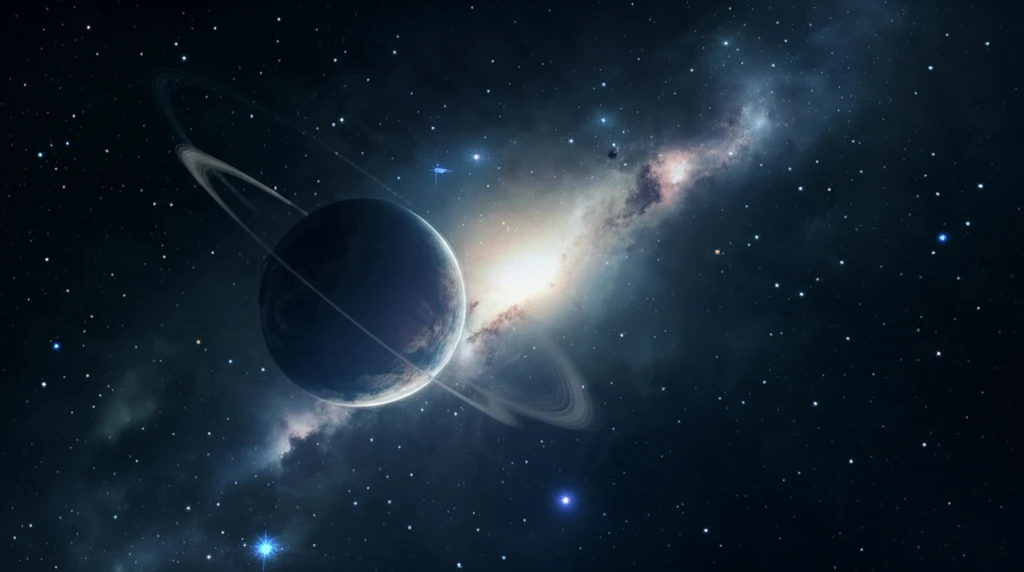
Decoding Alien Skies: How Scientists Are Building a 'Spectral Zoo' of Exoplanet Atmospheres

"Embark on an interstellar journey to understand how astronomers are piecing together the secrets of distant worlds by analyzing the light that filters through their atmospheres. Discover the challenges and triumphs of exoplanet spectral analysis."
For decades, the search for life beyond Earth has captivated scientists and dreamers alike. As our technology advances, we're no longer just speculating about the existence of other worlds—we're beginning to analyze their atmospheres. The sheer variety of exoplanets discovered—planets orbiting stars other than our Sun—has revealed a stunning range of possibilities, each with its own unique atmospheric conditions. This has led to the development of a new field: exoplanet atmospheric characterization.
Imagine trying to understand the weather on a planet trillions of miles away. That's the challenge facing today's astronomers. By studying the light that passes through or is emitted by these exoplanets' atmospheres, scientists can deduce their chemical composition, temperature, and even the presence of clouds and hazes. This information provides clues about a planet's potential habitability and whether it could support life as we know it.
This article delves into the methods and challenges of creating a "spectral zoo" of exoplanet atmospheres. We'll explore how scientists use sophisticated instruments and techniques to dissect the faint signals from distant worlds, and what they hope to learn about the universe and our place within it.
The Scale of Discovery
Scientists have confirmed more than 6,000 exoplanets to date, with discoveries continuously updated as new detections emerge. To manage this growing catalog, researchers have developed tools like the Atmospheric Detectability Index, designed to assess which planets are most amenable to atmospheric characterization in future surveys. As ground-based extremely large telescopes and new space missions come online, they are expected to produce huge numbers of new planet detections, making statistical frameworks essential for prioritizing atmospheric studies.
Detecting Gases and Their Limits
The standard approach to identifying gases in exoplanet atmospheres relies on comparing atmospheric models that include or exclude specific chemical species. However, the vast space of possible molecular combinations is highly degenerate, meaning different atmospheric compositions can produce similar observational signatures that complicate definitive identifications. NASA's TESS mission is rapidly expanding the sample of known exoplanets orbiting bright host stars, enabling more detailed atmospheric studies using ultraviolet and optical spectroscopy. Despite these advances, disentangling overlapping spectral signals remains a fundamental limitation of current methods.
A Taxonomy of Alien Atmospheres
As the catalog of characterized exoplanets has grown, scientists have identified at least eight major types of exoplanet atmospheres. These range from hydrogen-rich envelopes surrounding gas giants to the thin, tenuous atmospheric layers found on rocky, Earth-like worlds. Establishing this classification framework has been a foundational step, giving researchers a common vocabulary for organizing the remarkable diversity of alien skies encountered so far.
The Exoplanet Spectral Zoo: A Universe of Possibilities
The term “spectral zoo” aptly describes the vast and diverse range of exoplanet atmospheres that scientists are discovering. Unlike our familiar solar system, exoplanets exhibit a stunning array of characteristics. From scorching hot gas giants to icy super-Earths, each planet boasts a unique atmospheric composition and structure. This diversity presents both an opportunity and a challenge: to catalog and understand these atmospheres, we need a comprehensive approach.
- Water Vapor: Indicates potential for liquid water, a key ingredient for life.
- Methane: Can be a sign of biological activity, though also produced by geological processes.
- Carbon Dioxide: Influences a planet's temperature through the greenhouse effect.
- Oxygen: A strong indicator of life, as it's highly reactive and needs constant replenishment.
The Haze Problem and New Frontiers
Researchers are advancing toward the long-standing goal of detecting atmospheric biosignatures on exoplanets, with atmospheres of distant giant planets now being studied through direct imaging techniques. A persistent challenge is atmospheric haze — solid particles suspended in gas that alter how light interacts with atmospheric molecules. This muting of spectral fingerprints makes measuring gas composition significantly more difficult, even as spectroscopic methods grow more sophisticated. Efforts to characterize exoplanet atmospheres in detail through spectroscopy represent one of the most exciting frontiers in modern astrophysics.
When Atmospheres Don't Survive
Not all exoplanets can hold onto their atmospheres, and understanding atmospheric loss is as important as detecting atmospheres in the first place. Many planets are exposed to extreme ultraviolet radiation and violent coronal mass ejections from their host stars, which can strip atmospheres away entirely. NASA's planned ESCAPE mission is designed to study how exoplanet atmospheres evolve and erode over time, addressing a critical gap in understanding which worlds can sustain habitable conditions.
Earth Among the Alien Atmospheres
When placed in the context of exoplanet atmospheres, Earth's oxygen-rich atmosphere stands out as unusual among known planets, a distinction largely attributed to biological activity. Exoplanets display a far wider range of atmospheric compositions than anything in our solar system, spanning hydrogen-dominated atmospheres to those rich in carbon dioxide. This comparative perspective underscores how atmospheric chemistry can serve as a powerful diagnostic tool for understanding both the nature and potential habitability of distant worlds.
The Future of Exoplanet Exploration: Taming the Spectral Zoo
Despite the challenges, the field of exoplanet atmospheric characterization is rapidly advancing. As new telescopes and instruments come online, scientists will be able to probe exoplanet atmospheres with ever-increasing precision. The James Webb Space Telescope, for example, is already providing unprecedented insights into the atmospheres of distant worlds. By combining these observations with sophisticated computer models, we're getting closer to understanding the true diversity of planets beyond our solar system and whether any of them could harbor life. The journey to decode alien skies has just begun, and the discoveries that await us promise to be transformative.
Expert Voices on Atmospheric Detection
Experts in exoplanet science, including Prof. Lisa Kaltenegger and Prof. Nikole Lewis, have outlined systematic approaches for probing the atmospheres of distant worlds using tools like the James Webb Space Telescope. Building a robust statistical sample of atmospheric measurements is essential for moving beyond individual detections, requiring instruments that can survey large numbers of exoplanets. Over the past 30 years, more than 4,000 exoplanets have been discovered, providing an expanding pool of candidates for atmospheric characterization.
Building the Atmospheric Library
Projects like ExoComp are compiling comprehensive libraries of exoplanet atmospheric composition measurements, enabling population-level analysis of trends in planetary composition. As AI tools and advanced observational technologies are integrated into exoplanet research, researchers expect these capabilities to yield new discoveries and refine understanding of atmospheric processes. Characterizing the atmospheres of planets light-years away remains technically demanding, but the combination of growing datasets and computational methods promises to accelerate progress in the coming years.
Why Atmospheric Studies Matter
Studying exoplanet atmospheres is important because these envelopes hold answers about habitability, climate dynamics, and the origins of planetary systems. Understanding atmospheric composition helps scientists assess whether a planet could support conditions necessary for life as we know it. The broader significance of this research extends to fundamental questions about planetary formation and the diversity of worlds throughout the galaxy.
Nothing We've Ever Seen Before
Surveys have revealed that Earth-sized worlds are common in the galaxy, but their atmospheres could be vastly different from our own. As researcher Lauren Kreidberg has noted, in many cases exoplanets look like nothing we have ever seen before, highlighting the alien nature of many atmospheres catalogued so far. Astronomers study these atmospheres using several complementary methods, each providing distinct information that, together, builds a more complete picture of distant worlds.