
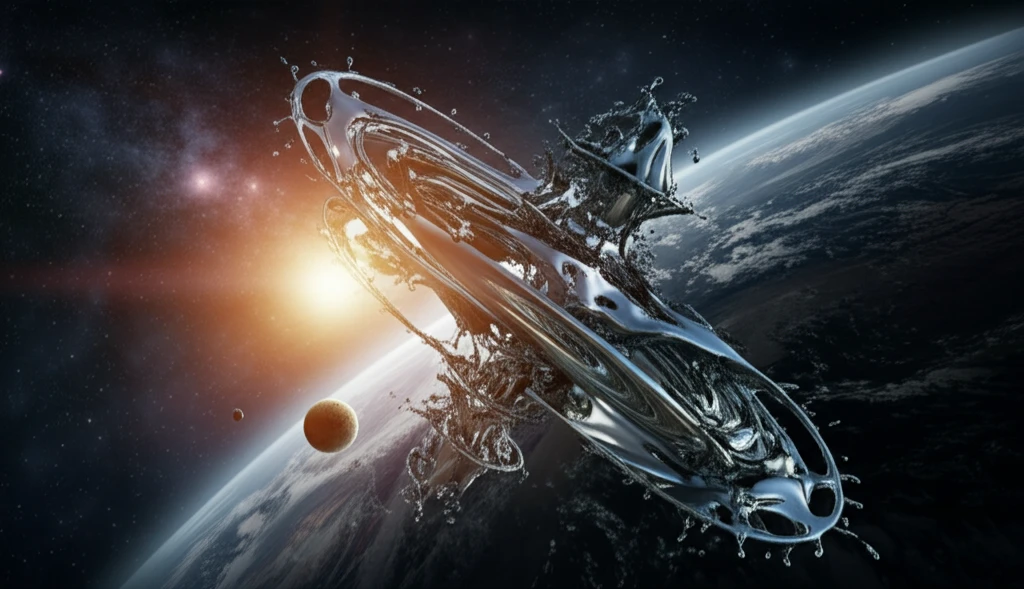
Unlocking Nature's Secrets: How Gravity and Magnetism Shape Fluid Dynamics

"Explore the fascinating world of magnetohydrodynamics and discover how manipulating gravity and magnetic fields can revolutionize technology and our understanding of the universe."
Imagine a world where we can precisely control the flow of energy and materials, manipulating them with the invisible forces of gravity and magnetism. This isn't science fiction; it's the realm of magnetohydrodynamics (MHD), a field that studies the behavior of electrically conducting fluids under the influence of magnetic fields. From the Earth's core to distant stars, MHD governs a vast array of natural phenomena, and understanding it could unlock revolutionary technologies.
At the heart of MHD lies a complex interplay between fluid dynamics, electromagnetism, and thermodynamics. When a conductive fluid, like liquid metal or plasma, moves through a magnetic field, it generates electric currents. These currents, in turn, create their own magnetic fields, which interact with the original field to influence the fluid's motion. Add gravity into the mix, and you have a system ripe with possibilities for innovation.
Recent research is pushing the boundaries of MHD, exploring how periodic changes in gravity, combined with magnetic fields, can be used to control fluid behavior. By carefully modulating these forces, scientists are discovering new ways to manipulate fluid flows, with potential applications ranging from more efficient energy generation to advanced materials processing and a deeper understanding of astrophysical phenomena.
Defining Magnetohydrodynamics and Its Scope
Magnetohydrodynamics (MHD) couples Maxwell's equations of electromagnetism with hydrodynamics to describe the macroscopic behavior of electrically conducting fluids such as plasmas, liquid metals, and electrolytes. In MHD, magnetic fields can induce currents that influence fluid motion, and those altered currents in turn modify the magnetic field itself. The framework treats all charged particles together as a single continuous fluid, making it a powerful model for studying phenomena across solar physics, astrophysics, space plasma physics, and laboratory plasma experiments.
Dissemination Challenges in MHD Research
Publishing MHD research poses unique challenges due to the visual complexity of fluid-magnetic interactions. The journal Magnetohydrodynamics has addressed these limitations by offering online supplementary materials—such as color figures and videos—that are difficult or expensive to reproduce in the print version. This hybrid publication model reflects a broader methodological constraint: MHD's inherently multidimensional nature often exceeds the communicative capacity of traditional static formats.
Origins and Foundational Ideas
The theoretical foundations of magnetohydrodynamics emerged from efforts to unify electromagnetic theory with fluid mechanics, drawing on key principles from both Maxwell's equations and the Navier-Stokes equations. Early milestones involved recognizing that electrically conducting fluids—once magnetized—exhibit behaviors distinct from ordinary hydrodynamic flows. These foundational insights laid the groundwork for MHD's application across an expanding range of natural and engineered systems.
Harnessing Gravity and Magnetism: A Deep Dive into MHD
The study of Rayleigh-Bénard magnetoconvection (RBM) with periodic gravity modulation and a uniform vertical magnetic field offers a unique window into the dynamics of fluids. RBM occurs when a fluid layer is heated from below, creating temperature differences that drive convection. By adding a magnetic field, the fluid's movement becomes even more complex, opening up new possibilities for control.
- Prandtl Number (Pr): A higher Prandtl number, which relates to the fluid's viscosity and thermal diffusivity, reduces the threshold for convection, making it easier to initiate fluid motion.
- Chandrasekhar Number (Q): A higher Chandrasekhar number, representing the strength of the magnetic field, increases the convection threshold, requiring more energy to start the flow.
- Bicritical States: These occur when the minimum forcing amplitude needed for convection happens at two different wave numbers, indicating complex flow patterns.
The Frontier of Turbulent MHD Simulations
Magnetized fluid turbulence—characterized by intricate coupling between fluid and magnetic fields—remains one of the most formidable challenges in theoretical and computational physics. As of mid-2025, researchers are developing hybrid operator approaches to resolve turbulent MHD dynamics at unprecedented fidelity, seeking to bridge the gap between idealized models and real-world astrophysical and laboratory conditions. The field continues to attract substantial research activity, with hundreds of publications and ongoing efforts to refine numerical methods for capturing multi-scale interactions.
Open Questions and Unresolved Challenges
Despite significant progress, MHD modeling faces persistent limitations in capturing the full complexity of real-world plasma behavior. Turbulent regimes, in particular, remain difficult to simulate accurately because of the multi-scale coupling between fluid motion and magnetic fields. Additionally, discrepancies between theoretical predictions and experimental observations continue to prompt debate about the completeness of current MHD frameworks for certain extreme conditions.
MHD Across Disciplines
Magnetohydrodynamics provides a unifying lens for comparing phenomena across astrophysics, laboratory plasmas, and industrial applications. While the fundamental equations remain consistent, the relative importance of magnetic forces versus fluid inertial forces varies widely between contexts—from solar coronae to liquid-metal reactors. This variability underscores the need for discipline-specific adaptations and benchmarks when applying MHD theory to diverse systems.
The Future of Fluid Control: Applications and Breakthroughs
The ability to manipulate fluid flows with gravity and magnetism has far-reaching implications. In energy, MHD could lead to more efficient generators and power systems. In materials processing, it could enable the creation of new alloys and composites with enhanced properties. And in space exploration, it could revolutionize propulsion systems and our understanding of planetary and stellar dynamics. As research continues to unravel the secrets of MHD, we can expect a wave of technological innovation that transforms our world.
Converging Insights Across Domains
Across its many applications, MHD demonstrates that the interplay between magnetic fields and conducting fluids is central to phenomena ranging from stellar dynamics to potential spacecraft propulsion. Researchers consistently emphasize that capturing this interplay demands both theoretical rigor and advanced computational tools. The growing body of interdisciplinary work suggests that breakthroughs in one domain—such as turbulence modeling—may yield transferable insights for others.
Toward Next-Generation MHD Models
The development of hybrid and high-resolution computational methods promises to bring turbulent MHD simulations closer to experimental and observational reality. Future work is expected to focus on resolving multi-scale interactions that current models struggle to capture, particularly in extreme astrophysical environments. Advances in both hardware and algorithmic design are likely to expand the range of MHD problems that can be tackled with high fidelity.
Scaling and Communication Barriers
MHD research contends with systemic challenges including the computational expense of high-fidelity simulations and the difficulty of communicating multi-dimensional results through conventional publication formats. The need for supplementary digital materials—such as videos and color figures—reflects a broader tension between the richness of MHD data and the constraints of traditional media. Addressing these barriers will be essential for accelerating the field's progress and accessibility.
From Theory to Application
MHD's reach extends from fundamental science to practical technologies, including experimental propulsion concepts for spacecraft that leverage magnetized plasma flows. The collaborative nature of MHD research—spanning physicists, engineers, and computational scientists—highlights the human infrastructure behind scientific progress. As MHD models grow more sophisticated, their potential impact on energy, space exploration, and materials science is likely to increase.