
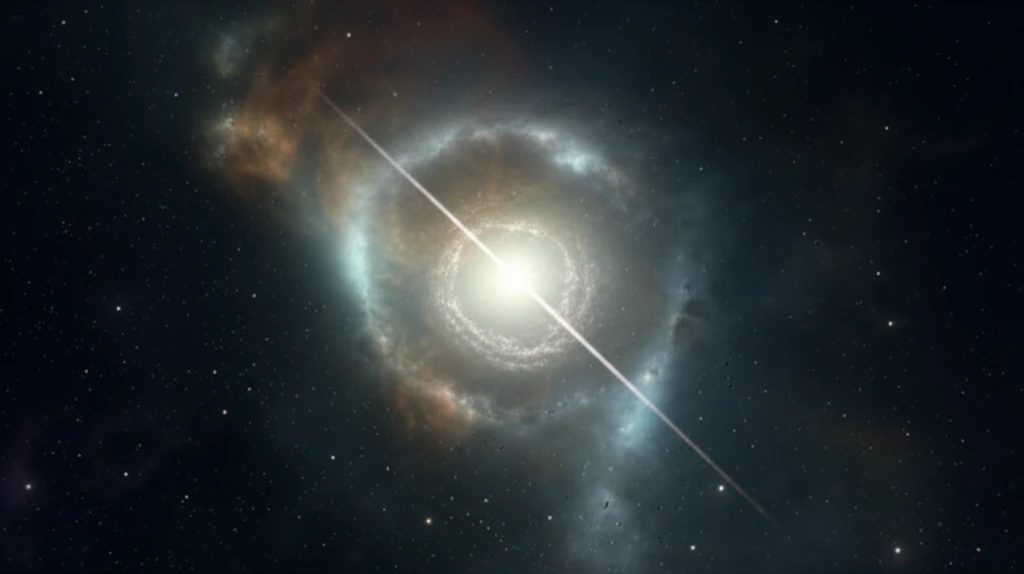
Decoding the Cosmos: How Cluster Radius Reveals Stellar Secrets

"Explore how astronomers use cutting-edge techniques to determine cluster radius and sampling radius in the determination of cluster membership probabilities of star clusters, refining our understanding of the universe."
Imagine sifting through grains of sand on a vast beach, each grain representing a star in the night sky. How do you identify which grains belong to a specific pile, a star cluster bound together by gravity and shared history? This is the challenge astronomers face when studying open clusters, groups of stars born from the same molecular cloud.
Modern astronomy relies on large-scale surveys that catalog millions of stars, making it possible to search for these stellar groupings with unprecedented detail. Identifying cluster members, however, isn't as simple as spotting a dense patch of stars. Stars within a cluster share similar motions and positions, but these characteristics can be muddied by observational errors and the presence of unrelated stars along the same line of sight.
To tackle this problem, astronomers use sophisticated algorithms like the one developed by Sanders in 1971. This method estimates the probability that a star belongs to a cluster based on its motion, comparing it to the overall motion of the cluster and the surrounding field stars. But even the best algorithms have limitations. One critical factor is the size of the area surveyed around the cluster, known as the sampling radius. Choosing the right sampling radius can make or break the accuracy of membership determinations. Let’s explore how astronomers optimize this crucial parameter to uncover the hidden secrets of star clusters.
Cluster Radius Across Galaxy Populations
Studies of galaxy clusters have tested the significance of correlations between color residuals and cluster radius across different galaxy classes, using both Spearman rank ordering and Pearson's r to estimate significance levels for number-density and mass relationships. The SLUGGS Survey has contributed precise radial velocity measurements from the Keck I telescope HIRES instrument, including data for 40 stars in the outer halo globular cluster NGC 2419, used to probe stellar mass functions and search for dark matter signatures. Environmental analyses further distinguish cluster-based environments from statistical density classes using nearest-neighbor estimators that rank galaxies by local projected density without explicitly identifying gravitationally bound halos.
Adapting Clustering Methods to Radial Data
Estimating the centroid of a cluster with radial data distributions requires novel adaptations of standard algorithms. One approach projects points onto the unit circle and averages them, representing an adaptation of the K-means algorithm specifically designed for radial data. In image processing, adaptive radial clustering has been developed for nonlinear smoothing filters that avoid steepest-ascent modification algorithms and instead use special radial clustering to maintain pixel features while modifying outliers in local regions.
Origins of Clustering Analysis
The roots of K-Means clustering can be traced back to the field of statistics and data analysis, forming a foundational milestone in unsupervised learning methods. Comprehensive guides to K-Means clustering document its history, origin, milestones, and impact on the broader field of data science. These clustering methods underpin many modern techniques used in analyzing spatial distributions, including those applied to stellar and galactic cluster radius measurements.
The Delicate Balance: Cluster Radius and Sampling Radius
The core idea behind membership determination is to distinguish between cluster members and field stars based on their proper motions—how stars appear to move across the sky over time. Cluster members tend to share a common motion, while field stars exhibit a more random distribution. The Sanders algorithm uses bivariate normal distributions to model these motions, one circular distribution for the cluster and one elliptical for the field. The algorithm then calculates the probability that each star belongs to either distribution, assigning membership probabilities accordingly.
Power-Law Behavior and Cluster Dynamics
Recent measurements indicate that the average cluster radius r follows a power law of r proportional to P to the 1.86 power. Ion time-of-flight measurements from laser-cluster interaction using CD4 gas at 50 bar have produced energetic deuterium ions with a temperature of kT equals 52 plus or minus 2 keV. The SLUGGS Survey catalog of globular cluster radial velocities continues to be refined, with corrections noting that some globular clusters were observed more than once and recorded with unique GC IDs to prevent duplicate entries.
Mass Density Requirements for Cluster Lensing
Gravitational lensing analysis imposes stringent constraints on cluster mass distributions. For a cluster with a depth of approximately 300 kiloparsecs, the three-dimensional mass density needed to reach the lensing critical surface mass density is approximately 10 to the negative 24 grams per cubic centimeter. This value corresponds to a density roughly 10,000 times the critical density of the Universe, highlighting the extreme mass concentrations required for clusters to function effectively as gravitational lenses.
Structured Comparison Frameworks
Comparative analysis of cluster radius measurements benefits from structured comparison platforms that enable side-by-side evaluation across multiple categories. Platforms offering over 100 comparison categories with detailed specifications, filters, and data visualizations provide frameworks applicable to evaluating competing measurement methodologies. Dedicated comparison utilities allow researchers to systematically enter parameters and identify relevant alternatives when evaluating cluster radius determination techniques.
Unlocking the Secrets of the Cosmos
By carefully considering the interplay between cluster radius and sampling radius, astronomers can refine their techniques for identifying true cluster members. This improved accuracy allows for more reliable studies of stellar evolution, cluster dynamics, and the overall structure of our galaxy. Just as a skilled detective carefully examines a crime scene, astronomers must meticulously analyze star clusters to reveal their hidden stories.
Open Cluster Populations in the Solar Neighbourhood
Studies of young nearby open clusters and their luminosity functions have advanced understanding of stellar populations. Research has analysed the oldest cluster in the solar neighbourhood, Ruprecht 147, while other work discovered a disrupting young open cluster in the halo of the Milky Way. Membership lists have been provided for 431 open clusters, enabling systematic studies of cluster radius distributions and luminosity functions across diverse stellar populations.
Renewable Growth and Future Energy Trajectories
According to the U.S. Energy Information Administration's Short-Term Energy Outlook, solar, hydropower, and wind generation grew by 21%, 9%, and 6% respectively in the first half of 2026 compared with the first half of 2025. Continued growth in renewable energy capacity additions is expected to sustain this trend through 2027. Broader scientific discussions of key challenges and future outlooks continue across disciplines, framing the context in which multi-disciplinary cluster research evolves.
ESG Integration and Systemic Impact
Systemic approaches to global challenges increasingly emphasize that environmental, social, and governance concerns are not separate projects but integral to how organizations build and operate. Research exploring skills training and wage-based incentive programs has examined their impact on the social mobility of rural early childhood education providers in Tennessee, focusing on lived experiences with upskilling. These systemic perspectives frame the broader institutional context within which scientific cluster research must navigate funding, infrastructure, and workforce development challenges.
Radial Patterns in Real-World Optimization
Practical applications of radial pattern analysis extend well beyond astronomy. A modified version of the Sweeping Algorithm has been proposed for solving the Capacitated Vehicle Routing Problem for real-world cases where locations are present on radial patterns. This research demonstrates that radial spatial arrangements are a recurring structural motif requiring specialized algorithmic approaches across domains, from logistics routing to the characterization of stellar cluster distributions.