
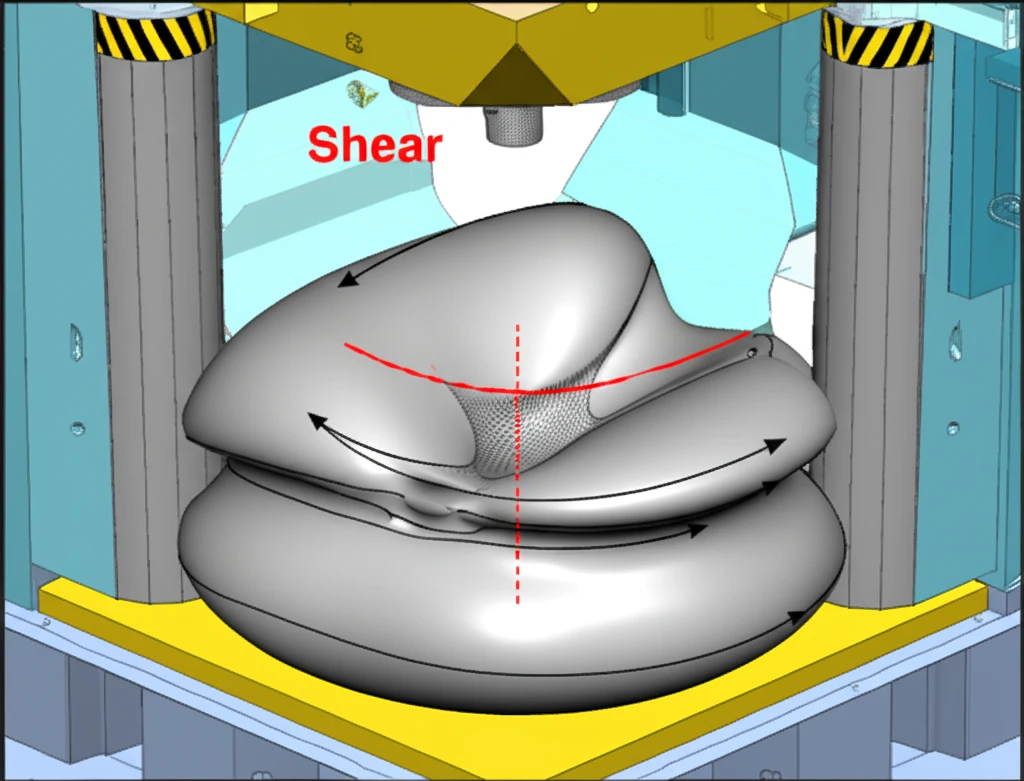
Beyond the Barrel: How a New Model is Revolutionizing Compression Testing

"Unlocking Material Secrets with Advanced Kinematic Solutions"
Imagine trying to understand how a building will stand strong against wind and earthquakes. Material scientists face similar challenges when predicting how materials will behave under extreme stress. One common method is the barrel compression test (BCT), used to design everything from car parts to aircraft wings. The challenge? Traditional models, particularly the cylindrical profile model (CPM), often fall short, providing an incomplete picture of material behavior due to their inability to accurately capture shear deformation.
Enter the Exponential Profile Model (EPM), a new kinematic model poised to revolutionize compression testing. Developed to address the shortcomings of CPM, EPM offers a more realistic representation of material deformation under combined compression and shear. This means more accurate material characterization, which translates to safer, more efficient engineering designs.
This article dives into the mechanics of EPM, comparing it against traditional CPM methods and showcasing its potential to unlock new insights into material properties. Learn how EPM is setting the stage for a new era in material science.
Measuring Load and Measuring Success
Compression testing begins with a simple premise: applying a compressive load to a test specimen and measuring how it responds. The impact of that measurement extends well beyond materials laboratories, however. In digital systems, for instance, compression statistics show why tool choice matters — at default settings, xz achieves roughly 88% compression on typical text data, compared with 70% for gzip and 65% for bzip2. The gap widens further on repetitive or structured data such as logs and configuration files, underlining how much difference method selection can make.
Standards, Fixtures, and the Shape Problem
Standardized compression testing relies on published methods tailored to specific products and materials. ISO 3037, for example, measures the edgewise crush resistance of corrugated fibreboard using a non-waxed edge method, one of many procedures executed on instrumented compression frames. Across these methods, a well-known constraint applies: the approach requires a uniform sample shape, with the top and bottom surfaces parallel, before a standard compression test can be run. Where that condition cannot be met, such as with many biological tissues, indentation testing offers a common alternative.
Milestones and Machine Heritage
The word 'milestone' entered English in 1746 as a stone or pillar set up on a highway to mark distance in miles — and it still serves as the metaphor for the checkpoints by which progress in any field is measured. A foundational milestone for mechanical testing came with the tensile testing machine, which was set up to simulate service stresses as closely as possible, and whose frames, grips, and load-measurement principles carried over into the compressive testing equipment used today. From those beginnings, the discipline accumulated the standardized procedures that now let engineers certify materials under load.
The Problem with Cylinders: Why Traditional Models Fail
The cylindrical profile model (CPM) simplifies compression testing by assuming the material deforms uniformly, maintaining a cylindrical shape. This is a useful approximation, but it omits a crucial aspect of real-world deformation: shear. As material compresses, it bulges outwards, creating a barrel shape, and this barreling effect introduces shear forces that CPM ignores.
- Inaccurate Data: CPM struggles to accurately convert test measurements into reliable flow data, leading to uncertainties in material characterization.
- Unrealistic Strain Estimation: The model provides an unrealistic estimation of strain and strain rate, especially critical given how strain influences material behavior.
- Limited Scope: CPM's inability to represent multi-axial deformation restricts its usefulness in complex forming processes.
- Control Issues: BCT machines are unable to maintain a uniform strain rate deformation scenario using CPM.
From Research Frames to Bestseller Gauges
Research literature continues to document compression testing as a standard route to failure characterization, with recent papers reporting fracture strength tests performed by compression testing on universal testing machines such as the EMICDL-200. The applied side of the field is equally active: consumer compression testers for engine diagnostics have accumulated substantial real-world review data, with one leading model holding the number four spot in the Engine Compression Gauges bestseller category, backed by 2,868 reviews and a 4.6-star rating. Reviewers also credit incremental engineering improvements — such as a reinforced rubber hose over standard thin-wall hoses — with meaningfully changing usability and confidence in readings.
Limits First, Verdict Second
Any rigorous assessment of a method must also confront its failures and limitations. In criticism, the parable of the pier glass is used to explain how a character's point of view is inherently limited — and that those limitations can be surpassed once they are acknowledged. The same principle applies to testing practice: recognizing what an approach cannot capture is the precondition for overcoming it. Balanced evaluations therefore lay limitations out plainly, weigh regressive or costly side effects, and only then arrive at a measured conclusion, a structure familiar from model agree-or-disagree essays.
Instrumented Systems vs. Improvised Checks
Comparative analysis of compression testing often comes down to the equipment in play. Laboratories rely on instrumented systems, with suppliers offering dedicated tensile and compression testers, fatigue test systems, and a range of tensile grips and bend fixtures that apply controlled loads and capture reproducible measurements. By contrast, DIY guides circulate widely for situations where no tester is on hand, describing manual compression testing methods, techniques for checking compression without tools, and effective alternatives to conventional equipment. The two approaches sit at opposite ends of the same spectrum, and choosing between them means weighing control and repeatability against speed and convenience.
EPM: A New Era in Material Testing
The Exponential Profile Model is not just a theoretical advancement; it's a practical tool with the potential to significantly improve material testing and characterization. By accounting for shear deformation, EPM provides a more realistic and accurate representation of material behavior, leading to better designs, safer products, and a deeper understanding of the materials that shape our world. As material science continues to evolve, models like EPM will be at the forefront, driving innovation and progress.
From Raw Loads to Defensible Decisions
Expert commentary converges on a common theme: compression testing is essential for product development, quality assurance, and compliance, with applications spanning a wide range of industries and material types. Running such tests well, however, involves more than a universal machine — practitioners need appropriate grips and fixtures, defined test control variables, and clear data analysis requirements, ideally following step-by-step instructions for the specific material at hand. Software plays a supporting but significant role, simplifying analysis, improving traceability, and ensuring that testing protocols remain consistent from one test to the next. Together these elements turn raw compressive measurements into defensible engineering decisions.
Markets Pushing New Methods Forward
Market analysts see strong expansion ahead for compression and related testing equipment. The spring tension and compression testing machine market, for example, is projected to grow, with its future outlook described as driven by technology and demand shifts. The tire testing service market similarly reports a promising outlook, centered on developing innovative testing methods and equipment to meet the evolving needs of the automotive industry. Across both segments, technology change and shifting demand are the reported catalysts, with innovation in methods and equipment called out as the key to keeping pace with industry needs.
One Test Among Many, Trust on the Line
Compression testing does not operate in isolation; it sits within a broader ecosystem of mechanical verification, from universal and fatigue testing machines to impact, bending, and force calibration equipment, all of which must be maintained and interpreted consistently. That breadth is itself a systemic challenge, because results are only as trustworthy as the calibration chain behind them. The credibility question deepens as automated analysis enters the picture: related discussions emphasize the broader impact on AI credibility and adoption, implying that new analytical tools are only as valuable as the trust they earn. Sustaining that trust, alongside keeping a diverse fleet of machines calibrated and consistent, is the systemic challenge facing modern testing practice.
Real Ice, Real Workers, Real Consequences
Compression and impact testing take on a distinctly human face once they leave the laboratory. Small-scale tests using real Baltic Sea ice measured contact force with a pendulum-type impact device to study ice impact loads on azimuthing thrusters, with design-mean-friction values varying from 0.5 to 1.4 across the test series. On the factory floor, the stakes are personal as well as physical: compressed air systems can injure workers and contaminate product through the same line, a hazard addressed through standards such as ISO 8573-1, BRCGS, and SQF and illustrated by fresh produce case studies. These examples are a reminder that real materials, real workers, and real consequences sit behind every carefully recorded measurement.