
Beyond the Ashworth Scale: Revolutionizing Spasticity Measurement with New Tech?

"Discover how the Electric Spastic Ankle Measure (E-SAM) could provide more specific and quantitative insights into muscle tone and spasticity following stroke, potentially transforming rehabilitation strategies."
Spasticity, characterized by a velocity-dependent increase in tonic stretch reflexes, is a common and challenging consequence of upper motor neuron injuries such as stroke and spinal cord injury (SCI). While the clinical definition of spasticity is well-established, accurately measuring and understanding its components remains a significant hurdle in rehabilitation. This lack of precise measurement tools impacts our ability to tailor treatments and fully understand the effects of spasticity, which can be both inhibitory and beneficial depending on the context.
Currently, clinical assessments of spasticity rely heavily on manual tools like the Ashworth Scale and the Modified Ashworth Scale (MAS). These scales are favored for their ease of use and widespread availability. However, they suffer from limitations in reliability and the ability to provide quantitative results. This has spurred numerous attempts to develop more precise measurement instruments, but many of these have proven too cumbersome or impractical for routine clinical use.
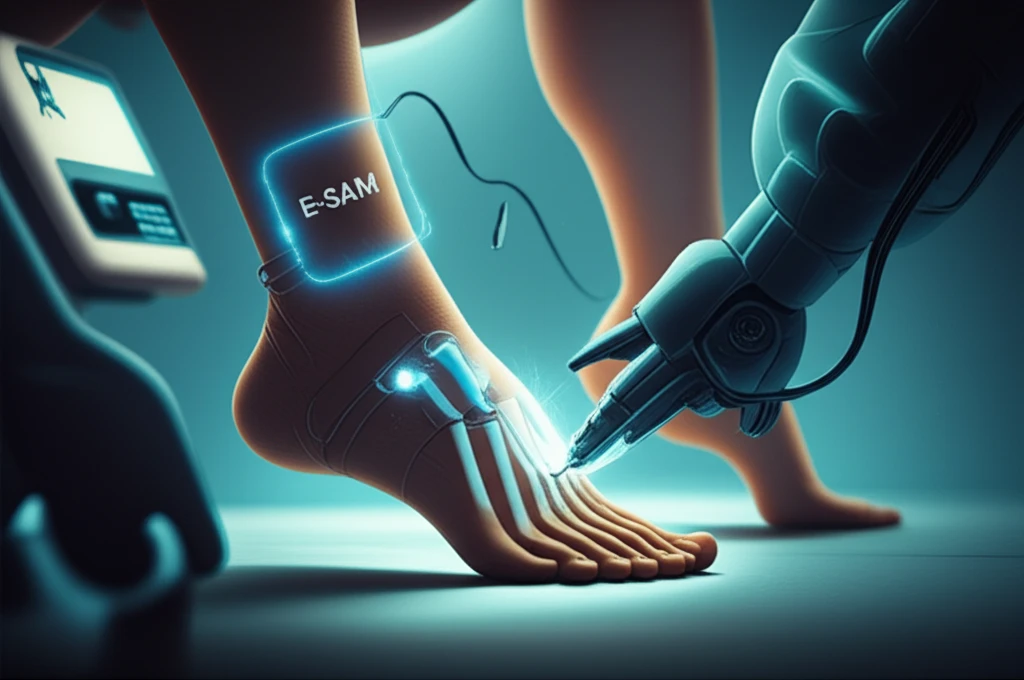
A recent study introduces a promising new tool, the Electric Spastic Ankle Measure (E-SAM), designed to quantitatively assess and isolate the spastic and viscoelastic components of muscle tone. This portable instrument offers the potential to overcome the limitations of existing methods, providing clinicians and researchers with a more detailed and objective way to evaluate spasticity.
How Does E-SAM Work and What Does It Measure?
The Electric Spastic Ankle Measure (E-SAM) is designed to offer a comprehensive assessment of ankle spasticity through a combination of mechanical and sensor technology. The device incorporates an ankle-foot orthosis (AFO) equipped with torque sensors on an upright bar, a goniometer at the ankle joint, and a foot plate that pivots on an anterior hinge. This setup allows for precise measurement of the forces and angles involved in ankle movement.
- Initial Setup: The patient is seated with the hip and knee joints positioned at 90 degrees, and the ankle is fixed at 10 degrees of plantarflexion using the E-SAM device.
- Measurement Initiation: The process begins when a lock bar is released without warning, allowing the foot to drop naturally.
- Data Acquisition: As the foot drops, torque and angle data are continuously recorded at a high sampling frequency (1 kHz) using specialized software (LabVIEW).
- Automated Locking: Upon reaching 5 degrees of dorsiflexion, the footplate automatically locks into place, stabilizing the ankle.
- Data Analysis: The recorded torque and angle data are then analyzed to evaluate muscle tone and spasticity, providing quantitative measures of these parameters.
The Future of Spasticity Assessment
The E-SAM device represents a significant step forward in the quantitative assessment of spasticity, offering a more detailed and objective alternative to traditional manual scales. By providing clinicians and researchers with the ability to measure and isolate the viscoelastic and spastic components of muscle tone, the E-SAM has the potential to improve treatment planning, monitor rehabilitation progress, and advance our understanding of the underlying mechanisms of spasticity. While further research is needed to validate its reliability and applicability across a wider range of patients, the E-SAM holds promise as a valuable tool in the management of spasticity and the improvement of patient outcomes.