
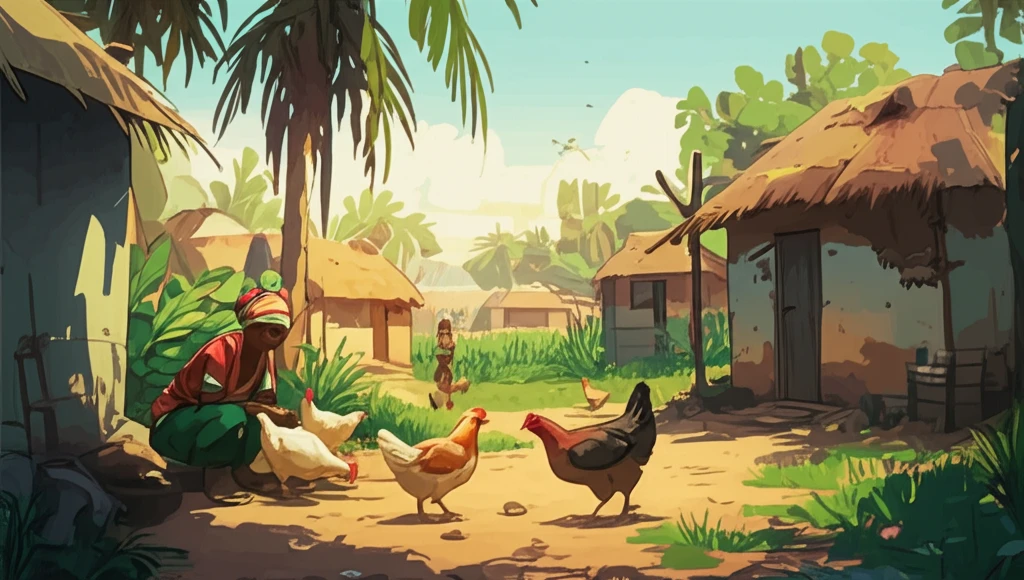
Backyard Bounty: How Indigenous Chickens are Transforming Niger's Farms

"Discover how local chicken breeds are boosting food security and empowering communities in Niger, offering a sustainable path to rural development."
In the heart of Niger, a silent revolution is taking place in the form of indigenous chicken farming. This practice, deeply rooted in the local culture, is proving to be a game-changer for rural communities, offering a pathway to enhanced food security and economic stability. As families increasingly rely on these resilient birds, it’s crucial to understand the transformative potential of this agricultural approach.
For many Nigeriens, local chicken breeding isn't just a source of sustenance; it's a vital component of their livelihood. These chickens provide a readily available source of animal protein and income, particularly essential for those in rural areas. As Niger strives to improve the productivity of its poultry sector, a closer look at the traditional methods and challenges faced by local farmers becomes indispensable.
Recognizing the need for deeper insights into this sector, a comprehensive socio-economic and technical survey was conducted from July to August 2017. This study aimed to gather essential information about family poultry keeping practices across Niger, setting the stage for informed strategies to support and enhance this crucial agricultural activity.
A Widespread African Livelihood
Indigenous chicken farming is one of the oldest and most widespread livestock production systems across Africa, with millions of rural households depending on native chickens as an important source of food security, household income, and cultural value. A study of indigenous chicken farmers found that 125 female farmers practiced indigenous chicken farming compared to 75 male farmers, highlighting the strong role of women in the sector. Marketing of indigenous chickens in regions such as the Kamuli Plains in Uganda takes place at farm gates and in local markets, with producers, consumers, middlemen, and indigenous restaurants serving as key players in the value chain.
Research Gaps in a Crucial Sector
Indigenous chicken farming is a crucial agricultural activity for small-scale farmers in rural areas, providing high-quality protein from meat and eggs while creating employment and income that helps alleviate poverty in developing African countries. Researchers have used market index approaches to measure the proportion of indigenous chickens marketed as a proxy for commercialization, revealing the drivers behind smallholder farmers' commercialization intent. Value chain analyses map the various actors and their roles from farm to fork, yet the sector still lacks the kind of integrated supply chain models needed to unlock its full economic potential.
From Local Birds to Improved Hybrids
The development of improved indigenous chicken breeds, such as the Improved Kienyeji in Kenya, represents a significant milestone — these hybrid birds are created by crossing selected local free-range chicken ecotypes to combine hardiness with better productivity. Indigenous chickens have deep historical roots across the globe; for example, Japanese indigenous chickens have a breeding history possibly beginning 2,000 years ago, with genetic characterization performed using mitochondrial DNA markers to trace their origins. These foundational genetic studies have laid the groundwork for contemporary breeding programs that aim to conserve local diversity while enhancing production traits.
Empowering Women Through Poultry
The survey revealed that a significant 43.1% of local chicken producers in Niger are women. This statistic underscores the critical role women play in agricultural production and household economics. By engaging in poultry farming, women gain not only a source of income but also increased autonomy and decision-making power within their families and communities.
- Diseases (45%)
- Lack of adequate housing, leading to increased predation (16%)
- Insufficient feed (11%)
- Limited access to training and resources (8%)
Traits, Taste, and Growing Demand
Recent reviews have evaluated the quantitative and qualitative traits of indigenous chickens across Southern African countries, aiming to consolidate fragmented research findings on breed performance and characteristics. In Kenya, indigenous chicken products are preferred by consumers due to their unique taste, high nutritional value, and organic production methods, with researchers noting that increasing demand could offer significant expansion opportunities for indigenous chicken farming. Indigenous poultry farming is widely practised in rural households and plays a significant role in the financial stability and livelihoods of farming communities.
Disease, Genetic Erosion, and Institutional Gaps
African indigenous chicken populations constantly face extinction threats due to disease, genetic problems, breeding cessation, and natural disasters, prompting organizations like ILRI to develop biobanking training programs aimed at conserving native breeds. In the broader value chain, marketing of indigenous chickens can improve farmers' poultry management skills, particularly in detecting disease symptoms and implementing prevention methods, but access to such training remains uneven. Predators and parasites represent persistent biological threats that smallholder farmers struggle to manage without external support.
Hardy Breeds, High Returns
Chickens are the most commonly raised poultry species in Africa, with indigenous breeds dominating smallholder systems across the continent. Country chicken farming involves raising indigenous breeds that are well-adigned to local environments, noted for being hardy, disease-resistant, and able to thrive with minimal inputs — traits that give them a distinct advantage over commercial breeds in resource-limited settings. In Kenya, the demand for indigenous chicks is high, and successful kienyeji farmers report selling birds to local farmers as well as neighbouring counties, demonstrating the commercial viability of indigenous poultry systems.
A Future Powered by Chickens
Indigenous chicken production holds immense potential for driving sustainable rural development in Niger. By empowering women, enhancing food security, and strengthening community bonds, this agricultural activity offers a pathway to a brighter future for countless families. Addressing the challenges of disease, housing, and access to resources is essential to fully unlock the transformative power of these humble birds.
A Sector at an Inflection Point
Indigenous chicken farming stands at a crossroads where traditional knowledge meets modern market demands. The convergence of consumer preference for organic, uniquely flavoured products and growing recognition of indigenous breeds' resilience suggests the sector has strong fundamentals for expansion. However, translating this potential into sustained growth will require coordinated investment in genetics, value chain infrastructure, and farmer training — areas where the evidence base is still maturing.
Market Participation and Nutritional Gains
Research from sub-Saharan Africa shows that 76% of interviewed smallholder farmers participated in indigenous chicken markets, demonstrating considerable commercial engagement even in resource-constrained settings. On average, participating in indigenous chicken markets increases the likelihood of achieving a higher household dietary diversity score by approximately 60%, underscoring the link between poultry market access and nutrition outcomes. These findings suggest that policies facilitating market entry for smallholder farmers could yield dual benefits for income generation and food security.
Low Profitability and Market Information Gaps
In Kenya, indigenous chickens constitute approximately 70% of the poultry population, with their role in rural livelihoods widely understood in terms of provisioning nutrition and household income. Despite this dominance, indigenous chicken farming in countries such as Tanzania remains hampered by low profitability, largely due to a lack of the market information that farmers need to make informed commercial decisions. Smallholder indigenous chicken farmers face systemic barriers including limited access to extension services, poor market linkages, and inconsistent availability of quality feed and veterinary care.
Local Adaptation, Global Lessons
A study of indigenous chickens in Ethiopia revealed that unique ecological environments drive distinct microbiome diversity in the birds' guts, offering important insights for poultry management across different farming systems worldwide. In Cameroon's southwest region, indigenous chicken production accounts for approximately 40% of all total meat production, with poultry farming emerging as a lucrative sector for smallholder farmers. These case studies illustrate how environment-specific research and localized production systems are generating knowledge that can inform indigenous chicken development strategies far beyond their immediate geographic origins.