
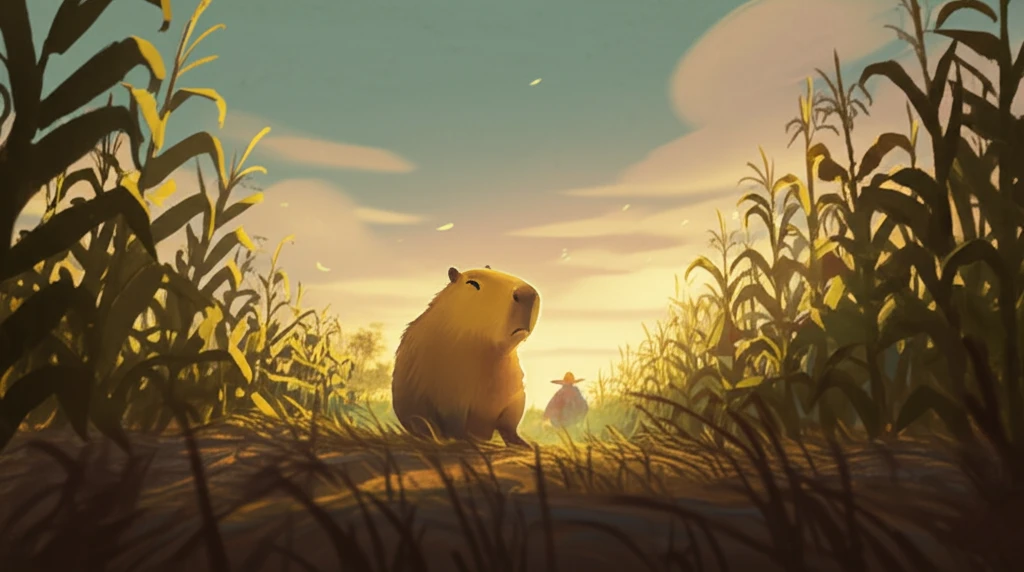
Capybara Conflicts: How Farmers Can Protect Crops Without Harming Wildlife

"Balancing agricultural needs with wildlife conservation: A practical guide for farmers facing capybara crop damage."
Across Brazil, a growing tension simmers between farmers and local wildlife, particularly with capybaras (Hydrochoerus hydrochaeris), the world's largest rodents. These semi-aquatic mammals, known for their gentle nature, often find themselves at odds with agricultural interests as they graze on cultivated crops.
Capybaras, adaptable eaters, have expanded their diet beyond natural grasses and aquatic plants to include crops like maize, sugarcane, and rice, leading to significant yield losses for farmers. This shift in feeding habits is largely driven by the conversion of natural landscapes into agricultural land, reducing the capybaras' natural habitat.
A recent study in the Dourados region of Brazil sheds light on the feeding behavior of capybaras and the extent of crop damage they cause. This research not only quantifies the economic impact on local farms but also explores potential strategies for mitigating conflicts between capybaras and agricultural activities, offering a balanced approach to conservation and farming.
Capybara Crop Damage in Agricultural Landscapes
Research from Brazil has documented and quantified the damage capybaras cause in agroecosystems, particularly in corn fields where their feeding behavior results in measurable crop losses. As capybara populations expand in agricultural landscapes, the increase in crop damage has become a growing concern for farmers in regions such as southeastern Brazil, Paraguay, and Colombia. Capybaras are also among the species most frequently involved in road accidents, causing extensive damage and even human casualties due to their large body size and social behavior. In some regions, capybaras are considered pests because they damage crops and compete with livestock for food and water.
Supplemental Feeding as a Crop-Conflict Mitigation Strategy
Capybaras primarily eat grasses and aquatic plants, but they adjust their diet to include fruits, tree bark, or crops when needed, a trait that is often mistakenly interpreted as a sign of overpopulation rather than a natural dietary flexibility. A practical solution proposed for rural communities experiencing crop damage is providing supplemental feeding stations, which can draw capybaras away from cultivated fields and toward designated food sources. This approach attempts to reduce human-wildlife conflict without resorting to lethal control, though it requires ongoing management and community commitment to be effective. The method remains a developing strategy rather than a universally adopted standard.
A Short History of Capybara-Human Coexistence
Capybaras have long coexisted with human populations across South America, but the formal study of crop-damage conflicts is a relatively recent development in wildlife management literature. As agricultural expansion accelerated in the twentieth and twenty-first centuries, researchers began systematically documenting the scale of capybara impacts on farmland, moving beyond anecdotal reports to quantified assessments. This shift from observation to structured research marks a key milestone in understanding how land-use change drives human-wildlife conflict. The foundational work in this area has centered on Southeastern Brazil, where deforestation and agricultural growth have intensified encounters between farmers and capybaras.
Understanding Capybara Behavior and Crop Selection
The study, conducted between April 2010 and September 2011, involved semi-structured interviews with farmers across 24 different properties in the Dourados-MS region. Researchers combined these interviews with direct field observations at six farms, recording capybara activity at various times of day and night to capture peak feeding periods. This comprehensive approach allowed for a detailed understanding of capybara herd sizes and feeding preferences.
- Capybaras primarily feed during the evening and night.
- Availability of water resources in rural areas is a key factor influencing the presence of capybara herds.
- Corn crops suffer the highest losses due to capybara feeding.
- Rice crops are preferred when available, but corn is more frequently targeted due to wider cultivation.
Overgrazing and Escalating Human-Farmer Conflict
Recent reviews highlight that capybaras have been known to cause damage to crops in areas where they are found, with their grazing behavior capable of leading to overgrazing and broader damage to agricultural land. This pattern of overgrazing has led to direct conflict between capybaras and farmers, as communities struggle to balance agricultural livelihoods with wildlife presence. The issue is not isolated to a single crop or region but reflects a broader pattern of interaction across capybara habitats. These findings underscore the need for evidence-based management strategies that address both ecological and economic dimensions of the problem.
The Economic Toll of Crop Damage on Rural Communities
Capybaras damage a wide variety of crops, and this feeding behavior directly reduces farmers' profits, creating significant economic strain in affected communities. The financial losses from crop damage strain relations between rural populations and capybaras, sometimes leading to retaliatory killing or calls for population control measures. These tensions highlight the difficulty of applying one-size-fits-all solutions to human-wildlife conflicts, as the economic impacts fall disproportionately on small-scale farmers with limited resources. Failure to address these economic pressures risks deepening the adversarial relationship between communities and wildlife.
Capybara Management in a Broader Wildlife Conflict Context
While capybaras present unique challenges as the world's largest living rodents, their conflict with agriculture shares common patterns with human-wildlife disputes involving other herbivorous species worldwide. The core dynamic—wildlife foraging on cultivated land in response to habitat loss and resource availability—is a recurring theme in conservation biology. Effective management of these conflicts typically requires a comparative understanding of which deterrent methods, habitat modifications, and community engagement strategies have succeeded or failed in similar contexts. Placing capybara conflicts within this broader comparative framework can inform more adaptive and evidence-based approaches to mitigation.
Strategies for Coexistence
Addressing the conflict between capybaras and agriculture requires a multifaceted approach that balances the needs of farmers with wildlife conservation. Farmers are encouraged to implement strategies such as planting crops further from forest edges, protecting and expanding natural habitats, and managing water resources to discourage capybara presence. Population control measures, where ethically and legally permissible, can also help reduce the impact on crop yields. By adopting these integrated strategies, farmers can mitigate crop damage while ensuring the long-term sustainability of both their farms and the local ecosystem.
Range Expansion Driven by Agricultural Deforestation
Capybaras are the largest living rodents and are found only in the Neotropics, but their range is expanding as agricultural deforestation occurs, particularly in Southeastern Brazil, Paraguay, and Colombia. Capybaras mostly eat grass and aquatic plants but may nibble on garden vegetables, meaning that protecting sensitive plants is a practical step for avoiding damage in areas where capybaras are present. The expansion of capybara populations into agricultural landscapes is not solely a function of overpopulation but rather a consequence of habitat modification that creates favorable conditions at the forest-farmland edge. Understanding this dynamic is essential for developing management strategies that address root causes rather than symptoms of the conflict.
Emerging Directions in Capybara Conflict Research
Future research into capybara-agriculture conflicts will likely benefit from advances in non-invasive monitoring technologies, landscape-level habitat modeling, and community-based participatory research methods. As climate change reshapes vegetation patterns and water availability across South American grasslands, capybara distribution and crop-damage hotspots may shift in ways that are difficult to predict with current data. Integrating indigenous and local knowledge systems with scientific research could yield more holistic and culturally appropriate management frameworks. Long-term interdisciplinary studies that link ecological, economic, and social dimensions of the conflict remain a critical but underdeveloped area of inquiry.
Habitat Loss, Climate Change, and the Persistence of Conflict
Capybaras face significant challenges from habitat loss and fragmentation, compounded by the unpredictable effects of climate change, making continued monitoring and protection essential. In some cases, farmers resort to killing capybaras to protect their crops, a practice that reflects the broader systemic failure to provide viable non-lethal alternatives. These pressures illustrate how agricultural expansion and environmental change can converge to intensify human-wildlife conflict in ways that are difficult to reverse. Addressing these root causes requires coordinated policy responses that bridge conservation, agriculture, and climate adaptation agendas.
The Emotional and Practical Realities of Living with Capybaras
For farming communities, the daily reality of capybara crop damage extends beyond economic loss to include the emotional toll of watching livelihoods undermined by wildlife they cannot easily control. Farmers in affected regions often describe a cycle of frustration, where deterrent methods fail or require constant effort, and official support for mitigation may be limited or slow to arrive. The human dimension of these conflicts is frequently overlooked in purely ecological analyses, yet it is the deciding factor in whether communities embrace coexistence or turn to lethal control. Any durable solution must center the lived experiences and practical constraints of the farmers who bear the direct costs of living alongside capybaras.