
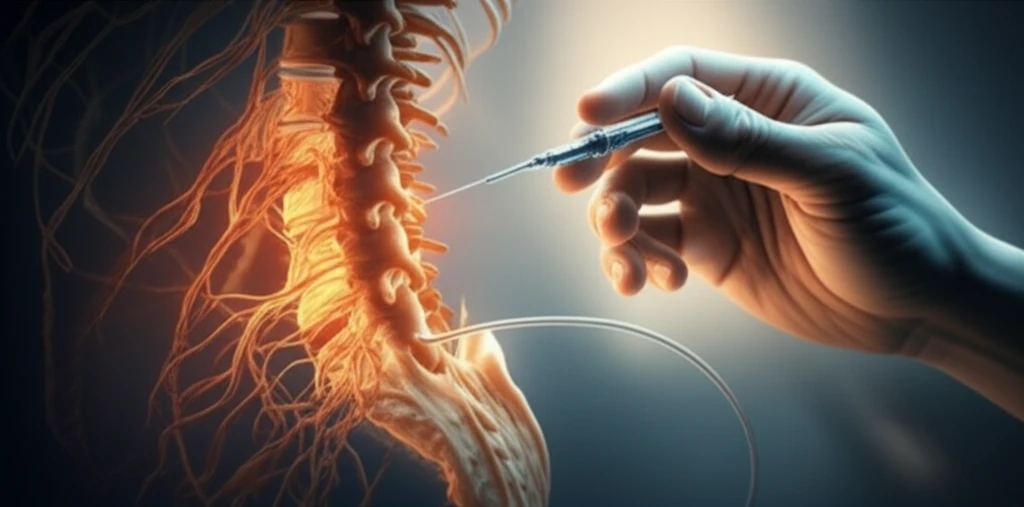
Illustration of spine with roots and catheter representing spinal tuberculosis treatment.

Back Pain Breakthrough: Can a Simple Procedure Prevent Complications from Spinal Tuberculosis?

"New research suggests that percutaneous catheter drainage (PCD) before surgery could significantly improve outcomes for lumbar spinal tuberculosis patients with psoas abscesses."


Spinal tuberculosis is a serious infection that can lead to the development of psoas abscesses (PA), pockets of pus that form in the psoas muscle, located in the lower back. These abscesses can significantly complicate treatment, reducing the effectiveness of anti-tuberculosis drugs and often necessitating surgical intervention.

Traditionally, surgery to address spinal tuberculosis and psoas abscesses involves a combination of posterior fixation (stabilizing the spine with screws) and anterior debridement and fusion (removing infected tissue and fusing vertebrae). While effective, this approach can be invasive and associated with significant blood loss and prolonged recovery times.

However, a new approach is gaining traction: preoperative percutaneous catheter drainage (PCD). This minimally invasive procedure involves inserting a catheter through the skin to drain the abscess before surgery. A recent study published in the Journal of Orthopaedic Surgery and Research investigates the benefits of preoperative PCD in patients with lumbar spinal tuberculosis and psoas abscesses. This article will break down the study's findings, exploring how PCD can improve patient outcomes and streamline the surgical process.

The Study: PCD as a Game Changer for Spinal Tuberculosis Treatment

Illustration of spine with roots and catheter representing spinal tuberculosis treatment.

The study, conducted between 2015 and 2017, involved 72 patients with lumbar spinal tuberculosis and psoas abscesses. The patients were divided into two groups: Group A, which received preoperative PCD in addition to standard surgical treatment, and Group B, which underwent standard surgery alone. Both groups received posterior pedicle screw fixation and anterior focal debridement and fusion.

Researchers then compared several key outcomes between the two groups, including:

  • Intraoperative blood loss
  • Duration of surgery
  • Length of the anterior incision
  • Postoperative recovery time (anal exhaust time)
  • Pain levels (using a visual analog scale or VAS)
  • Cobb angle (a measure of spinal curvature)
  • Inflammation markers (erythrocyte sedimentation rate or ESR, and C-reactive protein or CRP levels)
  • Sinus tract formation (an abnormal channel that can form after surgery)
The results revealed significant advantages for the group that received preoperative PCD (Group A). Specifically, patients in this group experienced less blood loss during surgery, shorter surgery times, smaller incisions, faster recovery, and a lower incidence of sinus tract formation. Furthermore, their inflammation markers improved more rapidly after surgery.

The Takeaway: A Safer, More Effective Approach to Spinal Tuberculosis Treatment

This study suggests that preoperative PCD can significantly enhance the effectiveness of anti-tuberculosis therapy, minimize surgical trauma, and reduce the risk of postoperative complications. By draining the psoas abscess before surgery, doctors can reduce the bacterial load, improve drug penetration, and create a more favorable environment for healing.

For individuals suffering from lumbar spinal tuberculosis with psoas abscesses, this research offers a promising outlook. Preoperative PCD appears to be a safe and feasible treatment option that can lead to better outcomes and a smoother recovery.

While this study provides valuable insights, further research is needed to confirm these findings in larger, multi-center trials and to explore the long-term effects of PCD. Additionally, future studies could investigate the potential benefits of combining PCD with local administration of anti-tuberculosis agents.

About this Article -

This article was crafted using a human-AI hybrid and collaborative approach. AI assisted our team with initial drafting, research insights, identifying key questions, and image generation. Our human editors guided topic selection, defined the angle, structured the content, ensured factual accuracy and relevance, refined the tone, and conducted thorough editing to deliver helpful, high-quality information.See our About page for more information.

This article is based on research published under:

DOI-LINK: 10.1186/s13018-018-0993-9, Alternate LINK

Title: A Comparative Study To Evaluate The Feasibility Of Preoperative Percutaneous Catheter Drainage For The Treatment Of Lumbar Spinal Tuberculosis With Psoas Abscess

Subject: Orthopedics and Sports Medicine

Journal: Journal of Orthopaedic Surgery and Research

Publisher: Springer Science and Business Media LLC

Authors: Zhen Lai, Shiyuan Shi, Jun Fei, Guihe Han, Shengping Hu

Published: 2018-11-19

Everything You Need To Know

1

What is spinal tuberculosis and why is it a concern?

Spinal tuberculosis is a serious infection in the spine that can lead to the development of psoas abscesses. These abscesses are pockets of pus that form in the psoas muscle, located in the lower back. The presence of psoas abscesses can complicate the treatment of spinal tuberculosis by reducing the effectiveness of anti-tuberculosis drugs and often requiring surgical intervention.

2

What is percutaneous catheter drainage (PCD), and what is its purpose in treating spinal tuberculosis?

Percutaneous catheter drainage (PCD) is a minimally invasive procedure where a catheter is inserted through the skin to drain the psoas abscess before surgery. This procedure is performed to reduce the bacterial load, improve drug penetration, and create a more favorable environment for healing in patients with lumbar spinal tuberculosis and psoas abscesses. The study compares outcomes of patients who underwent preoperative PCD in addition to standard surgical treatment, against those who had standard surgery alone.

3

How was the study conducted to evaluate the effectiveness of percutaneous catheter drainage (PCD)?

The study compared two groups of patients: Group A, who received preoperative percutaneous catheter drainage (PCD) in addition to standard surgical treatment, and Group B, who underwent standard surgery alone. Both groups received posterior pedicle screw fixation and anterior focal debridement and fusion. Researchers then compared several key outcomes between the two groups, including intraoperative blood loss, duration of surgery, length of the anterior incision, postoperative recovery time, pain levels, Cobb angle, inflammation markers, and sinus tract formation.

4

What were the main findings of the study regarding percutaneous catheter drainage (PCD)?

The study found that patients who received preoperative percutaneous catheter drainage (PCD) experienced several benefits. They had less blood loss during surgery, shorter surgery times, smaller incisions, faster recovery, and a lower incidence of sinus tract formation. Furthermore, their inflammation markers improved more rapidly after surgery. This demonstrates that preoperative PCD can enhance the effectiveness of anti-tuberculosis therapy and reduce the risk of postoperative complications.

5

Why is preoperative percutaneous catheter drainage (PCD) considered a significant advancement in the treatment of spinal tuberculosis?

Preoperative percutaneous catheter drainage (PCD) is significant because it can improve patient outcomes and streamline the surgical process for lumbar spinal tuberculosis patients with psoas abscesses. By draining the psoas abscess before surgery, doctors can reduce the bacterial load, improve drug penetration, and create a more favorable environment for healing. This can lead to reduced surgical trauma, quicker recovery times, and fewer complications, making it a safer and more effective approach to treatment.

Newsletter Subscribe

Subscribe to get the latest articles and insights directly in your inbox.