
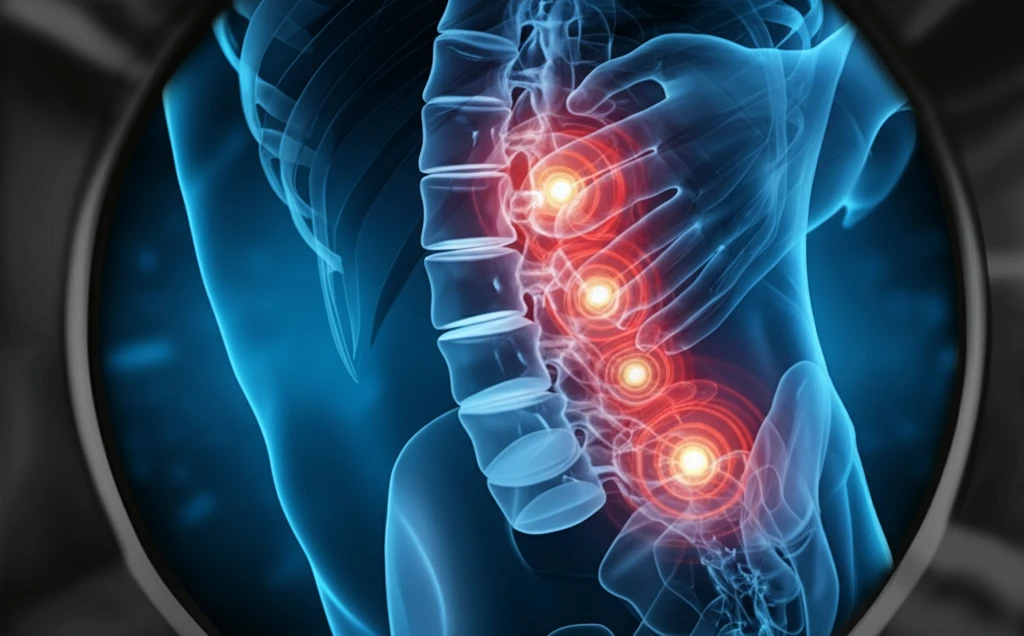
Unveiling the Spine's Secrets: How Endoscopic Visualization Is Changing Pain Management

"Discover how minimally invasive techniques are transforming the diagnosis and treatment of chronic back pain by visualizing the source of the problem."
For years, individuals experiencing chronic back pain have often found themselves in a cycle of temporary fixes, relying on treatments that mask the symptoms rather than address the root cause. Traditional methods of interventional pain management offer relief, but the duration of that relief depends heavily on the body's natural healing processes.
However, the landscape of spine care is changing. The ability to visualize the specific anatomical sources of pain, known as "patho-anatomy," using an endoscope, is revolutionizing how doctors approach diagnosis and treatment. By guiding surgical instruments through interventional needle trajectories, surgeons can now directly target and address the origins of pain.
This article explores how endoscopic visualization is opening new doors in the surgical treatment of lumbar spine pain. It explains the innovative techniques, specialized equipment, and potential benefits of this minimally invasive approach, offering hope for those seeking more effective and lasting solutions.
The Growing Role of Endoscopy in Modern Care
Endoscopic techniques have become a widely used cornerstone of modern medicine, allowing clinicians to look inside the body without traditional surgery. Across the broader landscape of health care, endoscopic approaches are increasingly applied not only to diagnose conditions but also to guide and deliver treatment. Because the technology continues to evolve and its use spans many specialties, its precise reach and impact are difficult to quantify with certainty. What seems clear is that endoscopy's capacity to combine diagnosis and treatment in a single, minimally invasive procedure has reshaped expectations about how pain and recovery are managed.
How Endoscopy Works and Where It Stops Short
Endoscopy is broadly described as a procedure that uses a scope to enter the body, taking pictures or video to help make diagnoses, screen for diseases, and potentially treat a condition if one is present. In practice, endoscopic examinations can be performed through natural openings or small incisions, and the approach is used to inspect a range of organs and duct systems, including procedures such as ERCP for the bile and pancreatic ducts. The technique is understood primarily as an imaging and therapeutic tool, valued for its ability to screen, diagnose, and treat a variety of conditions in a nonsurgical way. Nevertheless, the method has inherent limits, including its invasive nature, the risks and complications associated with certain procedures, and the fact that not every condition can be reached or fully evaluated through an endoscope.
From Rigid Tubes to Flexible Imaging
The history of endoscopy reflects a long progression from crude, rigid viewing tubes to the flexible, camera-equipped instruments used today. Early devices were limited by poor illumination, restricted flexibility, and an inability to see clearly inside living tissue. Over time, key advances in optics, miniaturization, and imaging technology steadily expanded what clinicians could observe and treat without open surgery. Because reliable historical records are limited, the exact chronology and attribution of individual milestones should be treated with caution, but the overall trajectory toward less invasive, more precise visualization is well established.
The Power of Seeing: Visualizing Pain Generators in the Spine
Endoscopic spine surgery utilizes specialized mobile cannulas, guided by real-time visualization, to precisely target the source of pain. This approach enables surgeons to perform decompression and ablation – procedures that relieve pressure on nerves and tissues – with greater accuracy. The development of new instruments, including specially configured endoscopes, access cannulas, and radiofrequency (RF) and laser technologies, further enhances the effectiveness of these surgical interventions.
- Enhanced Precision: Endoscopic visualization allows surgeons to see the exact source of pain, leading to more targeted and effective treatment.
- Minimally Invasive Approach: Endoscopic techniques require smaller incisions, resulting in less tissue damage, reduced pain, and faster recovery times compared to traditional open surgery.
- Broader Range of Treatment Options: Combining visualization with interventional techniques allows surgeons to address a wider variety of spinal conditions and pain generators.
Endoscopy as a Nonsurgical Diagnostic and Therapeutic Tool
Current reviews describe endoscopy as a nonsurgical procedure used primarily to examine the digestive tract, while also recognizing the benefits and risks involved. The technique is presented as a way to gain visual understanding of internal conditions without resorting to traditional open surgery. Alongside these benefits, sources emphasize that endoscopy carries certain risks that patients and clinicians should weigh before proceeding. This balanced framing reflects a broader trend in which minimally invasive visualization is increasingly used to guide both diagnosis and treatment decisions.
Risks and Limits of the Endoscopic Approach
Despite its many advantages, endoscopy is not without drawbacks, and honest accounts acknowledge that the procedure carries real risks. Depending on the type of examination, complications can arise during or after the procedure, which means clinicians must weigh expected benefits against potential harm. The technique also has technical limitations, as some areas of the body are difficult to reach and some conditions remain hard to visualize clearly. For these reasons, endoscopy is best understood as one valuable option within a broader toolkit rather than a universal solution to every diagnostic or therapeutic problem.
Endoscopy Versus More Invasive Alternatives
When weighed against traditional open surgery, endoscopy generally offers a less invasive route to diagnosis and treatment, which can translate into shorter recovery and less disruption to surrounding tissue. By allowing direct visualization through natural openings or small incisions, it avoids the large incisions associated with conventional procedures. However, direct comparisons are complicated by the fact that different conditions, patient populations, and clinical goals favor different approaches. Ultimately, the choice between endoscopy and other methods depends on the specific clinical situation and the trade-offs between risk, precision, and recovery.
A New Era of Spine Care: The Future is Visual
The integration of endoscopic spine surgery into standard practice requires surgeons to acquire new skills and embrace a different approach. By combining surgical expertise with interventional pain management techniques, and confirming results through rational treatment of patho-anatomy under local anesthesia, surgeons can provide more effective and lasting relief for patients suffering from chronic back pain. New procedures such as intradiscal therapy, disc augmentation and biologics will open the door to minimally invasive access to the lumbar spine without affecting and destabilizing the dorsal muscle column. Formal training or mentorship is needed to make this technology mainstream. New evolving technology facilitated by robotics and biologics will help evolve this procedure in the near future.
A Cumulative Case for Minimally Invasive Visualization
Taken together, the available material paints a consistent picture of endoscopy as a versatile, nonsurgical tool that supports both diagnosis and treatment. Across different sources, a shared theme emerges: the ability to visualize internal structures directly, while limiting surgical trauma, has broad appeal across many medical fields. At the same time, experts are careful to note that the approach is not risk-free and is not appropriate for every condition. This balanced view suggests that the value of endoscopy lies less in replacing all other methods and more in adding a powerful, minimally invasive option to clinicians' repertoires.
Toward Smaller, Sharper, and Less Invasive Tools
Looking ahead, endoscopic technology is widely expected to continue becoming less invasive, more flexible, and better at delivering clear images in real time. Advances in miniaturization and imaging refinement could allow clinicians to reach deeper or more delicate structures with greater ease. These developments would likely expand the range of conditions that can be managed without open surgery, further shifting the balance toward outpatient and minimally invasive care. Because many of these possibilities remain at an early or speculative stage, specific timelines and outcomes should be treated with appropriate caution.
Access, Training, and the Cost of Innovation
The broader adoption of endoscopic approaches raises systemic questions about cost, training, and equitable access. Advanced endoscopic equipment and the specialized skills required to use it are not equally available in every clinic or region, which can widen gaps in care. As the technology evolves, health systems face the challenge of investing in new tools while ensuring that clinicians are adequately trained and that patients can actually reach these services. Addressing these structural barriers is likely to be as important as the technology itself in determining how widely the benefits of endoscopic care are felt.
What the Shift to Endoscopy Means for Patients
For patients, the appeal of endoscopy lies largely in the prospect of avoiding a major operation, with the promise of a faster return to normal life. A less invasive procedure can mean less post-procedural pain, a shorter recovery, and a less intimidating experience overall. Yet the human impact also depends on the honesty of the guidance patients receive about the risks involved and whether the procedure is genuinely the right choice for their condition. When used appropriately, endoscopy has the potential to make a real difference in how people experience both diagnosis and recovery.