
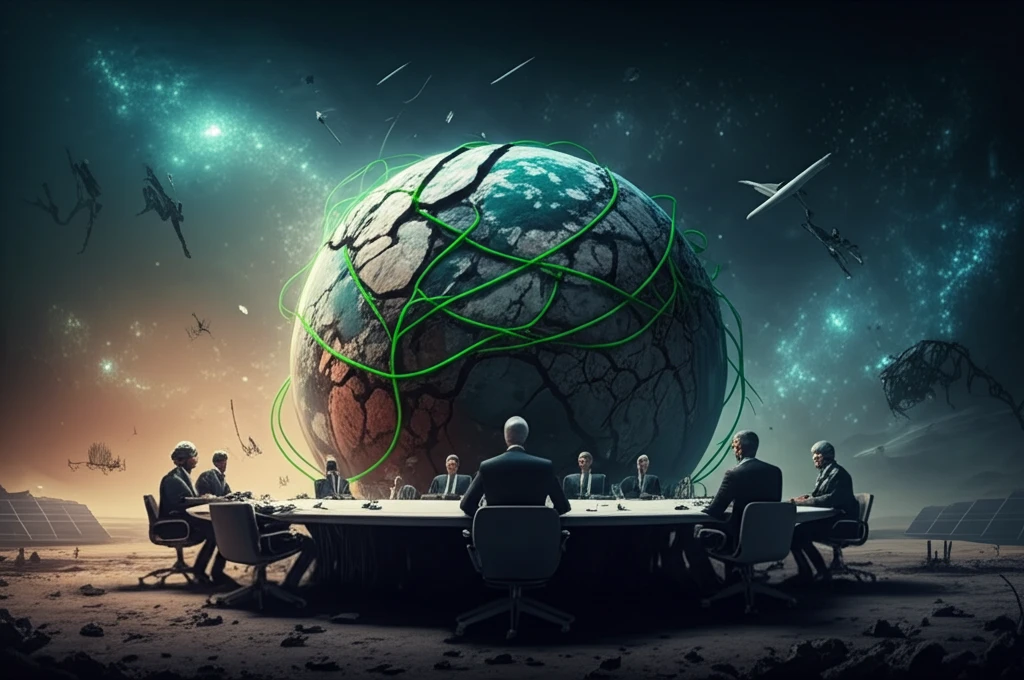
Are International Climate Treaties Doomed to Fail? Unpacking the Challenges and Finding Hope

"Dive into the complex world of global climate agreements, explore why they often fall short, and discover innovative solutions for a sustainable future."
Climate change stands as one of humanity's most pressing challenges, demanding global cooperation to mitigate its far-reaching impacts. International environmental treaties, designed to foster this cooperation, have become central to addressing the crisis. Conferences like those held in the UK (2021) and Egypt (2022) spark crucial conversations, but also ignite debates about the true effectiveness and practicality of the commitments made.
These agreements, while well-intentioned, often grapple with the complex interplay of power dynamics and conflicting stakeholder interests. The allure of short-term economic gains can overshadow the urgent need for long-term climate action, leading to delayed or diluted commitments. This creates a critical tension: how do we reconcile national economic priorities with the imperative of global environmental sustainability?
This article delves into the core challenges facing international climate treaties. We'll explore how differing national interests, economic pressures, and political landscapes can undermine these agreements. More importantly, we will look at potential paradigm shifts and innovative solutions that can pave the way for more effective and equitable climate action on a global scale.
Why Global Climate Treaties Often Miss the Mark: Unpacking the Core Challenges
One of the most significant hurdles lies in the inherent conflict between environmental aspirations and economic realities. Nations, particularly those with developing economies, often prioritize economic growth to improve living standards. This can lead to resistance towards stringent emission reduction targets or commitments that might hinder industrial development. The unfortunate truth is that, for many, the cheapest and most readily available energy solutions are often the least environmentally friendly, creating a difficult trade-off.
- Conflicting National Interests: Nations prioritize their own economic growth, leading to resistance against stringent emission targets.
- Weak Commitments: The ability to withdraw or dilute commitments undermines the strength of the agreements.
- Economic Growth vs. Environment: Reliance on fossil fuels for economic growth leads to increased pollution.
- Power Imbalances: Developed nations often exert more influence, potentially marginalizing the concerns of less economically powerful nations.
A Call to Action: Reimagining International Climate Efforts for a Sustainable Future
The path towards effective global climate action requires a fundamental shift in perspective. We must move beyond short-sighted economic interests and embrace a long-term vision of sustainability that prioritizes both human well-being and environmental preservation. This requires innovative solutions, equitable burden-sharing, and a commitment to transparency and accountability. As Antonio Guterres, Secretary-General of the United Nations, has urged, it is time to enter "emergency mode." The future of our planet, and indeed the future of humanity, depends on it.