
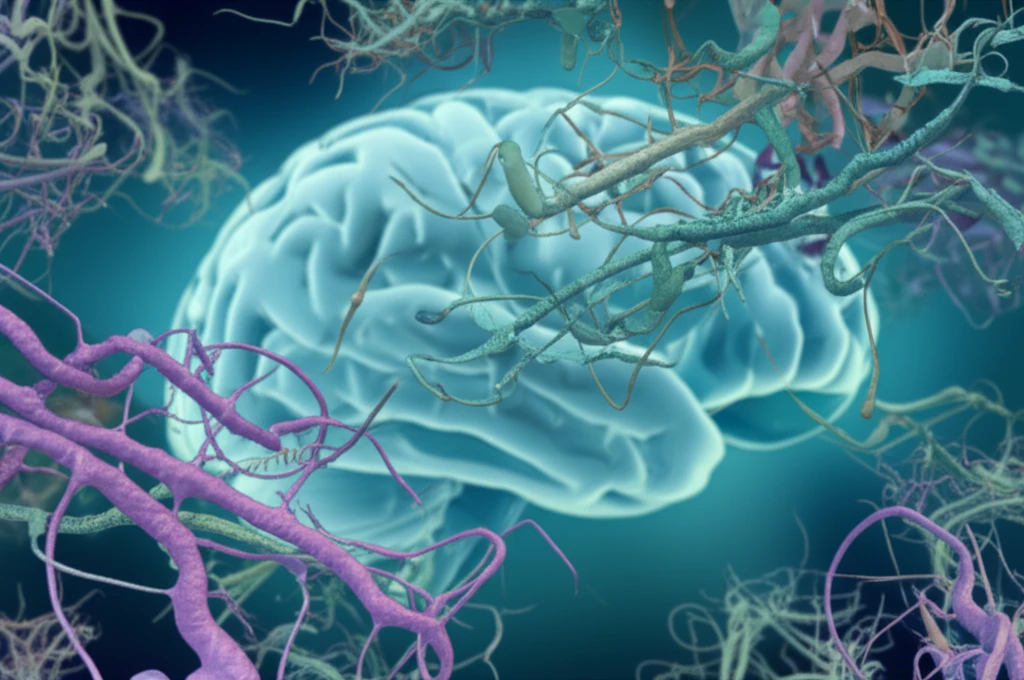
Abstract illustration of dynamic amyloid-beta monomers in the context of Alzheimer's disease research.

Alzheimer's Unveiled: New Insights into the Disordered World of Amyloid-beta Monomers

"Groundbreaking Research Combines Single-Molecule FRET and MD Simulations to Challenge Prevailing Theories on Alzheimer's Protein Structure"


Alzheimer's disease, a devastating neurodegenerative disorder, has long been associated with the accumulation of amyloid plaques in the brain. These plaques are primarily composed of amyloid-beta (Aβ) protein, a fragment derived from the amyloid precursor protein. While the structure of Aβ fibrils within these plaques has been extensively studied, the nature of individual Aβ monomers—the building blocks of these fibrils—remains a subject of intense debate.

Traditionally, Aβ monomers were believed to adopt specific, stable conformations that promote their aggregation into oligomers and, ultimately, fibrils. However, recent research is challenging this view, suggesting that Aβ monomers exist as highly dynamic, disordered proteins that rapidly interconvert between various conformational states. Understanding the true nature of these monomers is crucial, as they represent the earliest targets for potential therapeutic interventions aimed at preventing Aβ aggregation and the onset of Alzheimer's disease.

Now, a new study published in the Biophysical Journal is adding fuel to this paradigm shift. By combining single-molecule Förster resonance energy transfer (FRET) spectroscopy with molecular dynamics (MD) simulations, researchers have gained unprecedented insights into the structural and dynamic properties of Aβ40 and Aβ42 monomers, the two major isoforms of Aβ found in amyloid plaques. Their findings suggest that these monomers are far more disordered and dynamic than previously thought, potentially revolutionizing our approach to understanding and treating Alzheimer's disease.

Unraveling the Mystery: What Did the Researchers Discover About Amyloid-beta?

Abstract illustration of dynamic amyloid-beta monomers in the context of Alzheimer's disease research.

The research team employed a powerful combination of experimental and computational techniques to probe the structure and dynamics of Aβ monomers. Single-molecule FRET spectroscopy allowed them to measure distances within individual Aβ molecules, providing information about their overall conformation. MD simulations, on the other hand, provided atomic-level details of the various conformational states adopted by the monomers.

Their key findings include:

  • Highly Disordered Ensemble: Both Aβ40 and Aβ42 monomers exist as a diverse ensemble of rapidly interconverting conformations, with no single, dominant structure.
  • Lack of Stable Secondary Structure: The vast majority of these conformations lack significant secondary structure, such as alpha-helices or beta-sheets, indicating a high degree of disorder.
  • Rapid Conformational Dynamics: The monomers rapidly fluctuate between different conformations on a nanosecond timescale, highlighting their dynamic nature.
  • Marginal Difference Between Isoforms: While Aβ42 was slightly more compact than Aβ40, the overall structural and dynamic properties of the two isoforms were remarkably similar.
These results challenge the traditional view of Aβ monomers as stable, well-defined structures. Instead, they paint a picture of highly dynamic, disordered proteins that are constantly exploring different conformational states. This new understanding has significant implications for our understanding of Alzheimer's disease and the development of effective therapies.

Looking Ahead: What Does This Mean for Alzheimer's Treatment?

The discovery that Aβ monomers are highly disordered and dynamic opens up new avenues for therapeutic intervention. Rather than focusing on stabilizing specific Aβ conformations, future therapies may aim to modulate the overall conformational ensemble of the monomers, preventing them from aggregating into toxic oligomers and fibrils. This could involve developing molecules that bind to Aβ monomers and shift their conformational equilibrium towards less aggregation-prone states, or that promote the clearance of Aβ monomers from the brain. Only through continued research and innovation can we hope to conquer this devastating disease and offer hope to the millions affected by it.

About this Article -

This article was crafted using a human-AI hybrid and collaborative approach. AI assisted our team with initial drafting, research insights, identifying key questions, and image generation. Our human editors guided topic selection, defined the angle, structured the content, ensured factual accuracy and relevance, refined the tone, and conducted thorough editing to deliver helpful, high-quality information.See our About page for more information.

This article is based on research published under:

DOI-LINK: 10.1016/j.bpj.2017.12.025, Alternate LINK

Title: Highly Disordered Amyloid-Β Monomer Probed By Single-Molecule Fret And Md Simulation

Subject: Biophysics

Journal: Biophysical Journal

Publisher: Elsevier BV

Authors: Fanjie Meng, Mathias M.J. Bellaiche, Jae-Yeol Kim, Gül H. Zerze, Robert B. Best, Hoi Sung Chung

Published: 2018-02-01

Everything You Need To Know

1

What are amyloid-beta monomers and why are they important in Alzheimer's disease?

Amyloid-beta (Aβ) monomers are the fundamental building blocks of amyloid plaques, a hallmark of Alzheimer's disease. These monomers are fragments derived from the amyloid precursor protein. They are considered crucial because they are the earliest form of Aβ and the starting point for the aggregation process that leads to the formation of toxic oligomers and ultimately, amyloid fibrils. Understanding their structure and behavior is critical for developing treatments that can prevent or slow down this aggregation, potentially preventing the onset or progression of Alzheimer's disease.

2

How does the research described challenge the traditional view of amyloid-beta monomers?

Traditionally, Aβ monomers were believed to have stable, well-defined structures that readily aggregated. This research, however, reveals that Aβ monomers are highly dynamic and disordered, existing as a diverse ensemble of rapidly interconverting conformations. The monomers lack significant secondary structure, constantly shifting between different states. This challenges the previous assumption by suggesting a more complex and less predictable behavior for these crucial molecules, potentially changing how we think about treating the disease.

3

What specific techniques did the researchers use to study amyloid-beta monomers, and what did they reveal?

The researchers used a combination of single-molecule Förster resonance energy transfer (FRET) spectroscopy and molecular dynamics (MD) simulations. FRET spectroscopy measured distances within individual Aβ molecules, providing information about their conformations. MD simulations offered atomic-level details of the different conformational states. Their findings showed that both Aβ40 and Aβ42 monomers are highly disordered, lacking stable structures, and rapidly interconverting between various forms. While Aβ42 was slightly more compact, both isoforms exhibited similar overall structural and dynamic properties.

4

What is the difference between Aβ40 and Aβ42, and did the research reveal any significant differences?

Aβ40 and Aβ42 are two major isoforms of amyloid-beta found in amyloid plaques. Aβ42 has two more amino acids than Aβ40, and is known to aggregate more readily. The research found that while Aβ42 was slightly more compact, the overall structural and dynamic properties of the two isoforms were remarkably similar, with both existing as highly disordered and dynamic ensembles. This suggests that both isoforms behave in a similar way, which affects the overall aggregation process and disease progression.

5

How could the new understanding of amyloid-beta monomers change the approach to treating Alzheimer's disease?

The new insights into Aβ monomers as highly disordered and dynamic entities opens up new avenues for therapeutic interventions. Rather than attempting to stabilize specific conformations of Aβ, future therapies may focus on modulating the overall conformational ensemble. This might involve developing molecules that bind to Aβ monomers and shift their conformational equilibrium towards less aggregation-prone states or promoting the clearance of Aβ monomers from the brain. This paradigm shift could lead to more effective strategies that address the underlying causes of Alzheimer's disease by targeting the dynamic behavior of these crucial monomers before they aggregate into harmful oligomers and fibrils.

Newsletter Subscribe

Subscribe to get the latest articles and insights directly in your inbox.