
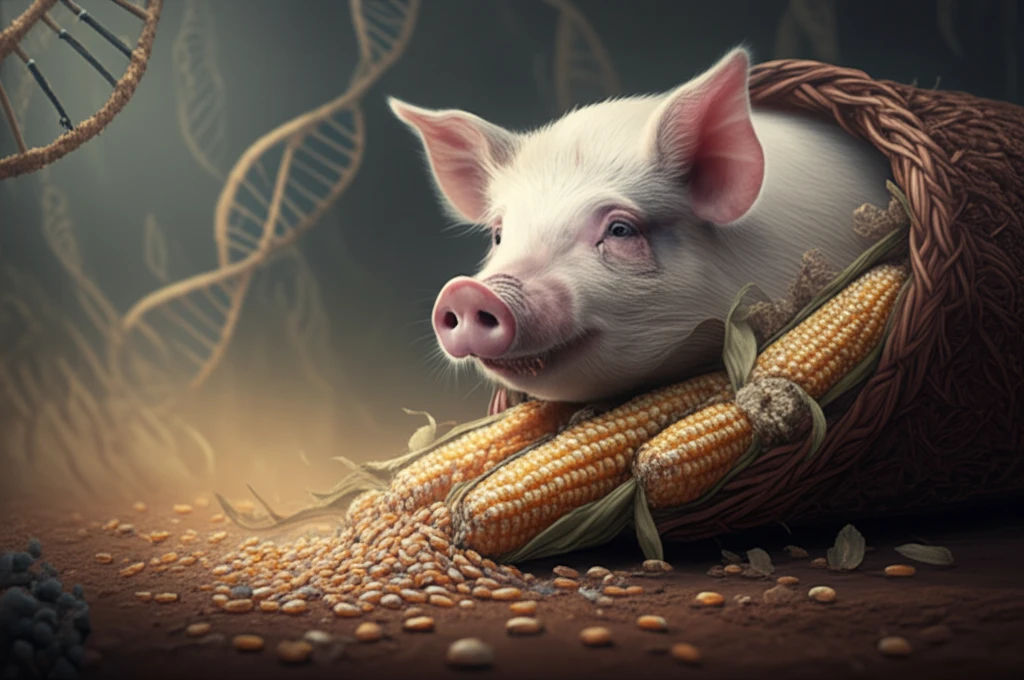
Pig Out on Health: How Hog Diets Could Unlock Metabolic Secrets

"Could what pigs eat lead to breakthroughs in treating human obesity, diabetes, and heart disease? New research explores how corn byproducts in pig diets affect gene expression, offering clues to combatting metabolic disorders."
For years, farmers have strategically crafted animal diets to optimize meat production. Now, a surprising new avenue of research is exploring the impact of these diets on gene expression, potentially uncovering novel insights into human health. A recent study published in BMC Genomics investigates how feeding pigs corn dried distillers grains with solubles (cDDGS)—a byproduct of biofuel production—affects the expression of genes in their adipose tissue (backfat).
The researchers, led by Maria Oczkowicz, aimed to understand how cDDGS, commonly used in pig feed, influences metabolic and cardiovascular health. cDDGS is rich in protein, fiber, and unsaturated fatty acids, making it a cost-effective alternative to soybean meal. However, high levels of cDDGS can negatively impact backfat quality, prompting the addition of saturated fats like beef tallow or coconut oil to counteract this effect.
This study's innovative approach is in line with the growing recognition of pigs as valuable models for understanding human physiology, given their similarities in organ size and function. The findings suggest that seemingly simple dietary adjustments in animals could hold the key to preventing and treating complex human diseases.
Measuring What Pigs Eat
Research on corn dried distillers grains with solubles (cDDGS) in pig feed shows measurable impacts on carcass quality: feed mixtures too high in cDDGS result in a worsening of backfat quality. In one study, RNA-sequencing analysis of backfat from crossbred pigs fed different diets traced these effects at the molecular level, with all expression data deposited in the GEO database under accession GSE101433. Quantifying such impacts relies on the broader data infrastructure represented by open global development data and statistical tools for measuring variability and spread in datasets. These general statistical resources do not directly address pig diets, but they provide the methods and datasets through which diet-related outcomes can be measured.
Formulation, Digestibility, and the Inclusion Ceiling
The accepted approach to feeding cDDGS centers on dietary formulation and on amino acid digestibility methods, with one proceedings recommendation to keep cDDGS at 10% or less in finisher diets. The method's key limitation shows up in performance: replacing soybean meal with cDDGS or canola meal negatively affected the performance of the birds, even though reducing dietary protein reduced litter-surface ammonia. Complementary value-add strategies are being explored, such as a two-step process of fermentation plus enzymatic hydrolysis that uses CDDGS as the sole substrate to produce extracellular proteases and peptones. Systematic research designs such as action research, case study, and mixed methods help practitioners build rigorous projects within the constraints of everyday working life.
A Gap in the Historical Record
A search for historical milestones and foundational discoveries in hog diet research returned no on-topic source material. The retrieved 'milestones' content comes from unrelated domains: a retired U.S. State Department series on foreign relations history, a YouTube explainer on the fictional history of Panem, a Roblox Tower Defense codes page, and a restaurant-simulation game's progression system. None of these documents the development of cDDGS-based swine nutrition, so a historical narrative for this field cannot be responsibly reconstructed from them. The gap indicates that the historical record on pig diets must be sought in agricultural and animal-science archives rather than in the general-interest material surfaced here.
Unlocking Genetic Secrets Through Pig Diets
The study divided crossbred pigs into four groups, each receiving an isoenergetic diet with varying amounts of cDDGS and different fat sources: rapeseed oil, beef tallow, or coconut oil. After two months, RNA sequencing was performed on backfat samples to analyze gene expression changes. The researchers focused on identifying differentially expressed genes (DEGs) – genes whose activity was significantly altered by the different diets.
- Metabolic Master Switch: cDDGS appears to activate genes controlling key metabolic processes, potentially improving energy utilization and fat metabolism.
- Brain Health Connection: The link to Huntington's and Alzheimer's pathways suggests a surprising impact on neurodegenerative processes.
- Inflammation Control: Changes in complement and coagulation cascades indicate a role in modulating the inflammatory response.
- Fatty Acid Fine-Tuning: cDDGS influences the expression of genes involved in the synthesis and breakdown of fatty acids, crucial for overall metabolic balance.
Fine-Tuning Inclusion Rates and Enzymes
A systematic review and meta-analysis of growth performance found that improvements in body weight gain and feed intake are greatest in finisher diets at cDDGS inclusion rates below 100 g/kg. The same meta-analysis reports that adding xylanase or carbohydrase mixtures can offset the reduction in body weight gain seen in cDDGS-based diets. Molecular studies extend this picture: the highest number of altered miRNAs (37) appeared when comparing animals fed cDDGS with coconut oil against animals fed a diet without cDDGS but with rapeseed oil. Literature trackers in this field also flag ongoing reviews of the feed value and potential non-food uses of proteins in dried distillers' grains, indicating an active and rapidly moving research area.
What the Critique Search Surfaced
A search for counter-arguments and documented failures around cDDGS-based feeding surfaced no on-topic peer-reviewed critique in the retrieved sources. The closest material illustrates how failure analysis proceeds in other domains: Pentagon officials told the GAO that a Lockheed missile program was struggling because the work instructions used to build the missile were too complex for the average worker to follow. The remaining results — a literary essay on Middlemarch, commentary on social standards of criticism, and a non-commercial gripe website — have no bearing on hog nutrition. Because the surfaced material provides no counter-evidence, any claims about the drawbacks of cDDGS feeding must be drawn from the peer-reviewed literature rather than from these sources.
Benchmarking Diets from Gene to Body Weight
Comparative analyses of pig diets typically benchmark alternative formulations against one another at both the molecular and whole-animal levels. In backfat transcriptome comparisons, the number of differentially expressed genes was much lower in one dietary group than another, with group I versus group III showing 13 DEGs, of which 5 were underexpressed and 8 overexpressed. At the whole-animal level, pigs fed cDDGS diets with higher branched-chain amino acid-to-lysine ratios (including a Finish group) tended to be heavier at the end of the trial, yet reached final body weights similar to pigs on a corn-soybean meal diet. Together these comparisons show that formulation choices shift molecular expression profiles while carefully managed whole-animal performance can remain comparable to standard rations.
The Future of Feed and Human Health
This research highlights the intricate relationship between animal nutrition and human health. The findings suggest that including cDDGS in animal diets can positively influence the expression of genes with therapeutic potential for metabolic, cardiovascular, and neurodegenerative diseases. While further research is needed to fully elucidate the underlying molecular mechanisms and potential long-term effects, this study opens up exciting new avenues for exploring the bioactive ingredients of cDDGS and their potential applications in both animal and human nutrition. Could the secret to better health be found in what we feed our livestock?
A Dosage-Sensitive Trade-Off
Expert commentary converges on a dosage-sensitive trade-off: feed mixtures too high in cDDGS result in a worsening of backfat quality, even when diets are isoenergetic. RNA-sequencing of backfat from crossbred pigs fed diets containing different amounts of cDDGS and various sources of fat provides a molecular window onto these effects. Synthesizing such findings benefits from systematic qualitative methods; thematic analysis has been formally described as a rigorous approach for organizing and interpreting research data. The overall picture is one in which the amount of cDDGS and the source of supplemental fat jointly shape carcass outcomes.
Higher-Quality Ingredients Ahead
A central driver of the future outlook is a 'new generation' of ethanol plants producing higher-quality cDDGS with more digestible energy, amino acids, and phosphorus than other DDGS sources. This positions cDDGS as an excellent alternative ingredient for livestock rations and may prompt a revisit of the inclusion thresholds identified in current research. Such forward-looking agricultural analysis parallels the projection-based approach of institutions like the IMF, whose World Economic Outlook presents near- and medium-term analyses and projections on a regular schedule. As ingredient quality improves, swine nutrition is likely to remain an evolving, data-driven field.
When Acronyms Mislead
The material retrieved for 'broader context' is dominated by an empirical study of downstream dependency package groups in software packaging ecosystems, a domain where the acronyms DDGs and CDDGs denote software dependency groups rather than dried distillers grains. That study demonstrates how predictive modeling — specifically random forest and gradient boosting regression — can forecast the development of such groups, an analytical pattern applicable to agricultural questions as well. The remaining source, a gaming leaderboard site, offers no agricultural context. The terminology collision highlights a systemic challenge: acronym-driven searches surface unrelated material, and genuine systemic questions such as supply chains and ingredient economics would require agricultural-specific sources not present here.
The Retrieval Gap
The search for human-impact angles on hog diet research returned exclusively gaming-related material: a Minecraft server guide, a privileges description for the ReallyWorld server, and an interactive world map for Genshin Impact. None of these sources address agricultural, nutritional, or human-health impacts. The retrieval failure itself is instructive, as ambiguous terms like 'world' and 'real' pull search results toward gaming communities. Without on-topic sources, claims about the human or health impact of hog diets cannot be responsibly made from this material.