
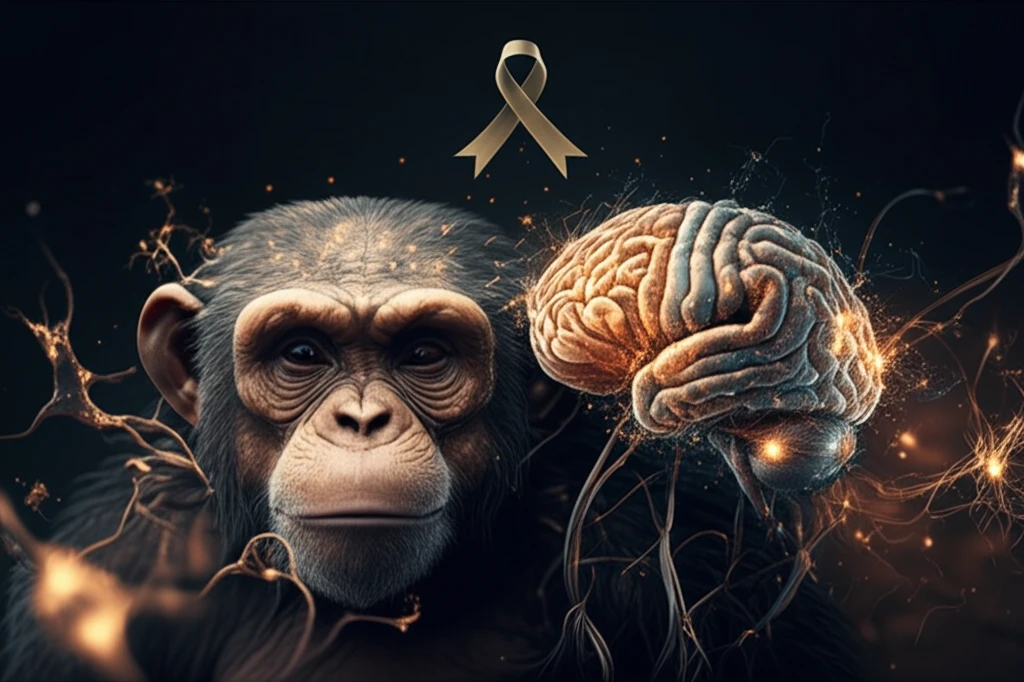
Cracking the Aging Code: What Chimpanzee Brains Reveal About Alzheimer's

"New research explores how astrocytes in chimpanzee brains respond to aging and Alzheimer's-like pathology, offering surprising clues for human treatments"
Alzheimer's disease (AD) remains one of the most formidable challenges in modern medicine. As the global population ages, the prevalence of AD continues to rise, placing immense strain on healthcare systems and affecting millions of lives. While extensive research has been dedicated to understanding the mechanisms of AD, effective treatments and preventative strategies remain elusive.
Astrocytes, the most abundant glial cells in the brain, play a crucial role in maintaining the central nervous system's (CNS) health. These cells are involved in everything from ion and water balance to neurotransmitter regulation and synaptic modulation. However, in the context of AD, astrocytes can become reactive, leading to a state known as astrogliosis, marked by increased expression of glial fibrillary acidic protein (GFAP) and cellular hypertrophy. Understanding how astrocytes behave in aging and AD is critical for developing targeted therapies.
To shed light on these complex processes, a recent study investigated astrocytic changes in aging chimpanzees, our closest living relatives. Chimpanzees, like humans, can develop AD-type pathology, including amyloid plaques and neurofibrillary tangles, making them a valuable model for studying the disease. By comparing astrocytic changes in chimpanzees and humans, researchers hope to uncover unique insights that could lead to new therapeutic strategies for AD.
A Landmark Look Inside Aging Chimp Brains
In a landmark study, Raghanti and her colleagues examined 20 brains from older chimpanzees ranging in age from 37 to 62, focusing on the neocortex and hippocampus, the regions most susceptible to Alzheimer's in humans. The findings mark the first time Alzheimer's-like signs have been detected in chimp brains, which is significant because chimpanzees are our closest living relatives. By contrast, early-onset Alzheimer's, which appears before age 65, affects only a very small number of people with the disease.
How Scientists Search for Alzheimer's Hallmarks
The standard approach in this research was to analyze the neocortex and hippocampus of aged chimp brains for the pathologic hallmarks known to mark Alzheimer's in humans. Researchers reported that aged chimpanzees develop brain characteristics that are similar, but not identical, to those seen in early Alzheimer's disease in humans. That distinction highlights a key limitation of the method: what holds true in humans may appear in a related but not identical form in our closest relatives.
Chimps Become the First Animals Found With AD Markers
Reported on August 1 in the journal Neurobiology of Aging, the work established chimpanzees as the first animal species shown to develop telltale markers of Alzheimer's disease. The discovery built on decades of work establishing the hallmarks that define Alzheimer's pathology in human brains. Finding those same hallmarks in our closest living relatives represents a foundational milestone in understanding the disease's biological origins.
Astrocytes in Aging Chimpanzees: A Unique Perspective
The study, conducted by Munger et al. (2019), examined the brains of 27 chimpanzees, ranging in age from 12 to 62 years. The researchers focused on specific brain regions, including the hippocampus (HC), mid-temporal gyrus (MTG), and prefrontal cortex (PFC), which are known to be affected by AD in humans. Using stereologic methods, they quantified GFAP-immunoreactive astrocyte density and soma volume in different cortical layers and hippocampal fields.
- GFAP expression does not increase with age in chimpanzees.
- Chimpanzee layer I astrocytes in the PFC are susceptible to AD-like changes, similar to humans.
- Astrogliosis in chimpanzees is primarily restricted to layer I of the PFC.
- Astrogliosis in the CA1 and CA3 subfields was associated with neuritic cluster density and amyloid plaque volume.
Pathologic Hallmarks Found in Aged Chimp Brains
A new, multi-institution research study found that the brains of aged chimpanzees, our closest living relatives, show pathology similar to the human Alzheimer's disease brain. Investigators analyzed brain regions most vulnerable to Alzheimer's in humans and detected the telltale changes that characterize the disease. Because chimpanzees live long lives, they offer a rare window into how the aging brain accumulates Alzheimer's-like pathology outside of humans.
Similar But Not Identical
Researchers were careful to note that the brain characteristics in aged chimpanzees are similar, but not identical, to those seen in early Alzheimer's disease in humans, meaning the two cannot be treated as the same condition. Genetic complexity adds further nuance: the apolipoprotein E4 allele is present worldwide despite its associations with higher cardiovascular morbidity and accelerated cognitive decline during aging. This complicates any simple comparison between species and warns against overstating how closely chimp pathology mirrors the human disease.
Chimps Versus Humans: Where the Pathology Overlaps
Aged chimpanzees and humans share the brain regions most vulnerable to Alzheimer's, including the neocortex and hippocampus, yet the resulting pathology is similar but not identical between the species. The comparison also matters for understanding human diversity: the APOE4 allele, tied to higher risk of cognitive decline and Alzheimer's, is found worldwide, and early-onset Alzheimer's before age 65 occurs in only a small number of patients. These contrasts help researchers separate universal features of the disease from species- and population-specific ones.
Implications for Human Alzheimer's Treatment
These findings have significant implications for our understanding of AD in humans. By identifying the unique characteristics of astrocytic responses in chimpanzees, researchers can gain valuable insights into the complex interplay between aging, AD-type pathology, and astrocyte activation. This knowledge could pave the way for the development of targeted therapies that modulate astrocytic behavior to mitigate the progression of AD. Further research is needed to fully elucidate the mechanisms underlying these differences and to determine how they can be harnessed to improve human brain health.
Our Closest Relatives Carry the Same Hallmarks
The multi-institution study converges on a striking conclusion: the brains of aged chimpanzees show pathology similar to the human Alzheimer's disease brain, confirming that the disease's hallmarks are not uniquely human. Because chimps are our closest living relatives, their shared pathology suggests the biological processes underlying Alzheimer's run deep in primate evolution. The finding reinforces that lifestyle and prevention matter even as genetic risk persists.
Where the Research Goes From Here
Future work will likely probe why chimpanzees develop markers that resemble but do not fully match human Alzheimer's, and how genes such as APOE4 influence risk across species. Scientists are also deepening research on star-shaped cells called astrocytes, whose role in the nervous system has evolved dramatically over roughly three decades of study and is now linked to aging. Understanding these cellular players may reveal new targets for slowing age-related cognitive decline.
The Wider Landscape of Alzheimer's Care
Alzheimer's care extends well beyond pathology, and a very small number of people with the disease have the early-onset form that strikes before age 65. Depression is common in people who have Alzheimer's, especially in the mild-to-moderate stages, yet mental health care is often overlooked in treatment plans. These systemic gaps make it clear that managing Alzheimer's requires addressing emotional as well as biological needs.
What This Means for People Living With Alzheimer's
For people living with the disease, the chimp findings underscore that Alzheimer's-like changes can take hold over decades of aging, making everyday habits all the more important. How you start your morning can set the tone for the rest of the day, and structured daily routines are promoted to support those living with Alzheimer's. Aerobic exercise is also highlighted as a way to support memory and brain health, offering practical steps in the fight against cognitive decline.