
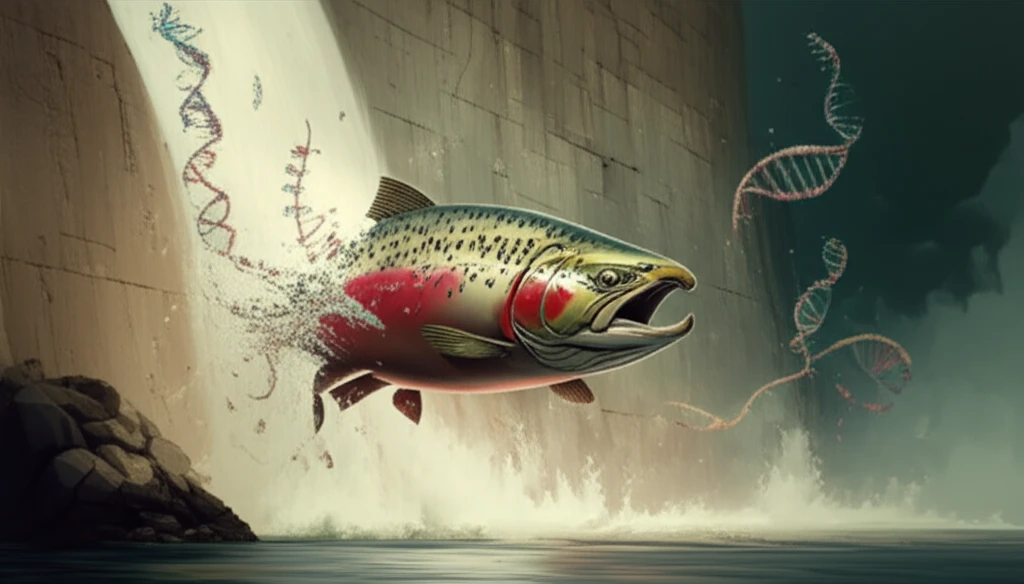
Vanishing Salmon: How Human Actions Erase Genetic Diversity and Threaten Ecosystems

"Discover how habitat destruction leads to rapid genetic loss in wild salmon, jeopardizing their survival and ecosystem resilience."
Phenotypic variation is the bedrock of species survival, enabling populations to adapt to changing environments and resist extinction. This diversity, however, is under siege. Across the globe, human activities are causing dramatic declines in phenotypic variation, leaving many species vulnerable.
A recent study published in PNAS (Proceedings of the National Academy of Sciences) sheds light on this critical issue, focusing on the alarming changes in wild Chinook salmon populations. The research reveals how anthropogenic habitat alteration, particularly dam construction, is leading to a rapid loss of adaptive genetic variation, threatening the long-term viability of these iconic fish.
This article explores the study's findings, highlighting the mechanisms driving this genetic erosion and the potential consequences for salmon populations and the ecosystems they support. Understanding these dynamics is crucial for developing effective conservation strategies to protect biodiversity and ensure the resilience of our natural world.
The Domino Effect: Habitat Change and Genetic Loss
The study meticulously examines how dam construction and other human activities have drastically altered the migration patterns of wild Chinook salmon. Historically, these salmon exhibited two primary migration phenotypes: spring-run and fall-run. Spring-run salmon migrate upstream in the spring, holding in cold-water habitats over the summer before spawning in the fall. Fall-run salmon, in contrast, migrate in the fall, spawning shortly after arriving at their spawning grounds.
- Rapid Genetic Shift: Post-dam construction, a rapid shift in allele frequencies occurred at the critical genetic locus, leading to a decline in spring-run salmon.
- Selection Pressure: Modeling demonstrates that continued selection against the spring-run phenotype could lead to complete loss of the spring-run allele.
- Limited Reservoirs: Empirical analysis reveals that populations that have already lost the spring-run phenotype are not acting as sustainable reservoirs of the allele.
A Call to Action: Protecting Adaptive Variation
This research underscores the urgent need to conserve and restore critical adaptive variation in wild populations. Human-induced phenotypic changes can have far-reaching consequences, leading to the loss of irreplaceable genetic resources and jeopardizing the long-term survival of species. By understanding the mechanisms driving these changes and implementing effective conservation strategies, we can safeguard biodiversity and ensure the resilience of our ecosystems for generations to come.