
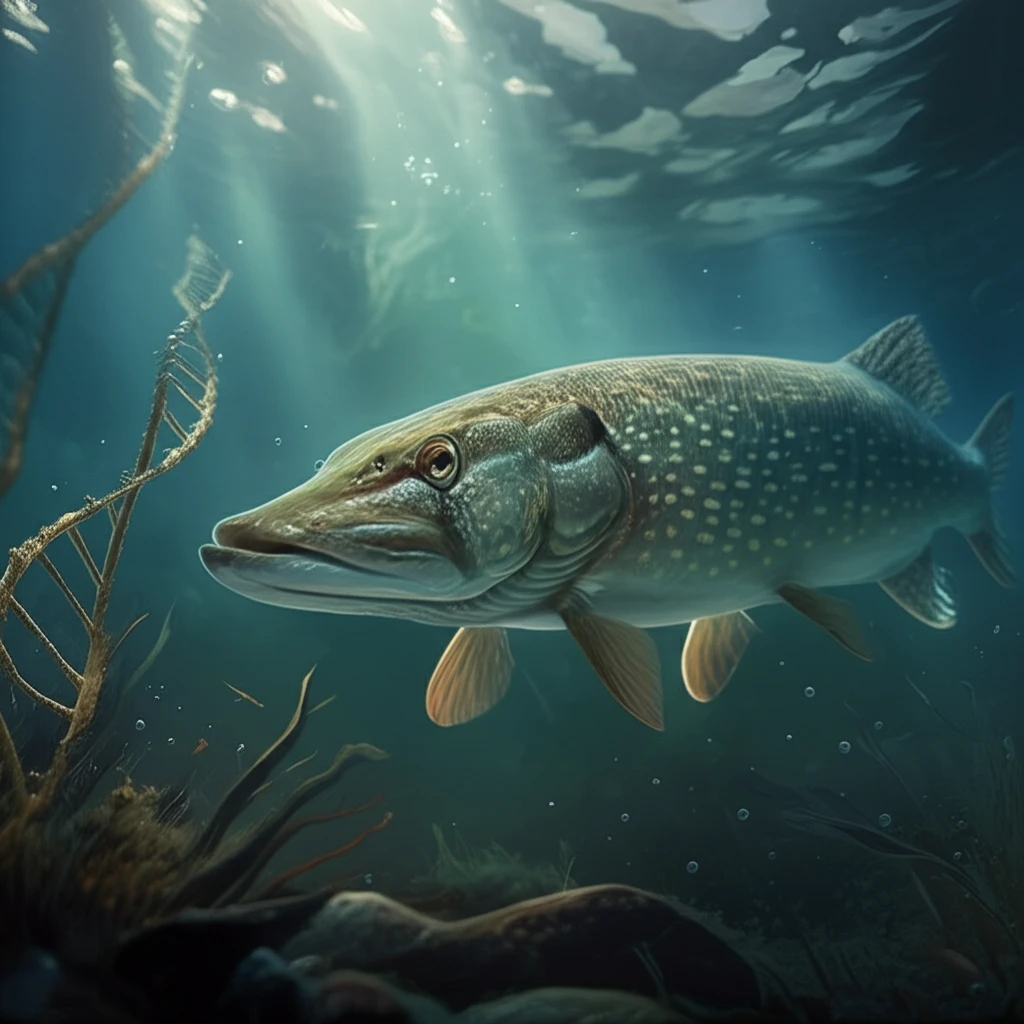
Pike Predicament: Are Fish Stocking Programs Doing More Harm Than Good?

"Uncover the surprising truth about northern pike stocking and its impact on genetic diversity."
For years, fish stocking has been a go-to strategy for boosting wild populations and creating better angling opportunities. But what if this seemingly helpful practice is actually causing more harm than good? A recent study sheds light on the potential downsides of stocking, particularly its impact on the genetic diversity of northern pike (Esox lucius) in a large river system.
The big question is: Does introducing hatchery-raised fish into natural environments lead to genetic changes that threaten the long-term health and resilience of wild populations? The answer is more complex than you might think, involving survival rates, reproduction, and the ability of stocked fish to integrate—or not—with their wild counterparts.
Researchers have been digging into the details, exploring everything from the size of the stocked fish to their degree of domestication, genetic relatedness, and the size of the wild population. Documenting these outcomes is crucial for figuring out whether stocking is a sustainable way to manage fisheries.
A Patchwork of Stocking Records
Stocking programs generate extensive statistical records, but those records are far from uniform. Washington's Department of Fish and Wildlife, for example, documents its stocking through a five-step data-recording procedure that begins when a district fish biologist prepares an annual allotment. At the local level, the Town of Southampton, New York, published its 2024 fish stocking statistics in April 2024, illustrating how record-keeping practices vary by jurisdiction. An Australian case study has meanwhile used historical stocking statistics from Victoria between 1994 and 2015 to ask whether practices meet the 'responsible approach' outlined by Lorenzen et al. (2010). The debate over what such statistics say about sound management persists, and researchers note that no study has yet taken a multi-national view of the governance dimensions behind salmonid stocking success and failure.
Reference Points and Biological Limits
A widely accepted approach for judging whether a fishery is managed sustainably tracks a stock's fishing pressure against its biomass. In a status plot of 15 fish stocks in China's coastal seas, stocks fall into three categories: a red zone where stocks are overfished or outside safe biological limits, a yellow zone for recovering stocks, and a green zone where fishing pressure is sustainable and biomass can produce high yields close to Maximum Sustainable Yield (MSY). The framework shows that reference points such as F/F_MSY and B/B_MSY are central to accepted fisheries assessment methods. Yet the same visualization makes the limitation explicit: only stocks in the green zone are considered healthy, and the source notes that many of China's coastal stocks sit in the red or yellow areas.
A Century of Hatchery Releases
Fish stocking is a long-standing practice defined as releasing hatchery-raised fish into a natural body of water to supplement existing wild populations or create a new population where none previously existed. The practice has been institutionalized at the state level for decades, as reflected in the North Dakota Game and Fish Department's fish stocking history records and in Ohio's stocking history dataset, which documents activities managed by the ODNR Division of Wildlife from 1970 to the present. The long horizon of such programs is also evident in the scientific record: research on Lake Trout (Salvelinus namaycush) supplementation stocking in Quebec counts stocking events going back to 1900 and emphasizes the importance of ecotypes in those efforts. Together, these records show that stocking has been a foundational tool of fisheries management for well over a century.
The Genetic Gamble: Stocking vs. Wild Integrity
A new study focused on a northern pike population in the Lot River in southwestern France to investigate the effects of stocking. For years, this 130 km stretch of river has been receiving about 1 ton of hatchery-raised pike annually. The goal? To enhance recreational angling. However, scientists wanted to know if this influx of stocked fish was messing with the genetic makeup of the native pike.
- Survival of Stocked Individuals: Do the stocked fish survive long enough to reproduce?
- Reproductive Success: Can stocked fish successfully breed with wild fish?
- Size and Domestication: How do the size and domestication of stocked fish affect their ability to thrive in the wild?
- Genetic Relatedness: How closely related are the stocked fish to the wild population?
Timing, Planning, and New Pressures
Recent guidance and research on stocking emphasize careful planning and timing. Pond management expert Darin Hickling highlights that reviewing stocking plans, monitoring water quality, and maintaining a balanced fish population contribute to healthier fisheries over time. On timing, early-spring stocking is recommended because it boosts fish health, improves spawning success, and helps establish a balanced fishery. New challenges are emerging as well: Asian Agribiz reports that Indonesia's prolonged dry season has begun to disrupt fish and shrimp farming, with reduced water availability delaying fish stocking and slowing shrimp growth. At the same time, research on the Murray-Darling Basin continues to examine the impacts of native fish stocking on the region's fish communities.
When Fish Production Systems Fail
Critics of the broader fish supply chain point to recurring handling and food-safety failures as evidence that fish production systems are not always reliable. In commercial catfish farming, post-harvest handling relies on Critical Control Points (CCPs) — steps where a control measure must be applied, because failure to control the hazard could result in consumer harm. Regulatory enforcement underscores the stakes: in a February 2025 warning letter, the U.S. Food and Drug Administration cited Chaohu Daxin Foodstuffs for failing to have and implement a HACCP plan for its fish and fishery products as required under 21 CFR 123.6. Such enforcement actions illustrate that when processing controls fail, the consequences range from regulatory sanctions to potential harm for consumers.
The Value of Side-by-Side Comparison
Systematic comparison is increasingly the standard way that options are weighed, and the same logic applies when evaluating fisheries management choices. General-purpose comparison platforms such as Versus offer side-by-side specifications, filters, and data visualizations across more than 100 categories, while dedicated tools like Cars.com's comparison feature let users compare up to four vehicles on metrics such as MSRP, fuel economy, drivetrain specs, and crash test results. These platforms demonstrate how structured, criteria-based comparison can surface meaningful differences that casual judgment overlooks. Applying the same disciplined, side-by-side framework to fish stocking decisions — species selection, densities, and timing — could make management choices more transparent and data-driven.
Time to Rethink Stocking Strategies?
This research raises important questions about the long-term sustainability of fish stocking programs. While stocking may seem like a quick fix for boosting fish populations and angling opportunities, it can have unintended consequences for the genetic health and resilience of wild populations. More research is needed to fully understand these complex interactions and to develop stocking strategies that balance the needs of both anglers and ecosystems.
The Underground Side of Stocking
Expert commentary on fish stocking increasingly focuses on what managers are failing to control. A review of unauthorized introductions concludes that illegal stocking remains an ongoing problem for fisheries managers, and it analyzes the pathways of nonnative fish introductions in Wyoming, USA, from 1961 to 2017 to understand why these species continue to spread. The findings point to a central tension in the stocking debate: even well-designed official programs operate in an environment where unauthorized releases undermine the very waterbodies managers are trying to protect. The implication, the review suggests, is that controlling the pathways of illegal introductions deserves as much attention as the stocking programs themselves.
Climate, Trade, and Supply Uncertainty
Looking ahead, the supply and stability of fisheries — including the feed stocks that aquaculture depends on — are increasingly uncertain. Analysts of the flame-dried fishmeal market report that fluctuations in global fish stocks driven by climate change and changing oceanic conditions are exacerbating supply uncertainties. Geopolitical tensions and trade barriers add another layer of risk by disrupting export-import flows, leading to price volatility and market fragmentation. For those weighing the future of stocking programs, such pressures could reshape what hatchery-raised fish and their inputs cost and how reliably they can be produced.
Systemic Strains Across Food Systems
Fish stocking is not the only food-production activity wrestling with systemic problems. In Nigeria, the livestock platform Farm Zone explicitly aims to tackle systemic challenges in the livestock sector, working to make purchases 'seamless and stress-free,' particularly during festive seasons when demand peaks. Company officials acknowledge that despite its successes, Farm Zone faces ongoing challenges that require navigating partnerships and building them out. The parallel is instructive: like aquaculture and stocking programs, agricultural supply systems are only as reliable as the logistics, partnerships, and seasonal demand planning behind them.
Warming's Measurable Toll on Fisheries
The real-world stakes of fisheries management are measured in how warming has already reshaped the food that people depend on. A study published in Science examined the impacts of historical warming on marine fisheries production, quantifying how rising ocean temperatures have affected fish populations that coastal communities rely on. Because stocking programs aim to supplement or rebuild such populations, understanding these warming-driven impacts is central to judging whether stocking can offset climate-related losses. The study's findings give the human dimension of the stocking debate a concrete, measurable foundation.