
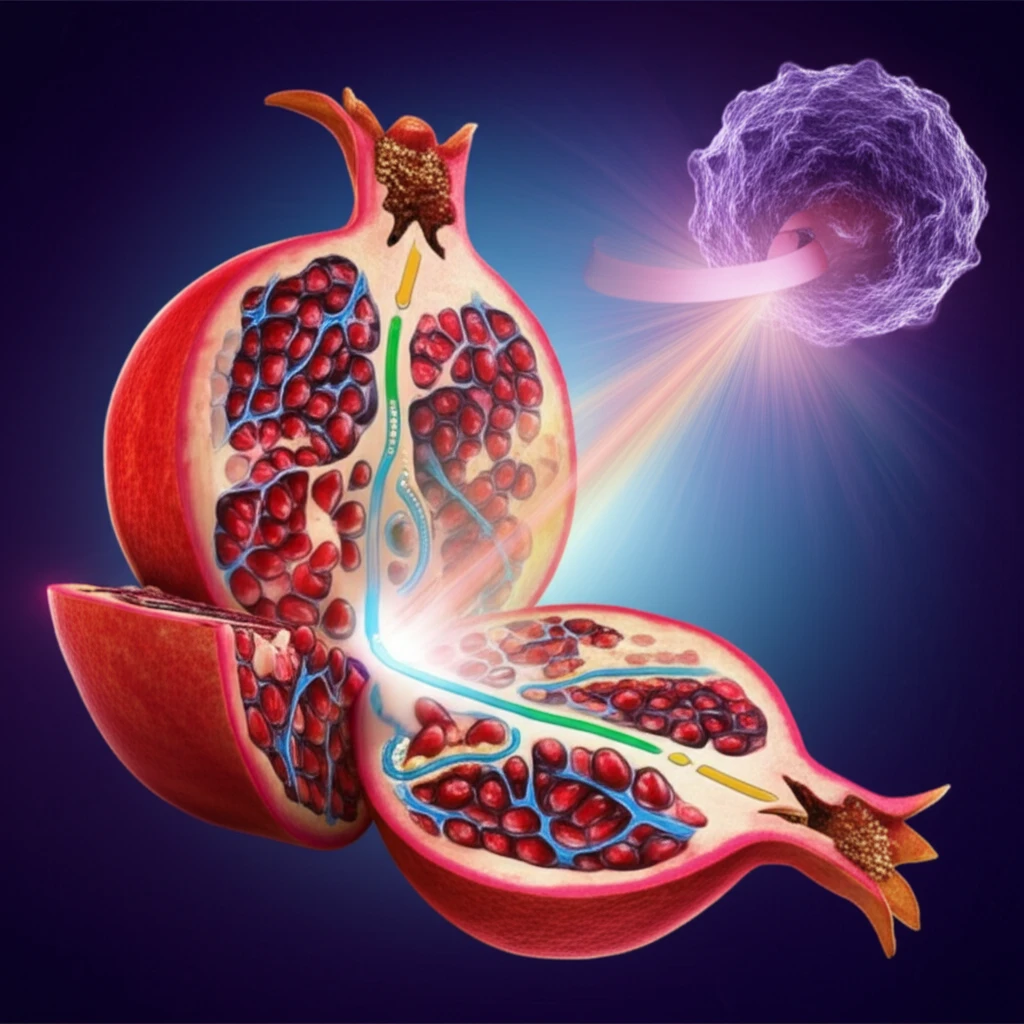
Surreal illustration of a pomegranate unraveling to neutralize pancreatic cancer cells via the PI3K/AKT/mTOR pathway.

Urolithin A: Can This Natural Compound Revolutionize Pancreatic Cancer Treatment?

"Discover how Urolithin A, derived from pomegranates, could offer a new, targeted approach to combating pancreatic cancer by disrupting the PI3K/AKT/mTOR pathway."


Pancreatic cancer, or pancreatic ductal adenocarcinoma (PDAC), continues to be a formidable challenge in oncology. With a five-year survival rate lingering below 9%, it's the third leading cause of cancer-related deaths in the United States. The aggressive nature of PDAC, combined with its resistance to standard treatments, underscores the urgent need for innovative therapeutic strategies. Traditional approaches, including gemcitabine and FOLFIRINOX, often provide limited efficacy and come with significant toxic side effects, emphasizing the necessity for more targeted and less harmful interventions.

In response to these challenges, the scientific community has increasingly turned its attention to natural compounds, celebrated for their low cost, high bioavailability, and minimal toxicity compared to synthetic drugs. These compounds often possess intrinsic antioxidant, anti-inflammatory, and antitumor properties. Notably, several FDA-approved anticancer agents are derived from naturally occurring substances, highlighting the potential of nature in cancer treatment. Epidemiological studies have even suggested a correlation between the consumption of berries and a reduced incidence of PDAC, sparking interest in the bioactive compounds found in these foods.

One such compound, Urolithin A (Uro A), a metabolite of ellagitannins found in pomegranates, has emerged as a promising candidate. Uro A exhibits potent antioxidant and anti-inflammatory properties, suggesting it could play a significant role in cancer prevention and treatment. Unlike its precursor, ellagic acid, Uro A is well-absorbed and tolerated, making it an attractive therapeutic option. Recent research has focused on Uro A's ability to target key signaling pathways involved in cancer development, particularly the PI3K/AKT/mTOR pathway, which is crucial for cell growth and survival. This article explores the potential of Uro A as a novel agent in the fight against pancreatic cancer, detailing its mechanisms of action and the latest findings from preclinical studies.

How Urolithin A Targets the PI3K/AKT/mTOR Pathway in Pancreatic Cancer

Surreal illustration of a pomegranate unraveling to neutralize pancreatic cancer cells via the PI3K/AKT/mTOR pathway.

The PI3K/AKT/mTOR pathway is a critical regulator of cell growth, proliferation, and survival. In many cancers, this pathway is hyperactivated, driving uncontrolled cell growth and resistance to cell death. The original study highlights Urolithin A's ability to disrupt this pathway, effectively targeting the core mechanisms that fuel pancreatic cancer progression. Researchers demonstrated that Uro A could simultaneously inhibit multiple points within this pathway, preventing the cancer cells from bypassing the treatment through alternative routes.

Specifically, Uro A blocks the phosphorylation of AKT and p70S6K, two key proteins in the PI3K/AKT/mTOR pathway. Phosphorylation is a crucial step in activating these proteins, and by preventing this, Uro A effectively shuts down their function. This action has several downstream effects, including reducing cell proliferation, increasing apoptosis (programmed cell death), and inhibiting the growth of tumor xenografts. These findings suggest that Uro A could be a potent agent in slowing or even reversing the growth of pancreatic tumors.

Here are the potential benefits of Urolithin A in pancreatic cancer treatment:
  • Targets Multiple Points: Unlike some therapies that focus on a single target, Uro A impacts several key proteins within the PI3K/AKT/mTOR pathway, enhancing its effectiveness.
  • Reduces Cell Proliferation: By inhibiting the PI3K/AKT/mTOR pathway, Uro A can slow down the rapid division of cancer cells, curbing tumor growth.
  • Increases Apoptosis: Uro A promotes programmed cell death in cancer cells, helping to eliminate them from the body.
  • Inhibits Tumor Growth: Studies have shown that Uro A can significantly reduce the size of pancreatic tumors in preclinical models.
To validate these findings, researchers used both in vitro (cell-based) and in vivo (animal) models. In vitro studies showed that Uro A could effectively block the phosphorylation of AKT and p70S6K in pancreatic cancer cells. In vivo studies, using genetically engineered mouse models, demonstrated that Uro A treatment led to a significant reduction in tumor growth and improved overall survival. These consistent results across different experimental models reinforce the potential of Uro A as a viable therapeutic agent.

The Future of Urolithin A in Pancreatic Cancer Therapy

The research supporting Urolithin A as a potential treatment for pancreatic cancer is compelling. Its ability to target key signaling pathways, reduce tumor growth, and improve survival rates in preclinical models offers a promising outlook. Moreover, Uro A's natural origin and good tolerability make it an attractive candidate for further investigation. As research continues, Urolithin A may become a valuable addition to the arsenal of treatments for this challenging disease, providing new hope for patients and their families. Further studies are needed to fully understand its potential and how it can best be integrated into clinical practice. The future looks bright for this natural compound in the fight against pancreatic cancer.

About this Article -

This article was crafted using a human-AI hybrid and collaborative approach. AI assisted our team with initial drafting, research insights, identifying key questions, and image generation. Our human editors guided topic selection, defined the angle, structured the content, ensured factual accuracy and relevance, refined the tone, and conducted thorough editing to deliver helpful, high-quality information.See our About page for more information.

Everything You Need To Know

1

What is Urolithin A, and where does it come from?

Urolithin A (Uro A) is a natural compound derived from pomegranates. It's a metabolite of ellagitannins found in these fruits. Unlike its precursor, ellagic acid, Uro A is well-absorbed and tolerated, making it a promising candidate for therapeutic applications.

2

How does Urolithin A target the PI3K/AKT/mTOR pathway in pancreatic cancer?

Urolithin A disrupts the PI3K/AKT/mTOR pathway by inhibiting the phosphorylation of key proteins, specifically AKT and p70S6K. These proteins are crucial for cell growth and survival. By blocking their activation, Uro A effectively shuts down the pathway, reducing cell proliferation, increasing apoptosis (programmed cell death), and inhibiting tumor growth.

3

What are the benefits of using Urolithin A in pancreatic cancer treatment compared to traditional methods like gemcitabine and FOLFIRINOX?

Traditional treatments such as gemcitabine and FOLFIRINOX often have limited efficacy and significant toxic side effects. Urolithin A offers a potentially safer and more targeted approach. It is a natural compound, with higher bioavailability, minimal toxicity, and it targets multiple points within the PI3K/AKT/mTOR pathway. It reduces cell proliferation, increases apoptosis, and inhibits tumor growth, providing an alternative with possibly fewer adverse effects.

4

Can you explain the significance of the PI3K/AKT/mTOR pathway in the context of pancreatic cancer?

The PI3K/AKT/mTOR pathway is a critical regulator of cell growth, proliferation, and survival. In many cancers, including pancreatic cancer (PDAC), this pathway is hyperactivated, driving uncontrolled cell growth and resistance to cell death. By targeting this pathway, Urolithin A aims to disrupt the core mechanisms that fuel pancreatic cancer progression, potentially slowing or reversing tumor growth.

5

What do the in vitro and in vivo studies suggest about the potential of Urolithin A in treating pancreatic cancer, and what are the next steps in research?

In vitro studies showed that Urolithin A effectively blocks the phosphorylation of AKT and p70S6K in pancreatic cancer cells. In vivo studies, using genetically engineered mouse models, demonstrated a significant reduction in tumor growth and improved overall survival. These consistent results across different experimental models reinforce Urolithin A's potential as a viable therapeutic agent. Further studies are needed to fully understand its potential and how it can best be integrated into clinical practice. This includes further research, which could lead to Urolithin A becoming a valuable addition to the arsenal of treatments for pancreatic cancer.

Newsletter Subscribe

Subscribe to get the latest articles and insights directly in your inbox.