
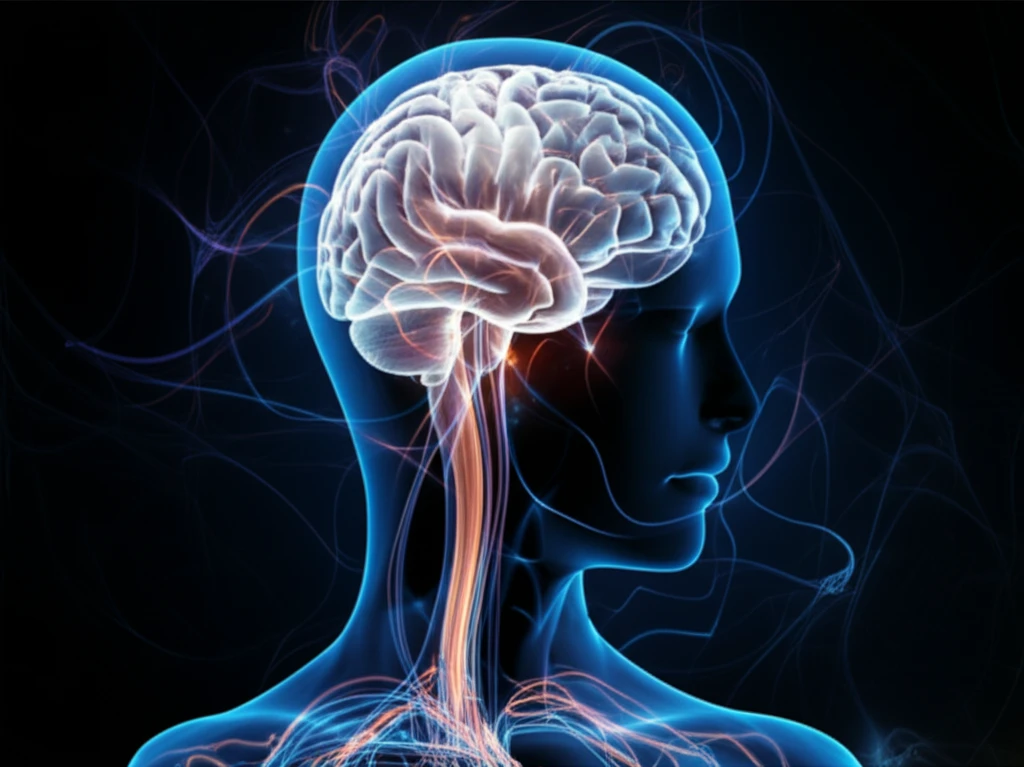
Brain-body connection illustration: Interconnected pathways symbolize optimized function and enhanced performance.

Unlocking Your Brain's Potential: How Mental Training Shapes Brain-Body Coordination

"New research reveals the surprising link between cognitive tasks and bodily activity, offering insights into optimizing brain function and physical performance through targeted training."


Our brains are not isolated computers but are intricately connected to our bodies, forming a dynamic system where mental and physical activities constantly influence each other. This connection is evident in how our heart rate variability (HRV) responds to different cognitive challenges.

A recent study delved into this brain-body relationship by examining how HRV changes during tasks requiring different levels of cognitive processing. Researchers compared HRV in mathematicians performing tasks involving both familiar, everyday language and more complex mathematical terms.

Heart rate variability, measured by sample entropy (SampEn), reveals the complexity and adaptability of the autonomic nervous system. Higher SampEn indicates greater variability and complexity, suggesting a more flexible and responsive system capable of handling diverse demands. The study aimed to uncover how HRV differs between early-formed and later-formed behaviors and under what conditions HRV would be higher, shedding light on the intricate interplay between brain activity and bodily functions.

Decoding HRV: A Window into Brain-Body Coordination

Brain-body connection illustration: Interconnected pathways symbolize optimized function and enhanced performance.

The study involved 35 mathematicians who completed two tasks: one using sentences with common, everyday words (representing early-formed behavior) and another using sentences with mathematical terms (representing later-formed behavior). Researchers recorded ECG data to analyze HRV and calculate SampEn.

The key finding was that SampEn was significantly higher during the mathematical test performance compared to the test with commonly used words. This indicates that performing more complex cognitive tasks requires greater brain-body coordination and adaptability.

  • Cognitive Load and HRV: Higher cognitive demands lead to increased complexity in HRV.
  • Brain-Body Interplay: The body's activity reflects and supports the brain's cognitive processes.
  • Functional Systems: Behaviors are supported by integrated neuronal and bodily systems.
These results suggest that the complexity of HRV can serve as an indicator of the cognitive effort and the level of brain-body coordination required for different tasks. By understanding how HRV responds to various cognitive demands, we can gain insights into optimizing training and improving both mental acuity and physical performance.

Practical Applications: Optimizing Your Brain-Body System

The study's findings highlight the potential for targeted mental training to enhance brain-body coordination. By engaging in activities that challenge our cognitive abilities, we can improve the flexibility and adaptability of our autonomic nervous system, leading to better overall performance.

Consider incorporating activities that demand focused attention and problem-solving, such as learning a new skill, playing strategic games, or engaging in complex tasks. These activities can help increase the complexity of your HRV, indicating improved brain-body coordination.

Ultimately, recognizing the intricate link between our brains and bodies opens new avenues for optimizing our mental and physical well-being. By understanding and leveraging this connection, we can unlock our full potential and enhance our ability to thrive in a complex world.

About this Article -

This article was crafted using a human-AI hybrid and collaborative approach. AI assisted our team with initial drafting, research insights, identifying key questions, and image generation. Our human editors guided topic selection, defined the angle, structured the content, ensured factual accuracy and relevance, refined the tone, and conducted thorough editing to deliver helpful, high-quality information.See our About page for more information.

Everything You Need To Know

1

What was the key finding regarding heart rate variability (HRV) during different cognitive tasks in the study?

The study found that Sample Entropy (SampEn), a measure of heart rate variability (HRV), was significantly higher when mathematicians engaged in tasks using mathematical terms compared to tasks using common, everyday words. This suggests that more complex cognitive tasks demand greater brain-body coordination and adaptability, reflected in the increased complexity of HRV.

2

How does Sample Entropy (SampEn) relate to brain-body coordination and cognitive function, according to the research?

Heart rate variability (HRV), specifically measured by Sample Entropy (SampEn), indicates the complexity and adaptability of the autonomic nervous system. A higher SampEn suggests greater variability, indicating a more flexible and responsive system that can handle diverse cognitive demands. This metric serves as a window into the interplay between brain activity and bodily functions.

3

Based on the findings, how can we optimize our brain-body system through targeted mental training?

By challenging our cognitive abilities through targeted mental training, we can enhance the flexibility and adaptability of our autonomic nervous system, as indicated by changes in heart rate variability (HRV). This, in turn, leads to improved brain-body coordination and better overall performance in both mental and physical tasks. Further research into specific mental exercises could unlock even greater benefits.

4

How does cognitive load affect heart rate variability (HRV), and what does this imply about the brain-body interplay?

The study showed a direct relationship between cognitive load and heart rate variability (HRV), measured by Sample Entropy (SampEn). When the mathematicians tackled tasks with higher cognitive demands, such as those involving mathematical terms, their HRV increased. This demonstrates that the body's activity actively reflects and supports the brain's cognitive processes, highlighting the importance of the brain-body interplay.

5

What are the broader implications of the research on brain-body coordination for understanding behavior and improving performance?

The study's key implication is that behaviors are supported by integrated neuronal and bodily systems. Specifically, cognitive tasks, especially those involving later-formed behaviors such as mathematical reasoning, require greater brain-body coordination. This coordination is reflected in increased heart rate variability (HRV). Understanding and optimizing this interplay can potentially lead to targeted interventions for improving both mental and physical performance. Further studies could explore the role of other physiological markers in brain-body coordination.

Newsletter Subscribe

Subscribe to get the latest articles and insights directly in your inbox.