
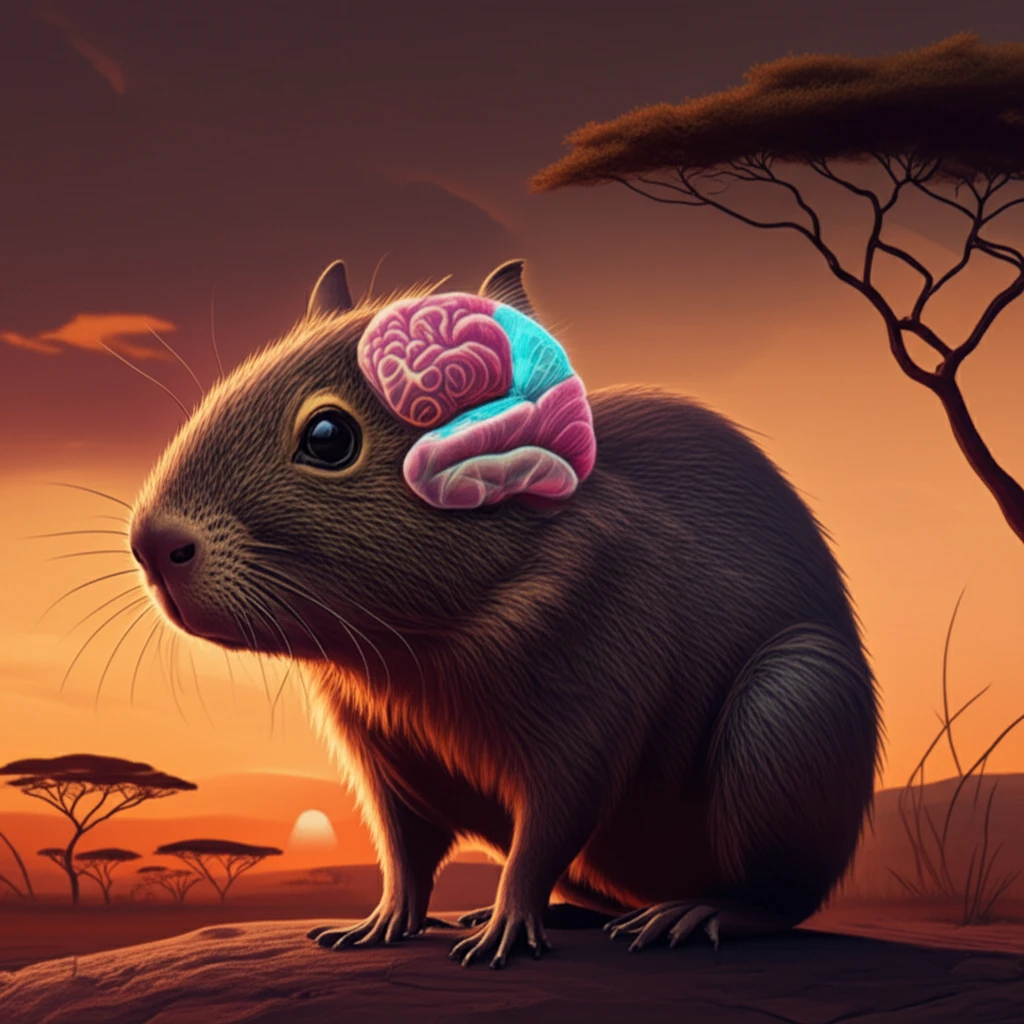
Illustration of a grasscutter brain highlighting the cerebellum lobes

Unlocking the Secrets of the Grasscutter Brain: What Cerebellar Lobes Reveal About Behavior

"New research explores the intricate brain structure of African grasscutters, offering surprising insights into their movement, coordination, and evolutionary adaptations."


The African grasscutter, also known as the greater cane rat, is one of Africa's largest rodents. These fascinating creatures are known for their unique behaviors, including foraging in groups, creating trails, and even standing upright to sense danger. But beneath the surface lies an intricate brain structure that holds clues to understanding their capabilities.

Recent research has focused on the cerebellum, a critical part of the brain responsible for coordinating posture, movement, and balance. While the basic cerebellar folding pattern of grasscutters has remained largely undocumented, a new study aims to provide valuable reference data on the morphometry of its cerebellar cortex.

By analyzing the lobulation patterns – the specific arrangement and size of lobes – within the grasscutter's cerebellum, scientists hope to uncover correlations between brain structure and behavior. This could shed light on how these animals have adapted to their environment and developed specialized skills for survival.

Decoding the Grasscutter Cerebellum: What the Lobes Tell Us

Illustration of a grasscutter brain highlighting the cerebellum lobes

The study, published in the Nigerian Veterinary Journal, involved a detailed quantitative analysis of the cerebella from seven African grasscutters. Researchers carefully measured various aspects of the cerebellum, including the size of different lobules (smaller subdivisions within the lobes), internal and external perimeters, and the overall cerebellar foliation index – a measure of how folded the cerebellum is.

Key findings from the research highlight significant relationships between specific cerebellar lobules and various aspects of the grasscutter's biology:

  • Head Weight and Cerebellar Size: A strong positive correlation was found between head weight and cerebellar weight, indicating that larger heads tend to house larger cerebella.
  • Rostral Lobe Variations: The size of the declive (a specific lobule in the rostral lobe) was significantly larger than other lobules in the same region, suggesting its importance in motor control.
  • Lobus Caudalis Peculiarities: The folium vermis, located in the lobus caudalis, was significantly larger than the tuber vermis and nodulus, implying its role in sensory integration and potentially visual-spatial awareness.
  • Foliation Index: The mean cerebellar foliation index was 2.86, suggesting a relatively increased length of the cerebellum due to its folded structure. This increased surface area allows for more complex processing.
These findings provide a baseline for understanding the functional significance of different cerebellar lobules in grasscutters. The variations in size and arrangement likely reflect the specific demands placed on these animals by their environment and lifestyle.

Implications and Future Directions

This research opens new avenues for exploring the link between brain structure and behavior in grasscutters. By understanding how the size and arrangement of cerebellar lobules correlate with specific skills and adaptations, we can gain deeper insights into the neural mechanisms underlying their survival. Future studies could investigate the genetic factors influencing cerebellar development and explore how these structures change in response to different environmental challenges. Further research with larger sample sizes are needed to add information on foliation patterns in this species and genetic analysis of the earliest stages of foliation may reveal how each lobule develops such that some lobules expand while others contract in size.

About this Article -

This article was crafted using a human-AI hybrid and collaborative approach. AI assisted our team with initial drafting, research insights, identifying key questions, and image generation. Our human editors guided topic selection, defined the angle, structured the content, ensured factual accuracy and relevance, refined the tone, and conducted thorough editing to deliver helpful, high-quality information.See our About page for more information.

This article is based on research published under:

DOI-LINK: 10.4314/nvj.v39i1.8, Alternate LINK

Title: Lobulation Pattern Of The Of The Cerebellum Of African Grasscutter (≪I≫Thryonomys Swinderianus≪/I≫)

Subject: General Medicine

Journal: Nigerian Veterinary Journal

Publisher: African Journals Online (AJOL)

Authors: B Obadiah, T Dzenda, N Wanmi

Published: 2018-10-23

Everything You Need To Know

1

What is the cerebellum, and why is it important in the context of African grasscutters?

The cerebellum is a crucial part of the brain that coordinates posture, movement, and balance. In African grasscutters, the cerebellum's structure, including the size and arrangement of its lobes, provides valuable insights into their behaviors and survival strategies. This area of the brain is critical for the complex motor skills grasscutters exhibit, such as foraging and trail creation.

2

What does the study reveal about the relationship between head weight and cerebellar size?

The research found a positive correlation between head weight and cerebellar weight. This suggests that larger heads, housing larger brains, might be associated with more complex motor control capabilities in the African grasscutters. The size of the cerebellum is an indicator of the extent of processing power it has to handle movement, coordination, and balance, all essential for their survival.

3

What is the significance of the declive in the rostral lobe?

The declive, a specific lobule in the rostral lobe, was found to be significantly larger than other lobules in the same region. This indicates that the declive plays a crucial role in motor control within the grasscutter. This is significant because it implies that the declive's size may be directly related to the animal's motor skills and its ability to navigate its environment effectively.

4

What does the size difference between the folium vermis and other lobules in the lobus caudalis suggest about the African grasscutter?

The folium vermis, located in the lobus caudalis, was significantly larger than the tuber vermis and nodulus. This implies the folium vermis's role in sensory integration and potentially visual-spatial awareness in the African grasscutter. This difference suggests that the grasscutters rely heavily on sensory input for navigating and interacting with their environment, which affects their survival.

5

What is the implication of the cerebellar foliation index in grasscutters?

The mean cerebellar foliation index was 2.86. A higher foliation index suggests a more folded cerebellum, which means the cerebellum has an increased surface area. This increased surface area allows for more complex processing in the cerebellum. This in turn enables the grasscutter to refine its motor skills and sensory integration.

Newsletter Subscribe

Subscribe to get the latest articles and insights directly in your inbox.