
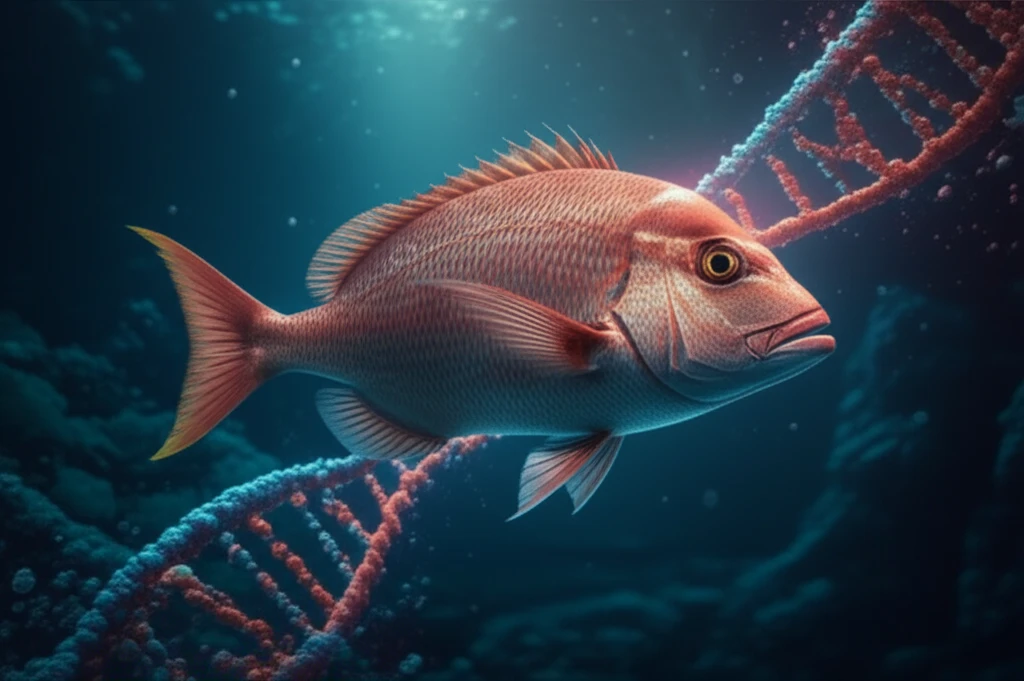
Unlocking the Secrets of the Crimson Snapper: How New Genetic Markers Can Help Restore Fish Populations

"Scientists identify key genetic markers to track and protect the iconic Crimson Snapper, offering new hope for sustainable fisheries."
The Crimson Snapper (Lutjanus erythropterus), a vibrant and economically important fish, faces increasing threats from overfishing and environmental changes in the West Pacific and Indian Oceans. This decline has prompted large-scale hatchery release programs in China since the 1990s, aimed at replenishing dwindling wild populations.
However, a significant challenge has been the inability to differentiate between released, captive-bred individuals and their wild counterparts. Without a reliable method for distinguishing these groups, assessing the true impact and effectiveness of restocking efforts becomes nearly impossible.
To address this critical gap, a new study has identified and characterized 22 polymorphic microsatellite loci—specific DNA markers—in L. erythropterus. These markers offer a powerful tool for distinguishing released fish from wild populations, enabling more effective monitoring and management strategies.
Crimson Snapper at a Crossroads
The crimson snapper (Lutjanus erythropterus) is an economically important marine fish found throughout tropical and subtropical waters of the Indo-Pacific region. While specific global population statistics remain limited, overexploitation has seriously declined stocks in key fishing regions over recent decades. The species supports both commercial and recreational fisheries, with harvest occurring across a wide geographic range from the western Pacific to the Indian Ocean.
Traditional Genetic Tools and Their Constraints
Traditional microsatellite marker development relied on cloning and Sanger sequencing of individual clones, a labor-intensive and costly process. The 'Seq to SSR' approach streamlined development of 84 new microsatellite markers for red snapper by using direct sequencing of genomic libraries, saving significant laboratory effort. Microsatellite loci have shown potential for distinguishing wild and hatchery-bred crimson snapper, which is critical for managing restocking programs in Southeast Asian fisheries. Next-generation sequencing technologies are now being incorporated into genetic management of snapper species, moving beyond the limitations of older methods.
Building a Genetic Foundation
Early genetic research on crimson snapper has established baseline understanding of population structure and phylogenetic relationships. DNA barcoding studies have contributed to differentiating snapper species and clarifying evolutionary lineages. These foundational efforts have laid groundwork for more advanced genomic analyses that continue to refine our understanding of this commercially important fish group.
Microsatellites: Genetic Fingerprints for Fish
Microsatellites are short, repeating sequences of DNA that vary in length between individuals. These variations act like genetic fingerprints, allowing scientists to identify and track specific fish or populations. The research team constructed a microsatellite-enriched genomic library from Crimson Snapper samples collected off the coast of Sanya, China.
- Extracting DNA from fish tissue.
- Digesting the DNA with a restriction enzyme (Msel).
- Ligating the DNA fragments to adapters.
- Amplifying the fragments using adapter-specific primers.
- Hybridizing the products with a biotin-labeled (GT)13 probe to isolate GT-rich DNA fragments.
- Cloning and sequencing the positive clones to identify microsatellite repeats.
Genomic Breakthroughs in Crimson Snapper Research
In 2023, researchers determined the first high-quality chromosome-level genome assembly of crimson snapper using high-throughput Single-Tube Long Fragment Reads sequencing and Hi-C data, with 95.84% of assembled bases mapped to 24 chromosomes. Studies of the opsin gene family have revealed insights into species differentiation mechanisms in snappers, building on earlier phylogenetic work using DNA barcodes. Microsatellite loci development has advanced significantly, with polymorphic markers now available for crimson snapper population studies. Recent work has also applied genetic techniques to museum specimens of snapper species, with implications for food identification and consumer protection.
Challenges in Genetic Management
Despite advances in genomic resources, significant challenges remain in applying genetic tools to crimson snapper conservation. Stock assessments remain unavailable for many crimson snapper biological stocks, limiting the practical application of genetic findings to management decisions. The complexity of population structure across the species' wide Indo-Pacific range presents ongoing difficulties for establishing clear genetic boundaries between stocks. Integration of genetic data with traditional fisheries management approaches continues to require refinement.
Snapper Genetics in Broader Context
Genetic approaches developed for crimson snapper share common methodologies with those used for related species, including red snapper (Lutjanus campechanus) in the Gulf of Mexico. While crimson snapper genomic resources are expanding, the number of available genome assemblies within the Lutjanidae family remains limited for comparative and functional studies. Different snapper species present unique challenges related to their geographic distribution and population structure, requiring tailored genetic approaches.
The Future of Crimson Snapper Conservation
The 22 newly identified microsatellite loci represent a significant advancement in the toolkit for managing Crimson Snapper populations. With an average of 4.32 alleles per locus, these markers provide sufficient variability to differentiate between individuals and populations. Observed and expected heterozygosities ranged from 0.065 to 0.867 and from 0.085 to 0.832, respectively, indicating a good level of genetic diversity.
Integrating Genetics with Fisheries Science
Weighted Gene Co-Expression Network Analysis has been applied to identify genetic regulatory mechanisms underlying pigmentation and body-color variation in crimson snapper during early development. Population genetic structure studies using mitochondrial DNA control region sequences have examined genetic differentiation of crimson snapper across East Asia. These combined approaches provide theoretical basis for improving body color in farmed fish and supporting genetic breeding programs in aquaculture.
Emerging Technologies for Conservation
Combining otolith chemistry with genetic markers offers a more holistic approach to understanding fish populations across different environmental and oceanographic gradients. Genomic prediction methods are being applied to growth traits in commercially important snapper species, leveraging chromosome-scale genome assemblies. Genetic tagging techniques are developing tools to track population dynamics of red snapper species across their ranges. These integrated approaches promise to enhance our ability to manage and restore snapper populations in the face of environmental change.
Enabling Future Conservation Through Genomics
The chromosome-level genome assembly of crimson snapper represents a significant milestone for Lutjanidae genomics, providing resources to support aquaculture genetic breeding programs. These genomic data enable future studies on conservation and management of crimson snapper populations. High-quality reference genomes are essential tools for understanding adaptive variation and supporting sustainable aquaculture practices. The availability of such resources positions crimson snapper research to address broader challenges in marine fisheries conservation.
From Science to Fisheries Management
Crimson snapper are primarily caught by line in both commercial and recreational fisheries, with the majority of harvest occurring within the Great Barrier Reef Marine Park in Australian waters. Research on biological stock structure has identified a single genetic stock across northern Australian waters, including the Timor Sea, Arafura Sea, and Gulf of Carpentaria. However, no comprehensive stock assessment of crimson snapper is available across its biological stock, highlighting the need for genetic tools to inform management decisions. These findings demonstrate how genetic research can directly support sustainable fisheries practices.
While some loci showed deviations from Hardy-Weinberg equilibrium and evidence of null alleles, the overall panel of markers provides a valuable resource for:
Distinguishing released captive-bred L. erythropterus individuals from wild individuals.<li>Assessing the genetic diversity and structure of Crimson Snapper populations.</li><li>Monitoring the effectiveness of restocking programs.</li><li>Informing sustainable fisheries management practices.</li>These genetic markers will empower scientists and conservationists to make informed decisions, ultimately contributing to the long-term health and sustainability of Crimson Snapper populations in the region.