
Unlocking the Mysteries of Bonefish: How Larval Dispersal Shapes Coastal Management

"Dive into the groundbreaking research revealing the hidden connections between bonefish populations and what it means for the future of marine conservation."
Most marine species have a dispersive pelagic larval stage, where larvae are transported by ocean currents. The distance these larvae are carried can vary greatly, impacting the genetic makeup and resilience of fish populations. For species like bonefish, which have a long planktonic larval duration (PLD), understanding these dispersal patterns is crucial for effective conservation.
Fisheries management often operates on a local scale, assuming that fish stocks are isolated units. However, this approach overlooks the potential for regional connectivity, particularly for species with prolonged larval stages. Bonefish (Albula vulpes), is economically important and is a prime example of a species where larval dispersal plays a significant role in population dynamics.
Recent research has shed light on bonefish biology, revealing that adults occupy small home ranges and undertake long-distance migrations to spawning locations. This new information underscores the importance of understanding how larvae disperse and connect different populations, which has important implications for fisheries management and conservation strategies.
The Coastal Game Fish That Runs Deep
Bonefish are coastal game fish renowned for their speed, wariness, and their propensity to tail in the shallows. They get their name from their plentiful and dense bones, which make plucking the meat quite painstaking. A shocking discovery showed that while these fish live near the shore, they dive deep to spawn far from the flats where anglers pursue them.
The Old Assumption of Open-Ocean Mixing
For years, marine scientists widely presumed that extensive larval dispersal and a high degree of planktonic cohort mixing kept larvae well mixed across the ocean. This view held that larvae of marine species are dispersed by currents, which creates the challenge of finding their adult habitats. Such assumptions made it hard to explain why related fish might be found clustered together rather than scattered.
From Dusk Gatherings to Deep-Water Spawning
Before spawning, bonefish form large schools near the coast at dusk, a long-observed behavior that gave researchers their first window into their reproductive cycle. A pivotal milestone came when Bonefish & Tarpon Trust scientists successfully located and documented a bonefish pre-spawning aggregation (PSA) in the Florida Keys. The foundational discovery that these shore-dwelling fish actually dive deep to spawn reshaped how scientists think about bonefish life history.
Mapping the Routes: A Larval Dispersal Study
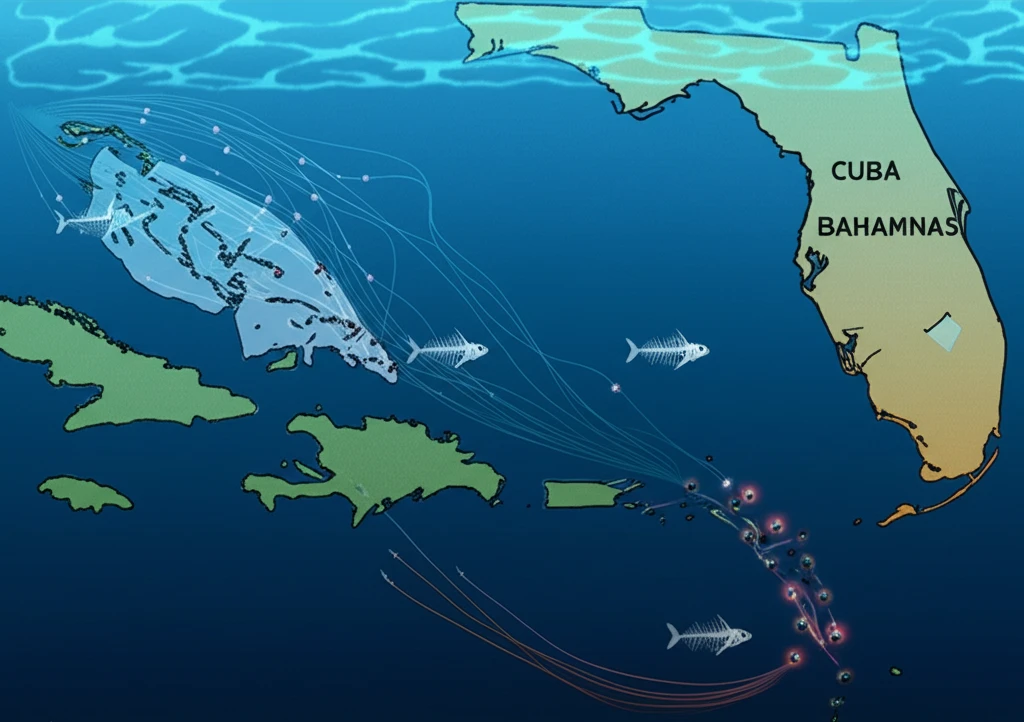
To address the knowledge gap surrounding bonefish larval dispersal, researchers conducted a comprehensive study using advanced modeling techniques. The study focused on simulating the surface trajectories of particles, representing virtual larvae, released from 26 known and predicted spawning sites around the Caribbean Sea, Florida, and the Bahamas.
- Release of 100 surface particles at each site twice per month (at full and new moons) from October to April each year.
- Tracking the particles for 53 days, representing the average planktonic larval duration for bonefish.
- Estimating the likelihood that management regions would rely upon larval retention versus larval dispersal from other management zones.
Genetic Proof of Caribbean Connectivity
A study launched in 2014 collected genetic samples from bonefish in multiple locations across the Caribbean. The results provided scientific evidence that the bonefish population across the Caribbean is closely connected rather than fragmented into isolated groups. These findings support the argument that bonefish conservation must be coordinated at both local and regional levels.
When the Mixing Model Falls Short
Research into reef fish populations found that limited dispersal actually explains the spatial distribution of siblings in a reef fish population. This result directly undercuts the long-held presumption that extensive larval dispersal and high planktonic cohort mixing disrupt kin aggregations in marine environments. The evidence suggests that larval movement can be far more constrained than standard models assumed.
Dispersal, Compared: Bonefish and Sandfish
The sandfish (Holothuria scabra) offers a useful contrast: aside from limited larval dispersal, there are several additional reasons its stocks are well-suited to being managed through a network of locally managed marine areas (LMMAs) in southern Manus. Where sandfish stay close to home, bonefish show broad connectivity across the Caribbean. These different dispersal patterns point to very different scales of management, from village-scale closures to international cooperation.
Implications for Conservation and Management
The study's findings emphasize the need to incorporate the likelihood of population connectivity into fisheries management and conservation strategies. It also highlights the importance of ensuring that the ontogenetic habitat requirements of bonefish are properly managed at a regional scale. By understanding how larvae disperse and connect different populations, managers can make more informed decisions about habitat protection, fishing regulations, and other conservation measures.
Why Connectivity Demands Wider Conservation
Scientists and advocates emphasize that bonefish and tarpon connectivity is essential for conservation at both local and regional levels. Educational materials from Bonefish & Tarpon Trust tell the story of how connectivity affects local and regional scale fisheries management decisions. The takeaway is that protecting the flats alone is not enough when fish move across borders to spawn.
Tracking the Aggregations
The documented discovery of a bonefish pre-spawning aggregation in the Florida Keys is described as an encouraging finding for bringing back bonefish in those waters. Locating these aggregations opens the door to protecting spawning fish at the moment they gather. Future research can build on this by tracing exactly how larvae from such aggregations disperse to restock distant flats.
Managing a Fish That Crosses Borders
Because larvae are dispersed by currents and must find their adult habitats, a bonefish stock's survival depends on conditions far beyond any single bay or flat. The genetic evidence that Caribbean bonefish form one closely connected population means no single nation can fully manage the fishery alone. This is a systemic challenge that requires regional coordination, not just local action.
A Prize That Links People and Policy
Bonefish are prized by anglers for their speed, wariness, and their propensity to tail, making them a cornerstone of flats fishing across the tropics. Their dense, plentiful bones make the meat painstaking to pick, so their real value is often recreational rather than culinary. Protecting them therefore means safeguarding a fishery and the coastal livelihoods and traditions built around the chase.