
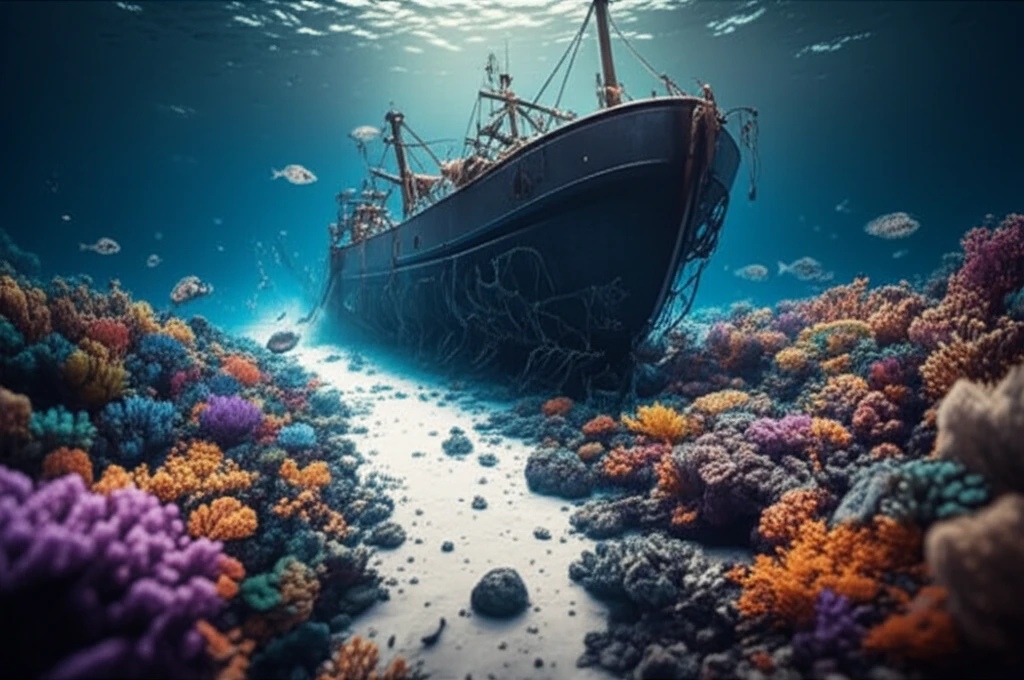
Deep-Sea Trawling: Why It's Time to Ban This Destructive Fishing Method

"The controversial practice of deep-sea trawling faces renewed scrutiny as experts call for stricter regulations to protect marine ecosystems and ensure sustainable fishing."
Deep-sea trawling, a fishing method that involves dragging heavy equipment across the ocean floor, is one of the most destructive practices in the world. While favored by the fishing industry for its efficiency, it indiscriminately destroys marine habitats and leaves a trail of devastation in its wake.
The European Union (EU) is scheduled to vote on a proposed ban on deep-sea bottom trawling. This decision marks a pivotal moment for marine conservation, building upon existing prohibitions in shallower waters. A ban could offer a chance for marine ecosystems to recover.
However, intense lobbying against the ban is underway by a fishing industry with close ties to governments and research organizations. These groups have even threatened legal action against scientists who publish data critical of the industry. As the EU Fisheries Committee, which includes members from countries with significant deep-sea fishing interests, deliberates, it's crucial to understand the facts and challenge misleading claims.
A Damage Footprint That Is Hard to Quantify
Reliable figures on the current scale of deep-sea trawling and its ecological toll remain difficult to pin down, since much of the activity occurs beyond routine monitoring and reporting. Estimates of swept area, bycatch volume, and habitat impact vary widely depending on the region, gear type, and survey method. What is clearer is the direction of the evidence: deep-sea bottom trawling is consistently associated with severe seabed disturbance and loss of vulnerable species. Precise, internationally comparable statistics, however, are still limited.
Gear, Ground Truthing, and Gaps in the Evidence
The standard way to study deep-sea trawling impact combines catch reporting, vessel monitoring, and seabed surveys of disturbed versus undisturbed areas. Each method has known limitations: catch logs under-record bycatch, acoustic and camera surveys cover only small patches of seafloor, and satellite tracks reveal where nets are towed but not what they damage. As a result, accepted assessments tend to be regional and conservative. These methodological constraints mean that the full scale of impact is likely understated rather than overstated in the literature.
Six Centuries of Recognized Damage, From 1376 to the Albatross
Trawling has been recognized as a profoundly damaging practice with lasting negative consequences for seabed ecology and marine life since its first mention in a 1376 parliamentary petition. Bottom trawling developed from the older practice of fishing with a net or long lines, but that earlier style was more controlled and discriminate in its catch, whereas trawl nets were weighted to keep them low along the seafloor. Early deep-sea science mapped these environments: of the 6,000 deep-sea soundings tabulated by Sir John Murray in the early 1900s, more than 800 were observed from the vessel Albatross, whose scientists took water samples and serial temperatures across the eastern Atlantic, Caribbean Sea, and Pacific Ocean. Modern assessments find bottom trawling removes vast amounts of non-target species, including habitat-forming deep-sea corals and sponges, yet the true extent of deep-sea fishery catches through history remains unknown.
Unmasking the 'Truths': Why Deep-Sea Trawling Claims Fall Flat
The fishing lobby has launched a campaign using the phrase 'the inconvenient truth' to promote their agenda. These pamphlets suggest that a lighter version of trawling equipment can minimize damage, target species are not being depleted, and non-target catch consists of abundant species. However, these claims do not withstand scrutiny.
- Claim: Deep-sea fish stocks are sustainable. Reality: Assessments rely on biased industry data from ten index species, ignoring the broader ecosystem impact. Vessels avoid areas without fish, skewing abundance data.
- Claim: By-catch is minimal. Reality: Trawls targeting a few species catch over 100 non-target species. The decline of the non-commercial Baird's slick-head, a common by-catch species, demonstrates the problem.
- Claim: The French deep-sea fishing sector is sustainable and important. Reality: The sector relies on substantial subsidies and has suffered significant financial losses despite this support. It employs a small fraction of the French fishing fleet.
An Active and Evolving Research Front
Current research on deep-sea trawling is moving quickly, with new studies regularly revising earlier assumptions about where impacts occur and how severe they are. Review papers increasingly emphasize the difficulty of measuring damage in remote, hard-to-reach habitats where baseline data are scarce. Work is also beginning to connect trawling damage to broader questions, such as carbon storage and the fate of long-lived species. The overall trend in the recent literature points toward greater, not lesser, concern about the practice.
Bycatch Harm and the Push to End Seamount Trawling
Assessing impacts is genuinely hard: understanding the severity of bottom trawling effects on vulnerable marine ecosystems, particularly in hard-to-reach deep-sea environments, is challenging because knowledge of VME distribution and habitat requirements is limited. Despite that uncertainty, the available scientific evidence demonstrates that bottom trawling on seamounts causes Significant Adverse Impacts as defined under the FAO Deep-Sea Fisheries Guidelines. The Deep Sea Conservation Coalition has urged governments to commit to a phased transition away from bottom trawling on seamount ecosystems by 2027 and to refrain from authorizing new seamount bottom trawl fisheries. The gear is inherently indiscriminate, producing bycatch of juvenile fish, marine mammals like dolphins, whales, and porpoises, sea turtles, seabirds, non-commercial fish species, sharks, and rays.
Certification, Coalition Pressure, and the Seamount Milestone
Bottom, or demersal, trawling is defined by the Marine Stewardship Council as a method using towed nets to catch fish and other species living on or close to the seabed, covering several gear types built around a cone-like net with a closed end (cod-end) that holds the catch. The Deep Sea Conservation Coalition takes the opposing view, driving action to protect the ocean depths from bottom trawling, as well as from fishing, geoengineering, and mining. That sustained pressure reached an institutional milestone when the IUCN World Conservation Congress adopted Motion 032 signaling determination to end bottom trawling on deep-sea seamounts. Seamounts, the motion notes, are biodiversity hotspots and vital feeding grounds sustaining ocean life from deep-sea corals and sponges to migratory whales, sharks, and turtles — ecosystems with decades of industrial trawling history.
A Call to Action: Protecting Our Deep-Sea Ecosystems
The EU's upcoming vote on the deep-sea bottom trawling ban is more than just a regional decision; it carries global implications for ocean conservation. If passed, it would set a powerful precedent, encouraging other nations to adopt similar measures and prioritize the health of our oceans.
Refugia at Risk, Carbon Disturbed, and a Case for the Mediterranean Ban
A study of New Zealand finds bottom trawling significantly impacts benthic ecosystems, including deep-sea habitats, and that spatial protection measures remain insufficient to preserve the essential habitats of VME indicator taxa under climate change — meaning bottom trawling undermines the viability of climate refugia. Bottom trawling is described as the most widespread anthropogenic disturbance to marine benthic ecosystems, with growing recognition that it can alter sedimentary carbon dynamics and influence ocean–atmosphere CO2 exchange. For the Mediterranean, an Oceana report argues the case for extending the deep-sea trawl ban is both scientifically backed and a climate measure: it targets the depth where most vulnerable marine ecosystems occur, would help recover threatened deep-sea species such as deep-sea sharks and overfished commercial species like deep-water shrimps, and would strengthen the sea's climate resilience.
A Fragile Mercury Sink Under Threat
A study in Nature Sustainability reports that fish trawling and climate perturbations threaten the largest known deep-sea mercury sinks. Intensified trawling and ocean warming could make these sinks unsustainable, potentially reintroducing legacy mercury into marine ecosystems and accelerating the mercury cycle in the twenty-first century. The findings highlight the urgent need to reduce anthropogenic mercury and greenhouse gas emissions. They also make the case for balancing fishery demand with ecosystem conservation to sustain these critical mercury sinks.
Conservation Momentum That Must Be Sustained
The challenges facing marine ecosystems are significant, but there is hope in the growing global movement for ocean conservation. Progress is visible in the establishment of marine protected areas and in the development of innovative sustainable fishing practices. However, these gains are partial, and the momentum must continue and strengthen if they are to withstand economic and political pressure that favors established destructive methods.
Coastal Communities and the Cost of Transition
The human dimension of a trawling ban extends well beyond the ocean, touching the coastal communities whose livelihoods depend on fishing. Small-scale and artisanal fishers are widely judged to be at greatest risk from restrictions, though the specific scale of that impact is not yet well documented. The distribution of costs and benefits across different groups is rarely accounted for in public debate. A durable ban would most plausibly need to pair regulation with support for affected communities, but how that would work in practice remains an open question.
It's time for responsible scientists and concerned citizens to speak out against misleading claims and advocate for policies that protect our deep-sea ecosystems. The long-term health of our oceans depends on it.
The time to consign deep-water trawling to history is now. By supporting this ban, we can reverse some of the damage done and safeguard the incredible biodiversity of our deep seas for future generations.