
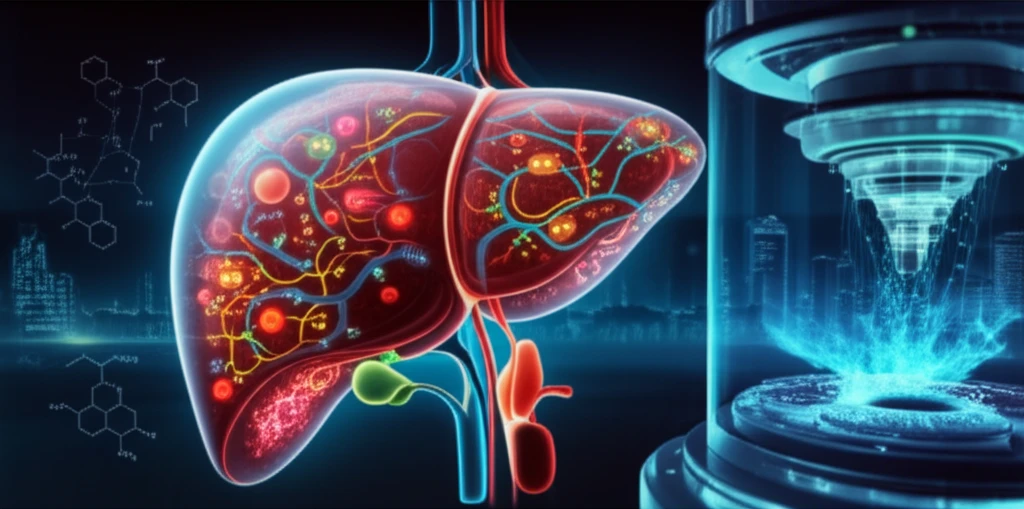
Surreal illustration of a liver cell with glowing metabolic pathways, symbolizing furanyl fentanyl breakdown and its detection via mass spectrometry.

Unlocking the Secrets of Synthetic Opioid Metabolism: How Understanding Furanyl Fentanyl Breakdown Can Save Lives

"A deep dive into how researchers are using advanced techniques to identify the metabolic pathways of synthetic opioids like furanyl fentanyl, offering new hope for detecting and preventing overdoses."


The rise of new psychoactive substances (NPS), particularly synthetic opioids, presents a formidable challenge to forensic and clinical toxicologists. Unlike traditional drugs of abuse, NPS are constantly evolving, with producers tweaking their chemical structures to evade legal controls. This makes it difficult to detect these substances in biological samples, hindering efforts to identify and treat cases of intoxication.

Furanyl fentanyl (Fu-F), a potent synthetic opioid, exemplifies this problem. As a fentanyl derivative, it shares a similar pharmacological profile to its better-known counterpart, but with potentially deadlier consequences. Its rapid emergence and association with numerous overdose deaths have prompted urgent research into its metabolism – how the body breaks it down.

Understanding the metabolic pathways of Fu-F is crucial for improving detection methods. By identifying the metabolites (breakdown products) of Fu-F, scientists can broaden the window of detection in biological samples like blood and urine, even after the parent drug has been metabolized. This article explores cutting-edge research that employs sophisticated techniques to map out the metabolic landscape of Fu-F, offering new insights into combating the opioid crisis.

Decoding Fu-F Metabolism: Why It Matters for Overdose Detection

Surreal illustration of a liver cell with glowing metabolic pathways, symbolizing furanyl fentanyl breakdown and its detection via mass spectrometry.

Researchers are employing innovative methods to dissect the metabolism of Fu-F, focusing on identifying the enzymes responsible for its breakdown and the resulting metabolites. Two primary in vitro (laboratory) approaches are used: human liver microsomes (HLMs) and HepaRG cell lines. HLMs contain a wide array of drug-metabolizing enzymes, while HepaRG cells are a human liver cell line that retains many of the functions of normal liver cells.

By incubating Fu-F with these in vitro systems and using liquid chromatography-high resolution mass spectrometry (LC-HRMS), scientists can identify the metabolites produced. LC-HRMS is a powerful analytical technique that separates and identifies compounds based on their mass and structure, providing a detailed snapshot of the metabolic processes at play.

  • HLMs (Human Liver Microsomes): These are like tiny enzyme factories extracted from human livers. They are packed with CYP enzymes (the main detoxifiers in your liver) and UGT enzymes (which help tag substances for removal). Researchers mix Fu-F with HLMs and track which new chemicals pop up as the enzymes break down the drug.
  • HepaRG Cell Lines: Imagine growing miniature livers in the lab. HepaRG cells are special liver cells that act a lot like real ones. Scientists treat these cells with Fu-F and then analyze what breakdown products the cells create. This method can catch metabolites that HLMs might miss.
  • LC-HRMS (Liquid Chromatography-High Resolution Mass Spectrometry): This fancy tech acts like a super-sensitive detective. It separates all the different chemicals in the sample and then identifies each one by precisely measuring its mass. It is the key tool for spotting even tiny amounts of Fu-F metabolites.
The research identifies several key metabolites of Fu-F, suggesting multiple metabolic pathways including hydroxylation, oxidation, hydrolysis, N-dealkylation and glucuronidation. The study highlights the complementary nature of HLMs and HepaRG cells, with each system producing a unique set of metabolites. This comprehensive approach provides a more complete picture of Fu-F metabolism than either method alone.

From Lab to Life: How These Findings Can Save Lives

The identification of key Fu-F metabolites has significant implications for forensic toxicology and overdose prevention. By incorporating these metabolites into drug screening assays, laboratories can improve the detection of Fu-F use, even when the parent drug is no longer present in detectable concentrations. This is particularly important in postmortem toxicology, where identifying Fu-F as the cause of death can be challenging.

Specifically, the research suggests that dihydrodiol-Fu-F and despropionylfentanyl are reliable metabolites that should be included in HRMS libraries. These compounds are consistently produced in vitro and have been detected in vivo, making them valuable targets for drug screening.

While in vitro studies provide valuable insights, further research is needed to validate these findings in real-world scenarios. Analyzing samples from confirmed Fu-F intoxication cases will help confirm the relevance of these metabolites and refine detection methods. Ultimately, a deeper understanding of Fu-F metabolism will empower healthcare professionals and law enforcement to combat the opioid crisis more effectively.

About this Article -

This article was crafted using a human-AI hybrid and collaborative approach. AI assisted our team with initial drafting, research insights, identifying key questions, and image generation. Our human editors guided topic selection, defined the angle, structured the content, ensured factual accuracy and relevance, refined the tone, and conducted thorough editing to deliver helpful, high-quality information.See our About page for more information.

This article is based on research published under:

DOI-LINK: 10.2174/1389201018666171122124401, Alternate LINK

Title: In Vitro Characterization Of Nps Metabolites Produced By Human Liver Microsomes And The Heparg Cell Line Using Liquid Chromatographyhigh Resolution Mass Spectrometry (Lc-Hrms) Analysis: Application To Furanyl Fentanyl

Subject: Pharmaceutical Science

Journal: Current Pharmaceutical Biotechnology

Publisher: Bentham Science Publishers Ltd.

Authors: Camille Richeval, Thomas Gicquel, Chloe Hugbart, Brendan Le Dare, Delphine Allorge, Isabelle Morel, Jean-Michel Gaulier

Published: 2018-01-24

Everything You Need To Know

1

How does the body break down synthetic opioids like furanyl fentanyl?

The body breaks down furanyl fentanyl (Fu-F) through multiple metabolic pathways, including hydroxylation, oxidation, hydrolysis, N-dealkylation, and glucuronidation. These processes are facilitated by enzymes found primarily in the liver. Understanding these pathways helps identify the metabolites, or breakdown products, which is crucial for detecting Fu-F use, even after the parent drug is metabolized.

2

What methods are scientists using to study how furanyl fentanyl is metabolized?

Scientists use human liver microsomes (HLMs) and HepaRG cell lines to study furanyl fentanyl (Fu-F) metabolism in the lab. HLMs, extracted from human livers, contain drug-metabolizing enzymes like CYP and UGT enzymes. HepaRG cells are human liver cell lines that mimic real liver cells. Both are incubated with Fu-F, and the resulting metabolites are analyzed using liquid chromatography-high resolution mass spectrometry (LC-HRMS).

3

What is liquid chromatography-high resolution mass spectrometry (LC-HRMS) and how is it used in identifying furanyl fentanyl metabolites?

Liquid chromatography-high resolution mass spectrometry (LC-HRMS) is used to identify furanyl fentanyl (Fu-F) metabolites by separating and identifying compounds based on their mass and structure. This technique provides a detailed snapshot of the metabolic processes, allowing scientists to detect even trace amounts of Fu-F metabolites. This is important as it helps in identifying the presence of the drug in biological samples even after the parent drug has been broken down.

4

How can identifying furanyl fentanyl metabolites save lives?

Identifying furanyl fentanyl (Fu-F) metabolites improves drug screening assays, allowing laboratories to detect Fu-F use even when the parent drug is no longer present. This is particularly important in postmortem toxicology, where identifying Fu-F as the cause of death can be challenging. Improved detection methods contribute to better understanding and combating the opioid crisis. Expanding detection windows helps medical professionals and law enforcement address overdose cases more effectively.

5

Why are new psychoactive substances like furanyl fentanyl so difficult to detect, and how does understanding their metabolism help?

New psychoactive substances (NPS), such as synthetic opioids like furanyl fentanyl (Fu-F), pose a challenge because their chemical structures are constantly evolving to evade legal controls and detection. This makes it difficult to identify these substances in biological samples, hindering efforts to treat intoxication cases. Research into the metabolism of drugs like Fu-F aims to counter this by identifying the metabolites, thus broadening the scope and extending the window of detection. Without identifying metabolites, toxicology would be limited to only identifying the parent drug, thus missing a significant window of detection.

Newsletter Subscribe

Subscribe to get the latest articles and insights directly in your inbox.