
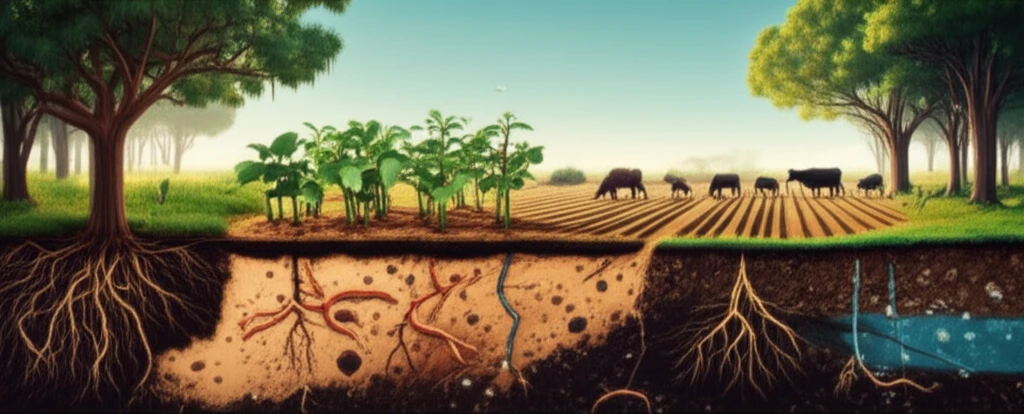
Diverse land management approaches promoting sustainable soil health and agriculture.

Unlocking the Secrets of Soil: How Land Management Impacts Your Food

"Dive into the fascinating world beneath our feet and discover how different farming practices influence soil health, carbon levels, and water infiltration—key factors in sustainable agriculture."


Imagine the ground beneath our feet as more than just dirt; it’s a complex ecosystem teeming with life and essential to our survival. Soil health is the foundation of agriculture, influencing everything from crop yields to the nutritional content of our food. But intensive farming and poor land management practices can degrade this vital resource, leading to erosion, reduced fertility, and environmental problems.

That's why understanding how different land management systems affect soil properties is crucial for developing sustainable agricultural practices. Think of it like this: a thriving, healthy soil is like a well-balanced diet for plants, providing them with the nutrients and water they need to flourish. On the other hand, degraded soil is like a junk food diet, leaving plants weak and vulnerable.

In a recent study, researchers investigated the impact of various land uses on the hydro-physical properties and organic carbon content of a yellow oxysol, a common soil type in Brazil. By comparing untouched natural areas with eucalyptus plantations and different farming systems, they uncovered valuable insights into how we can better manage our land to ensure healthy soils and sustainable agriculture.

The Great Soil Showdown: Comparing Land Management Systems

Diverse land management approaches promoting sustainable soil health and agriculture.

The study focused on the Triângulo Mineiro region of Brazil, a major agricultural area, and compared four different land management systems:

Let’s break down how these systems stack up:

  • Untouched Cerrado: A pristine area with native vegetation, untouched for over 30 years, serving as the ideal benchmark. Think of it as the “control group” in a scientific experiment.
  • Eucalyptus Plantation: Planted 30 years ago without fertilizers or cultivation, this system represents a low-intervention approach. It's like letting nature take its course with minimal human interference.
  • No-Till Corn: Corn grown using no-tillage methods, intercropped with pasture. This system aims to balance crop production with soil conservation. It's like a hybrid approach, combining the benefits of farming with sustainable practices.
  • No-Till Brachiaria Pasture: Brachiaria grass intercropped with corn, managed with cattle and fertilized annually with turkey litter. This system integrates livestock and crop production. It’s like a multi-faceted approach, combining different agricultural elements.
Researchers analyzed various soil properties, including:

What Does This Mean for Your Plate?

The choices we make about land management have a direct impact on the food we eat. By adopting sustainable practices that prioritize soil health, we can ensure a more resilient and productive agricultural system. So, the next time you're at the grocery store or farmers market, remember that the quality of your food starts with the soil beneath our feet.

About this Article -

This article was crafted using a human-AI hybrid and collaborative approach. AI assisted our team with initial drafting, research insights, identifying key questions, and image generation. Our human editors guided topic selection, defined the angle, structured the content, ensured factual accuracy and relevance, refined the tone, and conducted thorough editing to deliver helpful, high-quality information.See our About page for more information.

Everything You Need To Know

1

What is the significance of soil health in the context of sustainable agriculture and food production?

Soil health is the cornerstone of both sustainable agriculture and food production. A healthy soil acts as a well-balanced diet for plants, providing essential nutrients and water necessary for flourishing. This, in turn, influences crop yields and the nutritional value of the food we consume. Conversely, degraded soil, often a result of poor land management, functions similarly to a junk food diet for plants, leading to weakened crops and reduced yields, thereby impacting agricultural sustainability and the quality of food available.

2

How did the study in the Triângulo Mineiro region of Brazil investigate the impact of land management systems on soil properties?

The study in Brazil focused on comparing the effects of different land management systems on soil properties. The researchers examined a yellow oxysol, a common soil type in the region, comparing: Untouched Cerrado (pristine area with native vegetation), Eucalyptus Plantations (planted without fertilizers or cultivation), No-Till Corn (intercropped with pasture), and No-Till Brachiaria Pasture (intercropped with corn, managed with cattle and fertilized). They analyzed hydro-physical properties and organic carbon content of the soil, to understand how each system affects soil health and the overall sustainability of agriculture.

3

What are the key differences between the land management systems studied, specifically the Untouched Cerrado, Eucalyptus Plantation, and No-Till Corn?

The Untouched Cerrado represented a control, offering a benchmark of natural conditions without human interference, showcasing native vegetation untouched for over 30 years. The Eucalyptus Plantation, a low-intervention approach, was established 30 years prior without fertilizers or cultivation. In contrast, No-Till Corn employed no-tillage methods, intercropped with pasture, representing a blend of crop production and soil conservation. These systems allowed researchers to contrast the impacts of minimal intervention (Eucalyptus) versus conservation-focused farming (No-Till Corn) compared to undisturbed natural environments (Untouched Cerrado).

4

What is the role of no-till farming practices, and how do they contribute to soil health compared to traditional methods?

No-till farming practices, as seen in the study with No-Till Corn and No-Till Brachiaria Pasture, aim to minimize soil disturbance, which is a key element in preserving soil health. These methods involve planting crops without plowing or tilling the soil. The reduced disturbance helps to retain soil structure, prevent erosion, and increase organic matter content. Compared to traditional tilling, no-till farming can significantly enhance water infiltration, carbon sequestration, and the overall health of the soil, fostering a more sustainable and resilient agricultural system. By not disturbing the soil, the natural ecosystem of the soil is preserved.

5

How can understanding land management practices impact the quality of the food we eat?

The choices in land management practices directly influence the quality of food. Sustainable practices, like those found in No-Till Corn or the management of No-Till Brachiaria Pasture, that prioritize soil health are essential for a productive agricultural system. These practices affect the nutritional content of crops and reduce the likelihood of soil degradation. When the soil is managed sustainably, crops can thrive, leading to more nutritious food. Therefore, consumers who support practices that improve soil health contribute to a more sustainable agricultural model and better food quality, as the quality of food starts from the ground up.

Newsletter Subscribe

Subscribe to get the latest articles and insights directly in your inbox.