
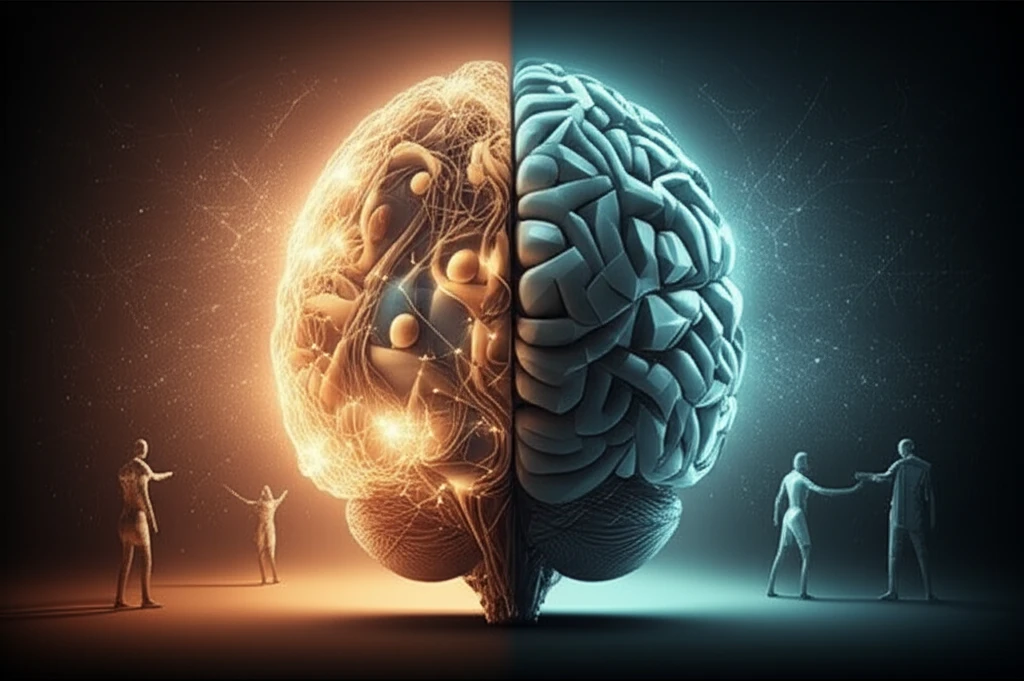
Unlocking the Secrets of Human Behavior: How Our Brains Decide Between Kindness and Control

"Groundbreaking research reveals the psychological forces that shape our choices, from cooperation to punishment."
Imagine a world where understanding human behavior was as simple as flipping a switch. What if we could pinpoint the exact triggers that make us kind, cooperative, or, conversely, inclined to punish and exert control? For years, economists have theorized that our choices are based on consistent preferences, but a revolutionary study challenges this view, unveiling the complex interplay of motives that shape our actions.
This research, published in Scientific Reports, dives deep into the psychological forces that drive our economic and social behaviors. It explores how two distinct motives – 'Care' and 'Power' – can influence our decisions in different ways. Using innovative experiments, scientists have uncovered how these hidden drivers shape our tendencies toward cooperation and punishment.
This article will explore the core findings of the study, breaking down the complex science into easily digestible insights. We'll examine how the 'Care' motive promotes cooperation, while the 'Power' motive encourages behaviors related to punishment and control. Prepare to gain a fresh perspective on why we make the choices we do, and how our brains are wired for both kindness and dominance.
Psychology Data and Measurable Impact
Current psychology research is supported by resources for locating open-source and reusable datasets, including UCLA's Psychology research guide. Recent reports from WorldMetrics describe their coverage as verified 2026 psychology statistics and research data. ZipDo highlights measurable outcomes across therapy, stigma, PTSD, ADHD, memory, and workplace behavior, although the supplied material does not provide specific figures.
Methods and Their Limits
Research on human behavior commonly combines observation, measurement, comparison, and interpretation, but no single method captures every influence on a person's decisions. Findings may depend on the population studied, the setting, and how behavior is defined or measured. These limits make cautious interpretation and replication important, particularly when extending laboratory findings to everyday life.
A Developing Scientific Field
Psychology has developed through changing efforts to explain how people think, feel, and act. Its foundational discoveries have come from multiple traditions, including behavioral observation, cognitive research, and biological investigation. Because explanations of behavior remain subject to revision, historical milestones are best understood as stages in an evolving field rather than final answers.
The Brain's Hidden Drivers: Unpacking Care and Power Motives
The study's lead researchers hypothesized that distinct psychological motives, like 'Care' and 'Power,' play a significant role in our decision-making processes. 'Care,' in this context, represents the motivation to help others and foster connection. 'Power,' on the other hand, reflects the drive to control and influence our surroundings. To investigate these motives, the researchers created specific experimental conditions designed to activate each of these psychological states.
- The Care motive was associated with increased cooperation in economic games.
- The Power motive was linked to increased punishment of norm violations.
- These findings challenge traditional economic assumptions about consistent preferences.
- The research provides insights into how our brains are wired for cooperation and control.
Research in Motion
Recent psychological research continues to examine behavior through diverse methods and perspectives. Reviews and current studies may refine earlier explanations, identify boundary conditions, or expose weaknesses in established conclusions. The supplied material does not identify a specific new review or finding, so broad claims about the latest evidence should remain appropriately cautious.
Limits and Competing Explanations
Accounts of human behavior can fail when they oversimplify complex motivations or assume that findings apply equally across people and settings. Alternative explanations may emphasize learning, context, biology, culture, or measurement limitations. For that reason, apparently persuasive conclusions should be tested against competing interpretations rather than treated as universally predictive.
Learning Across Species and Methods
Comparative psychology studies non-human animal behavior and mental processes to identify similarities and differences that may illuminate human psychology. Its evolutionary foundation rests on shared ancestry, allowing findings from rats, dogs, cats, and other animals to inform human understanding when generalization is made carefully. Comparative work can be combined with cross-cultural comparisons, longitudinal studies, and big-data analysis, each offering distinct advantages and challenges.
A New Understanding of Human Nature
The study's findings have significant implications for our understanding of human behavior. They suggest that our choices are not solely determined by individual preferences but are shaped by the interplay of psychological motives and situational factors. These insights provide valuable lessons for fields such as business, policy, and education, offering innovative ways to promote cooperation, reduce conflict, and build a more equitable world. By recognizing the influence of our 'Care' and 'Power' motives, we can cultivate a deeper understanding of ourselves and create systems that foster positive social change. The research provides a more nuanced picture of human behavior, one that acknowledges our capacity for both kindness and the drive for control.
Integrating Science and Humanity
One recent proposal conceptualizes the psychologist as an expert in both behavior and humanity through a Scientific-Humanistic Complementarity Principle. This view responds to epistemological fragmentation by encouraging scientific analysis alongside broader humanistic interpretation. Behavioral expertise can also be applied in settings such as legal testimony, where psychological factors including memory, motivation, and emotions may be relevant.
Psychology’s Emerging Frontiers
The American Psychological Association identifies 2026 trends including integrated care, AI-driven tools, advocacy, workplace well-being, science communication, and children's mental health. Other commentary points to AI-assisted diagnosis, virtual reality exposure therapy, and growing attention to how social media affects adolescent mental health. Together, these sources portray psychology as a field being reshaped by technology, cultural change, and new approaches to care, while specific outcomes remain a matter for continuing research.
Behavior in Context
Human behavior is shaped by interacting personal, social, institutional, and environmental conditions. Psychological explanations can therefore become incomplete when they focus only on individual choice while overlooking context and unequal systems. A broader analysis should consider how culture, access, incentives, and social structures influence both behavior and the effects of interventions.
Behavioral Psychology in Practice
Case-study accounts describe behavioral psychology as relevant to healthcare, education, business, productivity, well-being, and social interaction. They also present applications in classrooms and workplaces, including social learning theory's role in peer influence and psychological or educational strategies for explaining behavior. These examples suggest that understanding behavior can support practical problem-solving, although case studies illustrate possibilities rather than proving that one intervention will work universally.