
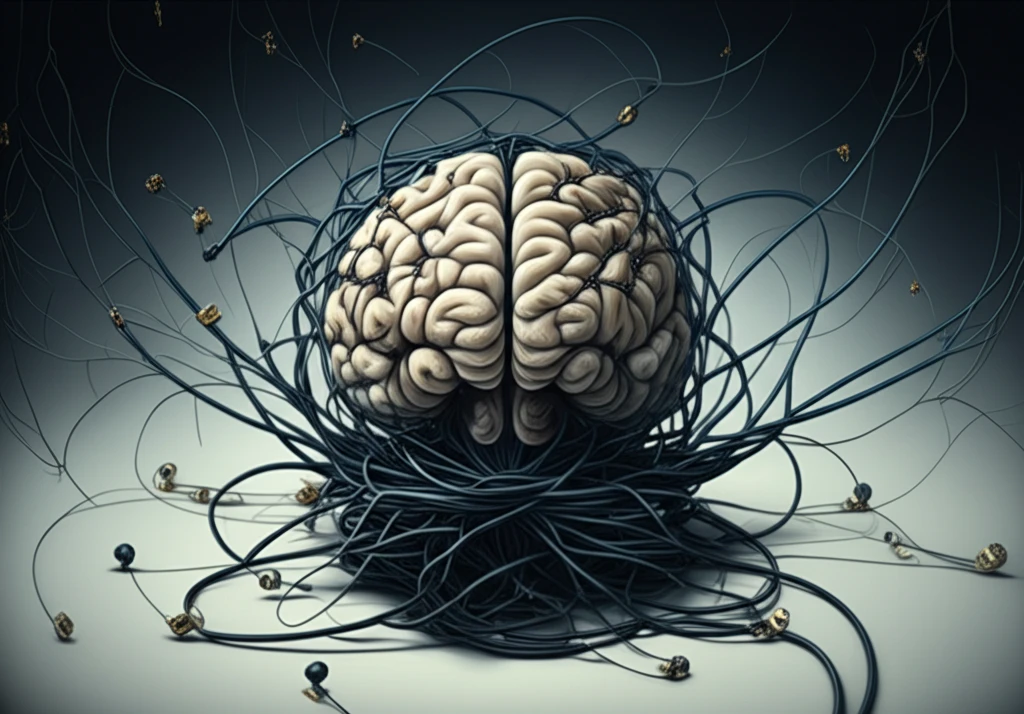
The Hidden Traps of Social Learning: How Networks Can Sabotage Your Smarts

"Discover how information overload and network structures can actually hinder your ability to learn and make informed decisions in today's hyper-connected world."
We live in an era of unprecedented connectivity. Social networks promise to connect us to a wealth of information and diverse perspectives, enabling us to learn and grow at an accelerated pace. Yet, this constant barrage of information can be overwhelming. In a complex web of interconnected individuals, how do we effectively filter and process information to arrive at informed decisions?
The truth is, simply being connected doesn't guarantee better understanding. The structure of our social networks, the way information flows, and the biases inherent in the system can inadvertently create 'smart traps' – situations where our networks actually hinder our learning process. It may feel like we're building collective intelligence, but often we find ourselves trapped in echo chambers or paralyzed by conflicting opinions.
New research has uncovered surprising ways in which social networks can undermine our ability to learn. The core of the issue lies in 'information confounding,' a phenomenon where multiple sources share the same underlying information, leading to a distorted perception of its validity. Understanding these traps is the first step towards building smarter, more effective networks that truly empower us to learn and grow.
A Rising Subject of Inquiry
Reliable statistics on how much of what people learn is shaped by their social networks are still hard to pin down, and much of what circulates in popular discussion draws on early or provisional research. What can be said more cautiously is that evidence and commentary increasingly point to social influence playing a visible role in how knowledge is formed and, at times, distorted. Readers should treat headline claims in this area as emerging findings rather than settled figures.
The Platform-Mediated Status Quo
Wikipedia reports that popular social media platforms with more than 100 million registered users include X, Facebook, WeChat, Instagram, LinkedIn, and several others, indicating that a large share of online social interaction now runs through a relatively small set of dominant services. Official institutions follow a similar model: the Social Security Administration promotes an online account through which users can estimate and manage benefits, request replacement cards, and securely submit forms and documents. These standard digital tools are built for convenience and self-service, which is precisely their appeal. At the same time, Wikipedia's definition of society describes it as the sum total of relationships among members who share culture and institutions, a far richer structure than any single portal can present. Seen this way, the accepted digital approach may systematically narrow the range of relationships people are exposed to, even though the scale of that narrowing remains difficult to measure.
The Original Meaning of Social
Merriam-Webster defines social as marked by or passed in pleasant companionship with friends or associates, grounding the word's history in companionship rather than in abstract information exchange. This foundational definition implies that being social has long been understood primarily as a matter of shared experience and personal connection. Any account of how networks may undermine learning therefore has to contend with this original framing, since the very traits that draw people together are also the channels through which blind spots can travel. Because the pleasant, trusting character of companionship is embedded in the definition itself, the historical lineage suggests the underlying dynamic is not new to digital networks, even if digital formats may accelerate it.
What is Information Confounding, and Why Does It Matter?
Imagine a scenario where you're trying to understand a complex topic. You turn to your social network for insights, consulting multiple friends and contacts. However, unbeknownst to you, many of these individuals are relying on the same original source. This creates a situation where the information appears more widespread and credible than it actually is. This is information confounding in action.
- Distorted Perception of Accuracy: Overestimating the validity of information due to multiple seemingly independent sources.
- Reduced Learning Efficiency: Wasting time and effort on redundant information rather than exploring truly novel perspectives.
- Confirmation Bias Reinforcement: Increasing the likelihood of encountering information that confirms existing beliefs, leading to echo chambers.
- Slower Adaptation to New Information: HInders quick adoption to new information due to being stuck in old patterns.
An Emerging Evidence Base
Research on how social networks shape learning and judgment is ongoing, but the picture remains preliminary and findings are frequently debated. Current studies and reviews tend to agree that people are strongly influenced by the people around them, yet they differ on how much of that influence helps versus harms. Because no single body of results dominates, the most honest framing is that this line of inquiry is maturing rather than settled.
Real but Contested Effects
Not all evidence supports the claim that networks undermine learning, and several counterarguments are regularly raised. Critics note that many failures attributed to social influence may instead reflect individual bias, and they point out that networks can also help correct their members' mistakes. Given genuine disagreement among researchers, the balanced view is that the harm is plausible and documented in some settings but not universally established.
Individual Versus Networked Learning
When individual study is compared with networked or group-based learning, the results vary sharply by context and task. Some comparisons suggest groups can outperform individuals on certain problem-solving tasks, while others find that conformity pressure cancels out those apparent gains. Because outcomes depend heavily on how the comparison is set up, any side-by-side verdict should be read with caution rather than treated as a general law.
Navigating the Network Maze: Strategies for Smarter Learning
While social networks can present challenges to effective learning, they also offer tremendous opportunities. By acknowledging the potential for information confounding and actively employing strategies to overcome it, we can harness the power of networks for genuine knowledge acquisition and informed decision-making. By focusing on promoting critical thinking, seeking diverse perspectives, and actively managing our information consumption, we can transform our networks from 'smart traps' into powerful engines of learning and growth.
A Careful Consensus in the Making
Commentary that attempts to synthesize the evidence generally lands on a measured conclusion: networks are neither uniformly helpful nor uniformly harmful to learning. Experts tend to emphasize context, motivation, and group norms as the decisive variables rather than the medium itself. The cautious takeaway is that social learning carries real, documented trade-offs rather than a single verdict, and the strongest statements about it should be resisted.
Open Questions Ahead
Future research is expected to clarify how network design, platform algorithms, and group size influence the quality of shared learning, though these are projections rather than established findings. Emerging questions include how to detect the point at which cooperation turns into conformity, and how to design interventions that preserve the benefits of collaboration while limiting its risks. Any outlook offered today should be treated as speculative, since the underlying evidence base is still forming.
Beyond the Individual
The hidden traps of social learning do not exist in isolation; they sit inside larger systems of institutions, culture, and shared norms. Systemic factors such as incentive structures, media environments, and unequal access to information can amplify whatever distortions a network introduces. Addressing the problem may therefore require changes at the system level rather than solely at the level of the individual learner, though work in this direction is still early.
What It Means Personally
Behind the research lie ordinary experiences: the confident friend whose claim turns out to be wrong, or the group chat that hardens around a half-truth. These everyday cases give the topic its weight and remind readers that the stakes are personal and practical. Even where the data are imperfect, the daily reality of learning and unlearning within social groups is something most people recognize firsthand.