
Unlocking the Secrets of Crustacean Venom: What Remipedes Can Teach Us

"Dive into the surprising world of remipede venom and discover the novel peptides that could revolutionize bioactivity research."
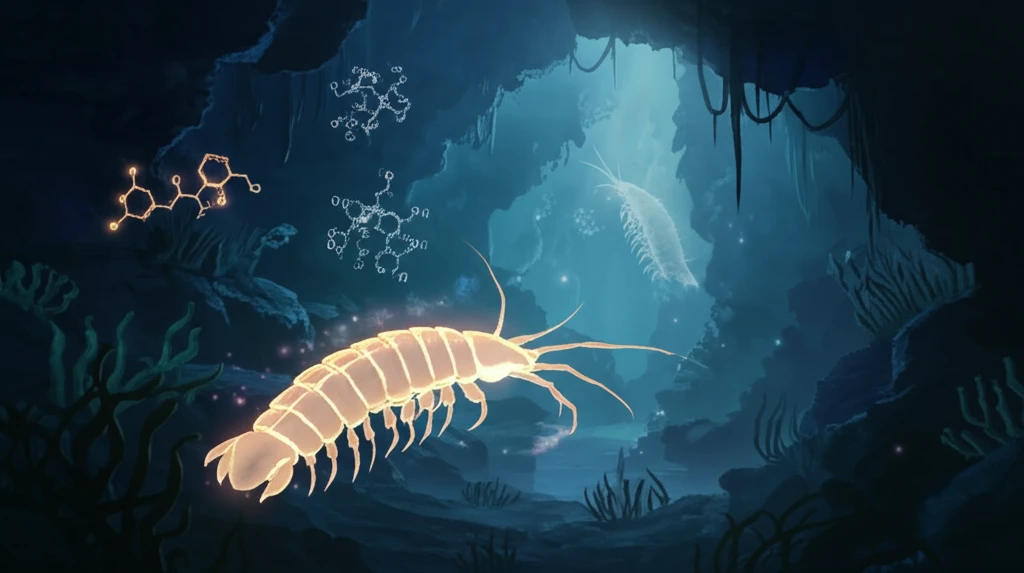
The world of venomous creatures is far more diverse than many realize. While snakes and spiders often come to mind, a lesser-known group, the remipede crustaceans, holds fascinating secrets within their venom. Found exclusively in marine cave systems, these centipede-like predators possess a venom unlike any other, offering scientists a unique opportunity to explore the evolution and potential applications of bioactive compounds.
Remipedes, with only 29 described species, have intrigued zoologists seeking to understand crustacean evolution. Once thought to represent an early diverging lineage, molecular evidence now places them within pancrustaceans, closely related to insects. This revised understanding highlights a unique trait: their sophisticated venom system. Living in oxygen-poor saltwater zones of anchialine caves, remipedes face low prey abundance and competition. To survive, they've evolved a venom that rapidly debilitates their prey, primarily other cave crustaceans.
A recent study published in Toxins journal delves into the venom of Xibalbanus tulumensis, revealing a complex cocktail of proteins and peptides. This research challenges previous assumptions about remipede venom composition and opens new avenues for bioactivity research. Let's explore the key findings and what they could mean for the future of medicine and ecological understanding.
A Venom System Unlike Any Other Crustacean
Nectiopodan remipedes possess a highly developed venom apparatus, making them the only known venomous crustaceans. The system is strikingly sophisticated: one set of muscles contracts the creature's glands to pump venom into its fangs, while a second set stabs the fangs forward and squeezes a duct to prevent the venom from flowing backwards. In its makeup, the venom is more like that of vipers than that of any arthropod cousin, and it includes a neurotoxin that paralyzes victims and is nearly identical to one found in spiders. Together these features mark the remipede as a singular outlier among roughly 70,000 crustacean species.
An Evolutionary Lens on Venom Recruitment
Researchers study remipede venom through an evolutionary venomics lens, treating each component as a recruitment event in the animal's history. Remipede venom components span the full range of evolutionary recruitment frequencies: from families that have been recruited into many animal venoms (such as serine peptidases and inhibitor cysteine knot peptides, or ICKs), to those with a very narrow taxonomic range (double ICKs), to families that appear unique to remipedes. A key limitation is uncertainty about how the venom would behave outside the remipede's own prey, since whether it would have any effect on a curious diver remains unknown.
The 2013 Confirmation That Rewrote the Record Books
Field work that scientists pursued at genuine personal risk culminated in 2013, when a team from the Natural History Museum confirmed the existence of the world's first known venomous crustacean. The creature turned out to be a blind, cave-dwelling remipede that uses its highly toxic venom to liquefy its prey before ingesting the soupy remains. The confirmation overturned long-held assumptions that crustaceans lacked venom systems and opened an entirely new line of inquiry into venom evolution.
A Venomous Cocktail: Peptides and Proteins
The study utilizes transcriptomic and proteomic techniques to analyze the venom of Xibalbanus tulumensis. This integrated approach identifies 32 venom protein families, including 13 novel peptide families named xibalbins. Four of these xibalbins lack similarities to any known structural class, making them particularly intriguing. Proteomic data confirms the presence of 19 of the 32 families in the venom, with serine peptidases, chitinase, and six xibalbins being the most highly expressed components.
Characterizing the Xibalbin Toxins
A multidisciplinary research team led by Dr. Björn von Reumont, who first described the venom system in remipedes in 2014 and is now a guest researcher at Goethe University Frankfurt, has characterized a group of toxins from the Xibalbanus tulumensis remipede. This underwater cave-dwelling crustacean remains the only crustacean for which a venom system has been described. Its venom contains several xibalbin peptides that share an inhibitor cysteine knot (ICK) scaffold, a structural motif familiar from other animal venoms.
Open Questions and Early-Stage Uncertainties
Research on remipede venom is still in its early stages, and much of what is known rests on a small number of species and studies. Findings drawn from limited specimens may not hold across the wider remipede group, and the venom's full biological role is not yet completely understood. As methods improve and more cave systems are explored, some current conclusions may need to be revised.
A Living Comparison Point for Venom Evolution
Because remipedes sit in a distinctive position within the crustacean lineage, their venom offers a natural reference point for comparing how venom systems arise across distantly related groups. Preliminary analyses point to intriguing parallels with the venoms of other animals, but the comparisons are still tentative. Broader sampling across crustacean groups will be needed before firm evolutionary conclusions can be drawn.
Implications and Future Directions
The study's findings necessitate a revision of previous hypotheses that remipede venom is primarily enzyme-based. While chitinase and peptidase S1 enzymes are abundant, the diversity of unique peptides, particularly xibalbins 1-4 and 9-11, showcases the venom's complexity. This discovery aligns remipede venom composition more closely with other predatory arthropods like spiders and scorpions, suggesting a convergent evolutionary pathway. Further research into these novel peptides could reveal valuable insights into their bioactivity, with potential applications in medicine, agriculture, and ecological studies.
A Venom That Mixes Paralytic and Digestive Roles
The remipede's venom contains a mixture of toxins, including a paralyzing agent, and is used to break down the body tissue of its meals before ingestion. Experts note that its venom is similar to that of a rattlesnake, an echo of convergent evolution across vastly different animal groups. The parallels underscore how evolution can arrive at comparable biochemical solutions in creatures separated by hundreds of millions of years.
Frontiers in Venom Genomics and Beyond
Looking ahead, researchers are likely to expand venom studies to other crustacean species and to sequence more remipede genomes to understand how venom genes evolve. The links between remipede venom components and those of spiders and snakes may guide functional studies of individual toxin families. Much of this work is speculative at present, and concrete advances will depend on continued cave exploration and collaboration across disciplines.
Cave-Dwelling Predators in a Fragile Habitat
The Xibalbanus tulumensis remipede lives in the cenotes, the underwater cave systems on the Mexican Yucatan Peninsula, where it injects venom produced in its venom gland directly into its prey. The venom delivers a potent neurotoxin that paralyzes the prey, and researchers note that this species is the only crustacean for which a venom system has been described. Its confinement to delicate cave ecosystems raises broader questions about habitat protection, since the study of such unique biology depends on the survival of these rare environments.
From Cave Venom to Medicine
The venom's promise reaches beyond biology into medicine. Its proteins can disrupt nerve signal transmission involved in pain sensitisation, opening up new approaches to pain treatment. Some components of the remipede venom can also inhibit crucial functions of heart muscle cells, the study points out, suggesting potential applications in cardiovascular research. These findings illustrate how an obscure cave-dwelling crustacean could inform the development of future therapeutics.