
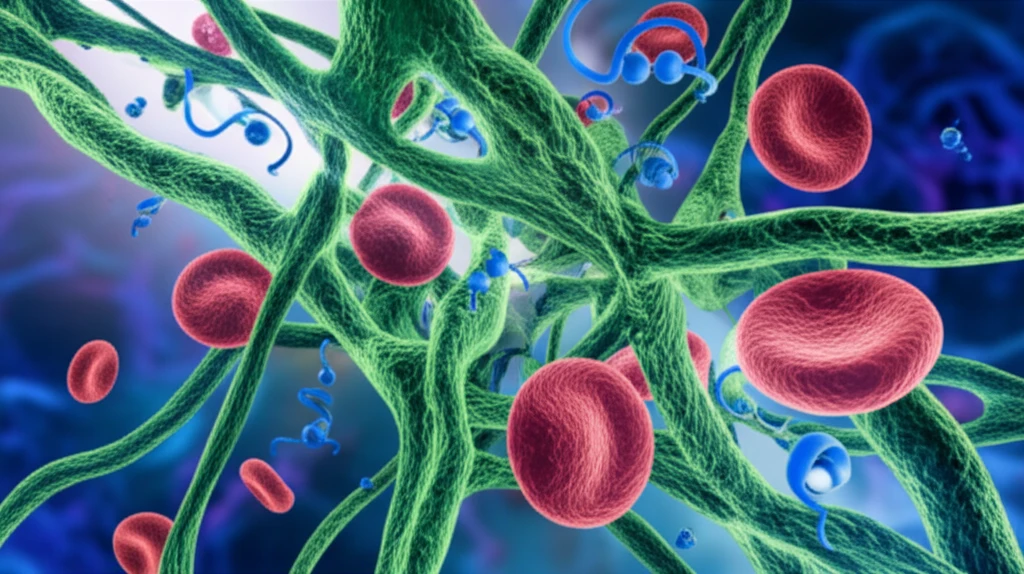
Illustration of blood clot structure with fibrin and red blood cells, showing plasmin molecules breaking down the clot.

Unlocking the Secrets of Blood Clots: How Contraction Affects Fibrinolysis

"Discover how the process of blood clot contraction uniquely influences the breakdown of clots from the inside versus the outside, impacting treatment strategies."


Blood clots are essential for healing, but when they block blood vessels, it's crucial to restore flow. This process, called fibrinolysis, breaks down the clot's fibrin network. How well this works depends on the fibrin's structure and arrangement. Scientists are now exploring how clot contraction—driven by platelets—affects fibrinolysis, a key factor previously understudied.

A recent study has examined whether blood clot contraction impacts how clots break down naturally from the inside (internal fibrinolysis) versus when broken down by external medications (external fibrinolysis).

This article will break down this research, explaining how these differences could lead to better treatments for blood clots. It will cover the key findings, what they mean, and how they might shape future medical approaches.

Internal vs. External Fibrinolysis: What's the Difference?

Illustration of blood clot structure with fibrin and red blood cells, showing plasmin molecules breaking down the clot.

To understand the study's implications, it's important to distinguish between internal and external fibrinolysis:

The study aimed to mimic these scenarios in the lab to see how clot contraction influences each type of fibrinolysis.

  • Internal Fibrinolysis: This occurs when the clot breaks down from within, mirroring the body's natural process of clot resolution.
  • External Fibrinolysis: This happens when a clot is broken down by external means, such as thrombolytic drugs administered to dissolve the clot.
Researchers used whole blood samples and manipulated clot contraction using specific inhibitors. They then measured the rates of internal and external fibrinolysis under these controlled conditions.

The Future of Clot Treatment

This research opens exciting avenues for refining how we approach thrombolytic therapy. By understanding that clot contraction affects internal and external lysis differently, treatments can be tailored to either promote natural clot breakdown or improve the effectiveness of external thrombolytic drugs. Further work is needed to understand how these findings translate into clinical practice, potentially paving the way for more effective and personalized clot management strategies.

About this Article -

This article was crafted using a human-AI hybrid and collaborative approach. AI assisted our team with initial drafting, research insights, identifying key questions, and image generation. Our human editors guided topic selection, defined the angle, structured the content, ensured factual accuracy and relevance, refined the tone, and conducted thorough editing to deliver helpful, high-quality information.See our About page for more information.

This article is based on research published under:

DOI-LINK: 10.1111/jth.14370, Alternate LINK

Title: Blood Clot Contraction Differentially Modulates Internal And External Fibrinolysis

Subject: Hematology

Journal: Journal of Thrombosis and Haemostasis

Publisher: Wiley

Authors: Valerie Tutwiler, Alina D. Peshkova, Giang Le Minh, Sergei Zaitsev, Rustem I. Litvinov, Douglas B. Cines, John W. Weisel

Published: 2019-02-01

Everything You Need To Know

1

Why are blood clots and their breakdown important?

Blood clots are essential for wound healing, but when they form inappropriately and block blood vessels, they can cause serious health issues. The process of breaking down a blood clot is called fibrinolysis. Understanding the mechanisms of fibrinolysis is crucial for developing effective treatments for thrombotic disorders.

2

What is clot contraction and why is it relevant?

Clot contraction, driven by platelets, is the process where a blood clot shrinks and becomes denser. This study investigated how clot contraction affects the breakdown of clots from the inside (internal fibrinolysis) versus when external medications break them down (external fibrinolysis). The study used specific inhibitors to manipulate clot contraction and measure the rates of internal and external fibrinolysis under controlled conditions to understand the impact.

3

What is the difference between internal and external fibrinolysis?

Internal fibrinolysis is the natural process where the body breaks down a clot from within. External fibrinolysis involves breaking down a clot using medications, such as thrombolytic drugs. The research explored how clot contraction influences these two different types of fibrinolysis. The study aimed to replicate these scenarios to analyze the differential effects of contraction on both types of fibrinolysis.

4

What are the key findings of the research?

The key finding is that clot contraction affects internal and external fibrinolysis differently. This research suggests that treatments could be tailored to promote natural clot breakdown or enhance the effectiveness of external thrombolytic drugs. By understanding these differences, it may be possible to develop more personalized clot management strategies.

5

What are the implications of this research for future treatments?

The implications are significant for the future of clot management. This research opens possibilities for refining thrombolytic therapy. It suggests that treatments can be designed to either improve the body's natural clot breakdown process (internal fibrinolysis) or make external medications more effective (external fibrinolysis). Further research is needed to translate these findings into clinical practice and improve patient outcomes.

Newsletter Subscribe

Subscribe to get the latest articles and insights directly in your inbox.