
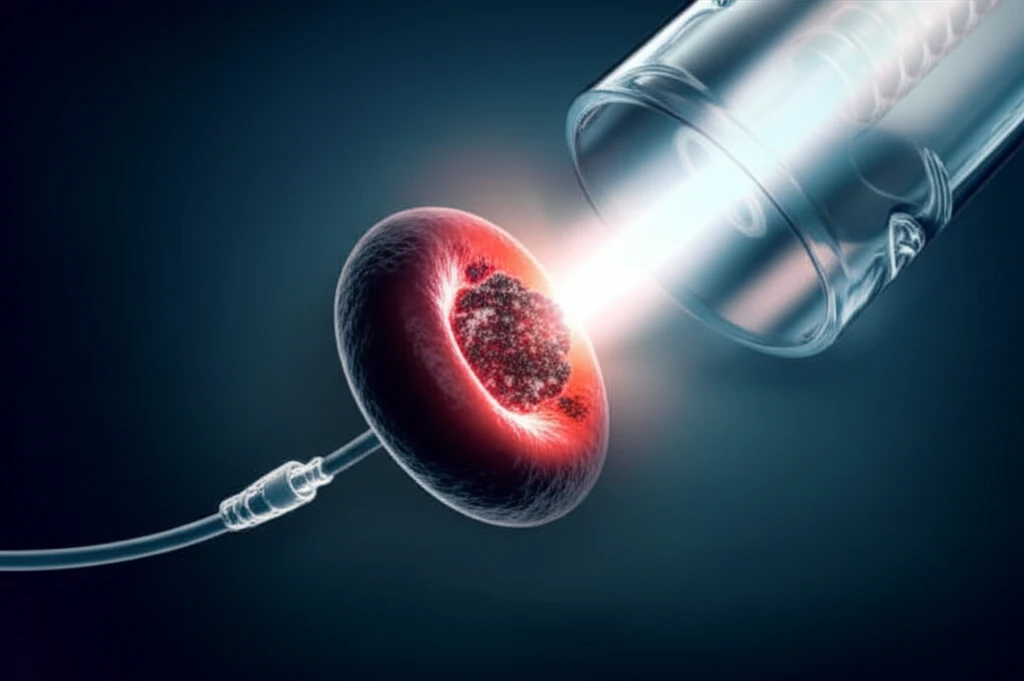
CVC-Directed Thrombolysis: A Game-Changer in Massive Pulmonary Embolism?

"Learn how a central venous catheter (CVC) can deliver life-saving treatment directly to pulmonary embolisms, improving outcomes in critical cases."
Pulmonary embolism (PE) is a life-threatening condition where blood clots block arteries in the lungs, leading to severe cardiovascular issues. Emergency physicians frequently encounter PE, which can range from minor blockages to massive saddle emboli causing circulatory collapse. Traditionally, thrombolysis (dissolving the clot with medication) and surgical thrombectomy (removing the clot surgically) are reserved for severe cases of PE, particularly when patients experience persistent hypotension or shock.
Administering thrombolytic therapy in hemodynamically unstable patients with confirmed or suspected PE is a balancing act. The American College of Emergency Physicians (ACEP) recommends thrombolysis for confirmed PE cases where the benefits outweigh the risks of bleeding. They also suggest considering it for unstable patients when a PE diagnosis is highly suspected but cannot be immediately confirmed. The challenge lies in quickly and effectively delivering the medication to dissolve the clot and restore blood flow.
A recent case highlights a novel approach to this challenge: using a central venous catheter (CVC) to deliver tissue plasminogen activator (tPA), a potent thrombolytic drug, directly to the pulmonary embolism. This method may offer advantages over traditional peripheral infusions, particularly in critical cases where rapid intervention is crucial.
The Scale of PE and VTE
The CDC reported on January 27, 2025, that up to 900,000 people in the United States are affected by venous thromboembolism each year. Risk is particularly high during or shortly after hospitalization, during cancer treatment, and during or shortly after pregnancy. A May 2026 network meta-analysis described pulmonary embolism as a common medical emergency, with first PE occurring at approximately 8.5 cases per month per 100,000 people in the United Kingdom. Management centers on anticoagulation, while thrombolysis is suggested as an adjunct for PE causing significant physiological compromise.
From Virchow to Catheter Therapy
Pulmonary embolism has a long medical history and remains a major cause of mortality worldwide. Historical reviews describe progress in understanding PE physiology, developing diagnostic modalities, and refining heparin and thrombolytic therapy, although venous thromboembolism remains common and lethal. One reported case illustrates the evolution of emergency treatment: an 88-year-old woman with hypertension and hyperlipidemia presented after a respiratory arrest and received central venous catheter-directed tissue plasminogen activator for massive PE. These developments reflect the continuing movement from foundational disease concepts toward targeted intervention.
What is CVC-Directed Thrombolysis and Why Does It Matter?
CVC-directed thrombolysis involves inserting a central venous catheter (CVC) into a large vein, typically in the neck or groin, and threading it close to the location of the pulmonary embolism. Instead of administering the thrombolytic drug through a peripheral IV line, it is injected directly through the CVC. This targeted approach aims to:
- Minimize systemic exposure to the drug, possibly reducing the risk of bleeding complications.
- Achieve quicker restoration of blood flow and improve patient outcomes, especially in cases of cardiac arrest or severe hemodynamic instability.
Evidence From Recent Cases and Reviews
Recent case reports describe fibrinolysis used during acute pulmonary embolism with cardiopulmonary arrest during orthopedic surgery. One report emphasizes that central perfusion may be more effective than peripheral infusion because it can increase tissue plasminogen activator concentration at the thrombus site. A 2025 review identifies acute PE as a leading cause of in-hospital mortality and the third most frequent cause of cardiovascular mortality, while noting that clinical presentation varies according to clinical and hemodynamic features. According to the review snippet, international guidelines rank systemic thrombolysis as first-line therapy in relevant high-risk settings.
Uncertainty in Risk and Treatment Selection
Accurately predicting which intermediate-high-risk PE patients will deteriorate remains challenging despite advances in risk-stratification models. Systemic thrombolysis can be effective in high-risk PE but is not a viable option for a significant proportion of patients, according to a 2025 review. Another 2025 source stresses that patients may rapidly deteriorate because of progressive right-heart failure, making immediate risk stratification and treatment initiation crucial but difficult. These limitations complicate decisions about when to use systemic or catheter-based reperfusion.
CDT Versus Systemic and Mechanical Options
For intermediate- or high-risk PE, available approaches include anticoagulation, systemic thrombolysis, and catheter-directed thrombolysis, but the role of CDT remains controversial. Systemic thrombolysis can produce early hemodynamic improvement but is associated with major bleeding and is withheld in many patients at risk. CDT has been reported to rapidly reverse hemodynamic and echocardiographic abnormalities in intermediate-risk PE, while suction thrombectomy offers immediate treatment without thrombolytics. However, comparative data between suction thrombectomy and CDT remain sparse, and whether CDT is superior to systemic thrombolysis in high-risk PE is still unclear.
The Future of PE Treatment: Is CVC-Directed Thrombolysis the Answer?
The successful outcome in this case suggests that CVC-directed thrombolysis may be a valuable tool in the emergency physician's arsenal for treating massive PE, particularly in patients experiencing cardiac arrest or severe instability. While this approach shows promise, it's important to acknowledge that more research is needed. The authors of the original study themselves call for further investigation to analyze the effectiveness of CVC-directed tPA and its impact on morbidity and mortality. Randomized controlled trials comparing central versus peripheral thrombolysis are essential to determine the optimal route and dosage of thrombolytic drugs in these critical situations. For now, CVC-directed thrombolysis remains a promising but investigational technique that warrants consideration in select cases of massive PE.
The Shift Beyond Systemic Thrombolysis
The European Society of Cardiology's 2019 guidelines recommend systemic thrombolysis for high-risk PE and for intermediate-risk PE with hemodynamic deterioration. Massive PE has historically been treated with systemic thrombolytics because of its acuity and high mortality rate. The risk of hemorrhage associated with systemic thrombolysis has increased interest in potentially safer endovascular treatments, including catheter-directed thrombolysis and mechanical thrombectomy. This context explains why CVC-directed approaches are being considered as alternatives or adjuncts rather than as an established universal replacement.
Timing, Teamwork, and Patient Outcomes
A 2026 case report analyzing two cases of acute fatal PE emphasizes early diagnosis, timely risk assessment, and precise thrombolytic therapy, particularly in hemodynamically unstable patients. The report highlights timing, dosage, and multidisciplinary management as important considerations in optimizing patient care. A 2023 real-world study reported that ultrasound-assisted catheter-directed thrombolysis for PE resulted in a lower bleeding risk than mechanical thrombectomy. Together, these reports frame treatment choice around both urgent clinical judgment and observed outcomes in practice.