
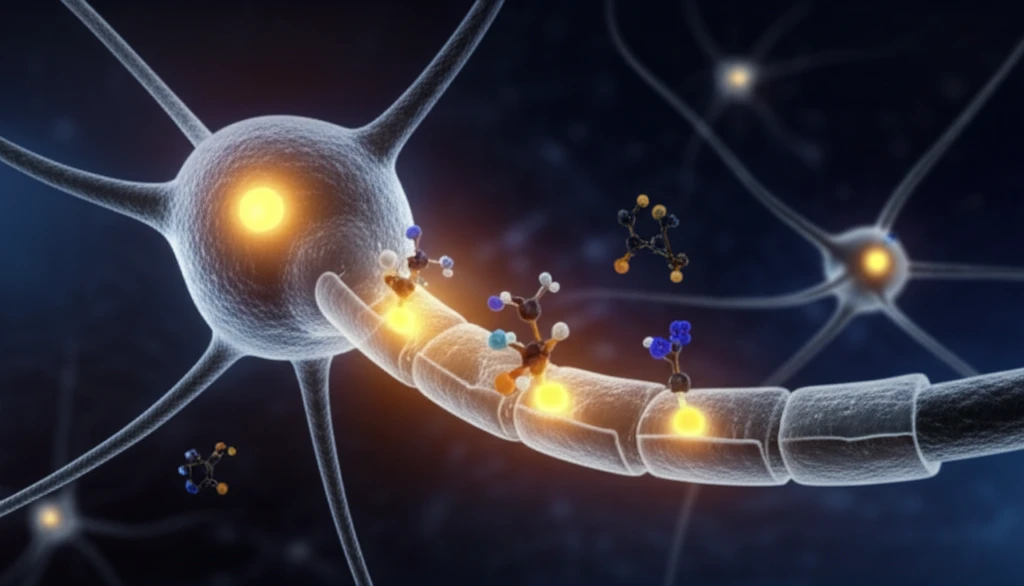
Targeted Pain Relief: 5-BDBD selectively blocking P2X4 receptors on a nerve cell.

Unlocking Pain Relief: How 5-BDBD Could Revolutionize Chronic Pain Treatment

"A deep dive into the innovative research showing the potential of 5-BDBD as a highly selective P2X4 receptor antagonist, offering new hope for those suffering from chronic pain and neurological disorders."


Chronic pain affects millions worldwide, significantly impacting quality of life. Traditional pain management strategies often fall short, leading researchers to explore new, targeted therapies. One promising area of research focuses on purinergic receptors, specifically the P2X4 receptor, which plays a critical role in pain signaling.

P2X receptors (P2XRs) are ATP-gated ion channels found in numerous cells, including those in the nervous system. Among these, the P2X4 receptor has emerged as a key player in various physiological processes, particularly in the development and maintenance of chronic pain. This has made it a prime target for developing novel pain relief medications.

Scientists have been working diligently to identify specific and potent antagonists for P2X4 receptors. One such compound, 5-(3-bromophenyl)-1,3-dihydro-2H-benzofuro[3,2-e]-1,4-diazepin-2-one, known as 5-BDBD, has shown significant promise. Recent research delves into the detailed effects of 5-BDBD, highlighting its potential as a selective P2X4 receptor antagonist.

5-BDBD: A Targeted Approach to P2X4 Receptor Antagonism

Targeted Pain Relief: 5-BDBD selectively blocking P2X4 receptors on a nerve cell.

A study published in Neuroscience Letters meticulously examined the effects of 5-BDBD on rat P2X4 receptors. The research aimed to understand how this compound interacts with the receptor and whether it could selectively block its activity without affecting other P2X receptor subtypes. The findings revealed that 5-BDBD is indeed a potent P2X4 receptor antagonist with a high degree of selectivity.

The researchers conducted electrophysiological experiments on HEK293 cells expressing rat P2X4 receptors. They measured ATP-induced currents in the presence and absence of 5-BDBD to assess its inhibitory effects. The results were compelling:

  • Potent Antagonism: 5-BDBD exhibited a significant antagonistic effect on P2X4 receptors with an IC50 of 0.75 µM when applied for 2 minutes prior to and during ATP stimulation.
  • High Selectivity: At a concentration of 10 µM, 5-BDBD did not significantly affect ATP-induced currents in P2X2aR, P2X2bR, and P2X7R receptors.
  • Modest Effects on P2X1R and P2X3R: While highly selective for P2X4 receptors, 5-BDBD showed a modest inhibitory effect on P2X1R and P2X3R-gated currents at a higher concentration (10 µM), inhibiting them by 13% and 35%, respectively.
These findings underscore the potential of 5-BDBD as a highly selective tool for studying and targeting P2X4 receptors. Its ability to discriminate between P2X4 and other P2X subtypes makes it invaluable for research and therapeutic applications.

Future Directions and Therapeutic Implications

The research on 5-BDBD opens new avenues for treating chronic pain and other neurological disorders. By selectively targeting P2X4 receptors, scientists can potentially develop more effective and precise therapies with fewer side effects. Further studies are needed to explore the full therapeutic potential of 5-BDBD and its derivatives, but the initial findings are highly encouraging.

About this Article -

This article was crafted using a human-AI hybrid and collaborative approach. AI assisted our team with initial drafting, research insights, identifying key questions, and image generation. Our human editors guided topic selection, defined the angle, structured the content, ensured factual accuracy and relevance, refined the tone, and conducted thorough editing to deliver helpful, high-quality information.See our About page for more information.

Everything You Need To Know

1

What is 5-BDBD, and why is it considered a potential breakthrough?

5-BDBD, or 5-(3-bromophenyl)-1,3-dihydro-2H-benzofuro[3,2-e]-1,4-diazepin-2-one, is a compound identified as a highly selective antagonist of the P2X4 receptor. This means it can block the activity of the P2X4 receptor while having minimal impact on other similar receptors. Its importance lies in its potential to offer a targeted approach to treating chronic pain and neurological disorders by modulating specific cellular pathways involved in pain signaling. Traditional pain management strategies often have broad effects and can lead to side effects. 5-BDBD offers a more focused intervention, potentially reducing these unwanted effects.

2

What exactly are P2X4 receptors, and why are they important in understanding pain?

P2X4 receptors are ATP-gated ion channels found in cells, especially those in the nervous system. ATP, or adenosine triphosphate, is a molecule that carries energy within cells and can activate these receptors. P2X4 receptors are significant because they play a critical role in the development and maintenance of chronic pain. When activated, they contribute to the signaling pathways that lead to the sensation of pain. By understanding and targeting these receptors, scientists aim to develop new ways to alleviate chronic pain. Other P2X receptors exist such as P2X1R, P2X2aR, P2X2bR, P2X3R and P2X7R

3

What does a P2X4 receptor antagonist do, and why is it important?

A P2X4 receptor antagonist is a substance that blocks or inhibits the activity of the P2X4 receptor. The importance of an antagonist like 5-BDBD is that it can prevent the receptor from being activated by ATP, thus disrupting the pain signaling pathway. This is particularly important in the context of chronic pain, where the P2X4 receptor may be overactive or contributing to the amplification of pain signals. Antagonists offer a way to selectively target and reduce this activity, potentially leading to pain relief. Research indicates 5-BDBD is a potent P2X4 receptor antagonist.

4

What does it mean when we say 5-BDBD has high 'selectivity,' and why is that important?

The selectivity of 5-BDBD refers to its ability to target and block the P2X4 receptor specifically, without significantly affecting other P2X receptor subtypes. This is crucial because it minimizes the risk of unwanted side effects that could arise from interfering with other physiological processes mediated by different P2X receptors. Research showed at a concentration of 10 µM, 5-BDBD did not significantly affect ATP-induced currents in P2X2aR, P2X2bR, and P2X7R receptors. While highly selective for P2X4 receptors, 5-BDBD showed a modest inhibitory effect on P2X1R and P2X3R-gated currents at a higher concentration (10 µM), inhibiting them by 13% and 35%, respectively.

5

What are the next steps in researching 5-BDBD before it can be used to treat people?

5-BDBD has shown promise in laboratory settings by demonstrating potent antagonism and high selectivity for the P2X4 receptor. This suggests it could be developed into a therapeutic drug for chronic pain and neurological disorders. However, further research is needed to fully understand its effects in living organisms, determine optimal dosages, and assess potential long-term effects and safety. Clinical trials would be necessary to confirm its efficacy and safety in humans. The initial findings are a crucial step toward developing more effective and targeted pain relief medications.

Newsletter Subscribe

Subscribe to get the latest articles and insights directly in your inbox.