
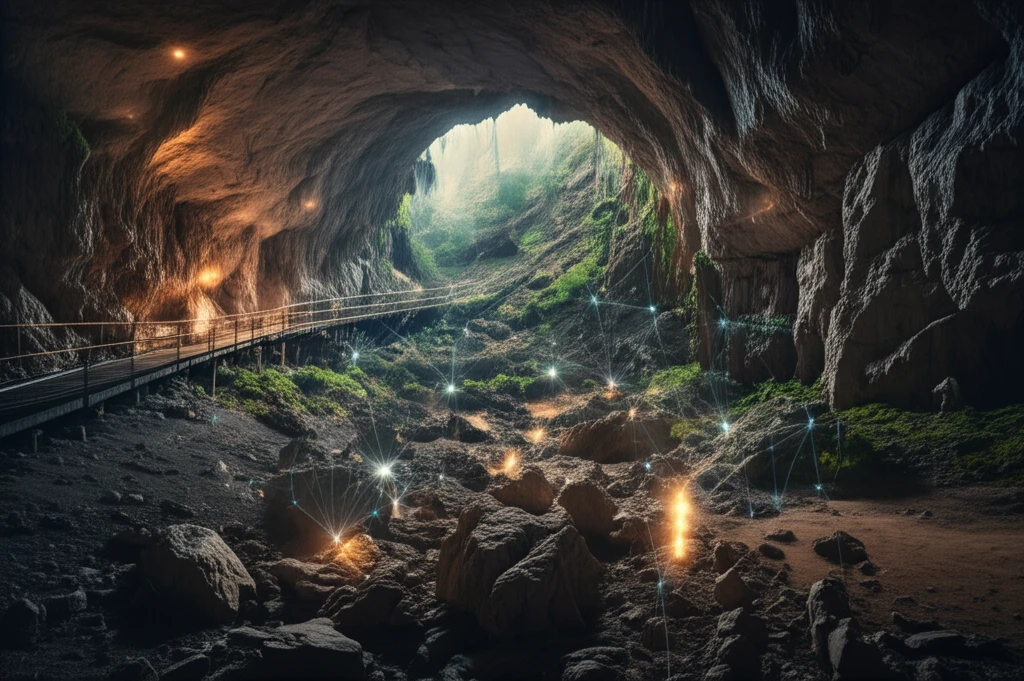
Unlocking Nature's Secrets: How AI Forecasts Tourism in Serbia's Stopića Cave

"Discover how neural networks and Google Trends data are revolutionizing tourism management in environmentally sensitive destinations."
Imagine trying to predict how many people will visit a delicate natural site, like a cave, next month. It's not just a guessing game; it's about understanding trends, protecting the environment, and ensuring everyone has a great experience. Modeling tourist demand is vital for managing resources, planning infrastructure, and mitigating risks in such destinations.
In the heart of Serbia, Stopića Cave has seen a surge in tourist interest, presenting both opportunities and challenges. Managing tourism here requires a delicate balance: how do you allow people to experience this natural wonder while ensuring its long-term preservation? This question is especially pertinent in vulnerable environments like caves, where even small changes can have significant impacts.
Recent research leverages the power of artificial intelligence to forecast tourism demand in Stopića Cave. By combining traditional methods with modern machine learning techniques, scientists are developing more accurate models to predict visitor numbers. This data-driven approach promises to revolutionize how tourism is managed in sensitive areas, ensuring sustainability and enhancing the visitor experience.
Defining Sustainability for Tourism
Sustainability is often conceptualized as a long-term goal, representing a desired state of a more sustainable world. Sustainable development, in contrast, refers to the specific processes and pathways required to achieve that goal. This distinction is critical for tourism management, where operational practices must align with long-term ecological and economic viability. Understanding these definitions provides the foundational framework for evaluating the impact of tourism on natural sites like Stopića Cave.
Traditional Forecasting Constraints
Traditional tourism forecasting often relies on historical visitor data and linear statistical models. These approaches typically assume stable conditions and may fail to account for the complex, non-linear variables affecting cave tourism, such as microclimate fluctuations and seasonal weather patterns. While established methods provide a baseline, their predictive accuracy can be limited in dynamic natural environments. This necessitates exploration of more adaptive, data-driven forecasting techniques.
Global Frameworks for Sustainable Development
The United Nations' 17 Sustainable Development Goals (SDGs) establish an urgent, global call for action by all nations. Adopted in 2015, these goals provide a universal framework for addressing interconnected challenges, including responsible tourism and environmental conservation. The SDGs emphasize that sustainable practices require coordinated efforts across developed and developing countries alike. This international consensus has shaped regional tourism policies and sustainability initiatives worldwide.
Why Forecasting Tourism Matters: Protecting Caves with Data
Predicting tourist demand isn't just about numbers; it's about understanding the story the numbers tell. By analyzing visitor trends, behaviors, and preferences, management can identify niche markets and emerging trends. Accurate forecasting allows for competitive pricing strategies, adapting prices based on expected tourist flow. It also informs the development of new services and products that cater to evolving tourist needs, and dictates the efficient use of marketing resources, maximizing reach and impact. All in all, tourist demand forecasting is an indispensable tool in the tourist industry.
- ARIMA Model: This is one of the most used models in time series analysis. It helps predict future trends even when the data isn't consistent.
- Support Vector Regression (SVR): This machine learning model is great for solving both linear and nonlinear regression problems, allowing for flexibility in data.
- NeuralProphet: This method combines the best parts of classical time series analysis with machine learning. It’s especially good for understanding the different parts of a time series.
AI Applications in Cave Tourism Forecasting
Recent research explores applying artificial intelligence to predict visitor patterns in unique geological sites. Machine learning models can process multi-source data, including weather, social media trends, and historical visitation, to generate dynamic forecasts. While specific studies on Stopića Cave may be limited, the methodological framework is transferable from analogous karst tourism research. These AI-driven approaches aim to improve both visitor experience and resource conservation.
Potential Limitations of AI Models
AI forecasting models face significant challenges, including data scarcity and the difficulty of capturing human behavioral nuance. Over-reliance on historical data may lead to inaccurate predictions during unprecedented events, such as extreme weather or pandemics. Furthermore, the 'black box' nature of some algorithms can hinder interpretability for park managers. These limitations highlight the need for hybrid approaches that combine AI with expert local knowledge.
AI Versus Traditional Forecasting Methods
Comparative analysis typically shows AI models outperforming traditional statistical methods in handling non-linear relationships and high-dimensional data. While conventional time-series models struggle with sudden demand shifts, machine learning algorithms can adapt more rapidly to new patterns. However, AI models often require more extensive computational resources and cleaner datasets. The optimal approach may involve integrating AI predictions with established tourism management frameworks.
The Future of Tourism: Balancing Exploration and Preservation
By using methods like ARIMA, SVR, and NeuralProphet, researchers are gaining valuable insights into tourist behavior and its impact on fragile environments. NeuralProphet shows the most promise and provides the best results for predicting tourism in Serbia. The study highlights the importance of combining classic and machine learning methods to fully understand the factors that affect tourist arrivals. Using neural networks can help in the decision making process. As tourism continues to grow, these AI-driven approaches will be crucial for ensuring the long-term sustainability of natural wonders like Stopića Cave, balancing the desire for exploration with the need for preservation.
Integrating AI into Conservation Strategy
Experts emphasize that AI tools should augment, not replace, human decision-making in cave tourism management. Effective implementation requires interdisciplinary collaboration between data scientists, ecologists, and site managers. The synthesis of AI insights with on-the-ground expertise can lead to more resilient and adaptive management plans. This integrated approach aligns technological capability with the core principles of sustainable development.
Emerging Trends in Intelligent Tourism
Future developments may include real-time adaptive pricing and access systems based on AI predictions. The integration of IoT sensors within caves could provide live environmental data to refine forecasts continuously. Another frontier is the use of AI for personalized visitor experience management without compromising conservation goals. These advancements aim to balance tourism revenue with the preservation of delicate subterranean ecosystems.
Systemic Barriers to Implementation
Widespread adoption of AI in tourism faces systemic challenges, including high initial investment costs and a shortage of specialized technical skills in rural areas. Data privacy concerns and the need for robust digital infrastructure also present significant hurdles. Furthermore, aligning AI-driven efficiency goals with broader socio-cultural values of local communities requires careful governance. Overcoming these barriers is essential for equitable and sustainable technological integration.
Balancing Technology with Community Values
Ultimately, the success of AI forecasting depends on its acceptance by local stakeholders and visitors. Transparent communication about how AI is used to protect the site and improve experience is crucial. Technology must serve human and environmental well-being, not merely optimize metrics. The real-world impact will be measured by how effectively these tools enhance both conservation outcomes and visitor satisfaction.