
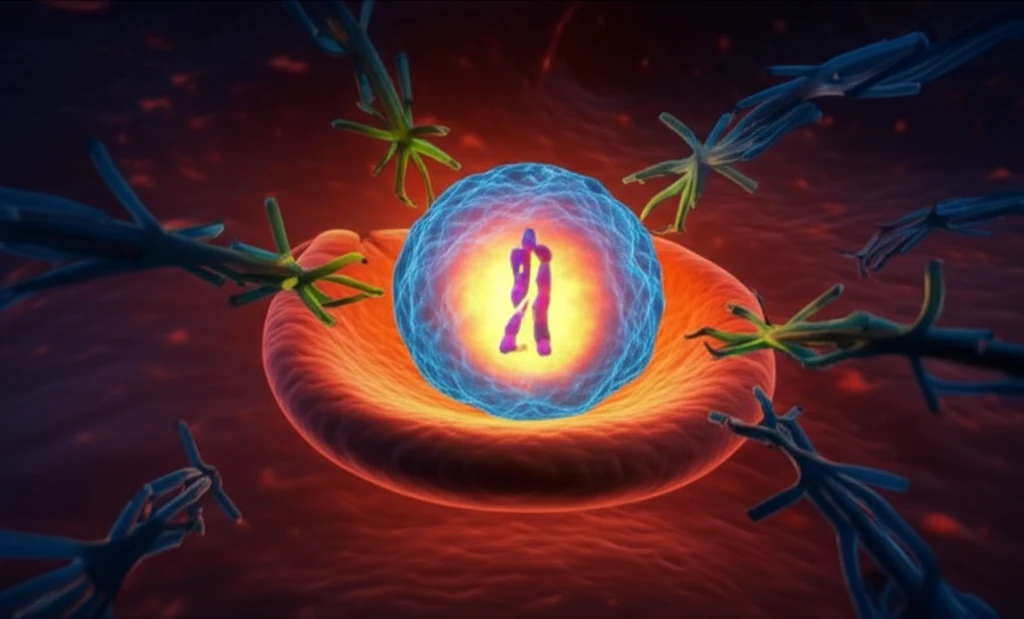
Microscopic view of blood platelets with a glowing Akt protein.

Unlocking ITP: How New Research Could Revolutionize Platelet Disorder Treatments

"Groundbreaking study reveals a key mechanism in immune thrombocytopenia (ITP), offering hope for more effective and targeted therapies."


Immune thrombocytopenia (ITP) is a complex autoimmune disorder characterized by an abnormally low platelet count, increasing the risk of serious and potentially fatal bleeding. Platelets, tiny blood cells, are essential for blood clotting, and when their numbers are reduced, even minor injuries can lead to prolonged bleeding or internal hemorrhages. For many individuals living with ITP, managing the condition can be a daily struggle, filled with uncertainty and the need for constant vigilance.

While current treatments, such as immune suppression and splenectomy, can provide relief for some, a significant number of ITP patients, particularly those with anti-GPIb-IX autoantibodies, show limited or no response to these conventional therapies. This resistance highlights the need for a deeper understanding of the mechanisms driving ITP and the development of more targeted treatment strategies.

Now, a groundbreaking study sheds light on a critical pathway involved in ITP, offering hope for more effective and personalized treatments. The research focuses on the role of Akt, a protein kinase, in platelet apoptosis (programmed cell death) and clearance, providing a potential target for therapeutic intervention.

Platelet Apoptosis: A Key Culprit in ITP?

Microscopic view of blood platelets with a glowing Akt protein.

The study, led by researchers at the Jiangsu Institute of Hematology and The University of Chicago, investigated why ITP patients with anti-GPIb-IX autoantibodies often respond poorly to standard treatments. Their findings revealed that platelets in these patients undergo apoptosis, a process of programmed cell death, at an accelerated rate. This discovery prompted the team to explore the underlying mechanisms driving this increased platelet destruction.

To confirm their observations, the researchers used anti-GPIba monoclonal antibodies, AN51 and SZ2, which mimic the effects of the autoantibodies found in ITP patients. They found that these antibodies induced platelet apoptosis in vitro, further supporting the role of apoptosis in ITP.

  • Anti-GPIba antibodies (AN51 and SZ2) induce platelet apoptosis in vitro.
  • Anti-GPIba antibody binding activates Akt.
  • Activated Akt elicits platelet apoptosis through activation of phosphodiesterase (PDE3A) and PDE3A-mediated PKA inhibition.
The researchers demonstrated that when anti-GPIba antibodies bind to platelets, they activate a protein called Akt. Activated Akt then triggers a cascade of events that ultimately lead to platelet apoptosis. Specifically, Akt activates phosphodiesterase (PDE3A), an enzyme that inhibits protein kinase A (PKA). PKA is typically involved in platelet survival, so its inhibition promotes apoptosis.

A New Hope for ITP Treatment

By identifying Akt as a central player in platelet apoptosis, this study opens new avenues for therapeutic intervention in ITP. The researchers demonstrated that inhibiting Akt or blocking its downstream signaling pathways could prevent platelet apoptosis and clearance. This suggests that drugs targeting Akt or related molecules could be effective in treating ITP, particularly in patients who do not respond to conventional therapies.

About this Article -

This article was crafted using a human-AI hybrid and collaborative approach. AI assisted our team with initial drafting, research insights, identifying key questions, and image generation. Our human editors guided topic selection, defined the angle, structured the content, ensured factual accuracy and relevance, refined the tone, and conducted thorough editing to deliver helpful, high-quality information.See our About page for more information.

This article is based on research published under:

DOI-LINK: 10.1073/pnas.1808217115, Alternate LINK

Title: Akt-Mediated Platelet Apoptosis And Its Therapeutic Implications In Immune Thrombocytopenia

Subject: Multidisciplinary

Journal: Proceedings of the National Academy of Sciences

Publisher: Proceedings of the National Academy of Sciences

Authors: Mengxing Chen, Rong Yan, Kangxi Zhou, Xiaodong Li, Yang Zhang, Chunliang Liu, Mengxiao Jiang, Honglei Ye, Xingjun Meng, Ningbo Pang, Lili Zhao, Jun Liu, Weiling Xiao, Renping Hu, Qingya Cui, Wei Zhong, Yunxiao Zhao, Mingqing Zhu, Anning Lin, Changgeng Ruan, Kesheng Dai

Published: 2018-10-18

Everything You Need To Know

1

What is Immune thrombocytopenia (ITP)?

Immune thrombocytopenia (ITP) is an autoimmune disorder. It is characterized by an abnormally low platelet count. This can lead to an increased risk of bleeding. Platelets are crucial for blood clotting, and their reduction can cause prolonged bleeding from minor injuries. It's a complex condition.

2

Why is the study important?

The study indicates that Anti-GPIb-IX autoantibodies play a role in ITP. The research focused on the role of Akt, a protein kinase, in platelet apoptosis (programmed cell death) and clearance. This is significant because it provides a potential target for therapeutic intervention and understanding why some patients do not respond to traditional treatments like immune suppression or splenectomy.

3

What is platelet apoptosis and its role in ITP?

Platelet apoptosis is programmed cell death. It is a key mechanism in ITP. In ITP patients, especially those with anti-GPIb-IX autoantibodies, platelets undergo apoptosis at an accelerated rate. This leads to reduced platelet counts. The researchers found that Anti-GPIba antibodies (AN51 and SZ2) induce platelet apoptosis in vitro, highlighting the role of apoptosis in the disease progression.

4

How does Akt contribute to platelet apoptosis in the context of this research?

The study discovered that Akt is activated when Anti-GPIba antibodies bind to platelets. This activation of Akt triggers a cascade that results in platelet apoptosis. Akt activates phosphodiesterase (PDE3A), which inhibits protein kinase A (PKA). PKA usually promotes platelet survival. By inhibiting PKA, platelet apoptosis is promoted.

5

What is the significance of these findings for the future of ITP treatment?

By identifying Akt as a central player, this study opens new avenues for treatment. Inhibiting Akt or its related pathways could prevent platelet apoptosis and clearance. Drugs targeting Akt or related molecules could potentially treat ITP, especially in patients who don't respond to current treatments. This offers hope for more personalized and effective therapies.

Newsletter Subscribe

Subscribe to get the latest articles and insights directly in your inbox.