
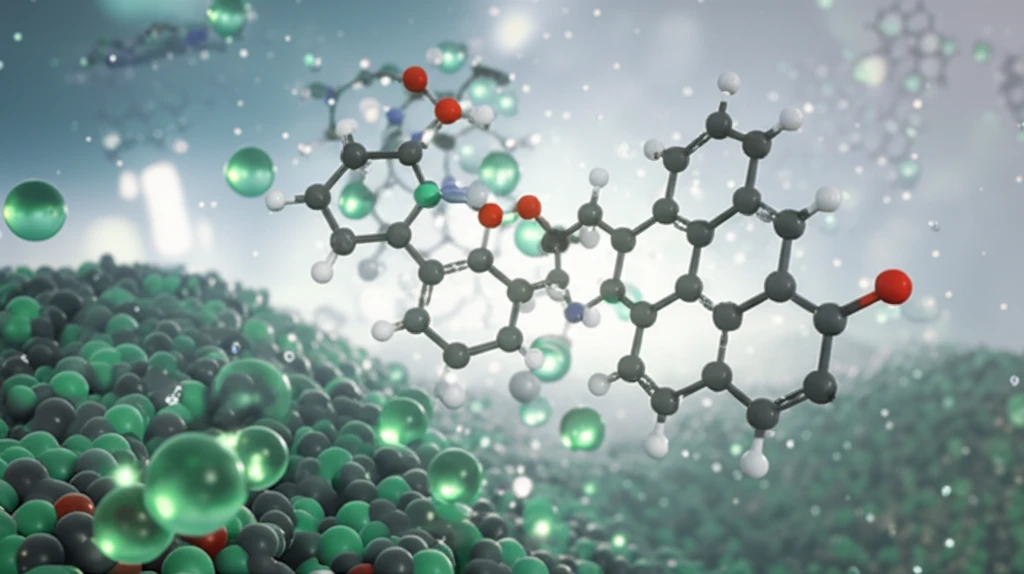
Unlocking Green Chemistry: How Metalloporphyrins on Silica are Revolutionizing Catalysis

"Discover how immobilizing metalloporphyrins on silica supports is forging a path to greener, more efficient catalytic processes."
In the ever-evolving world of green chemistry, the quest for catalysts that are not only active and selective but also recyclable is paramount. Imagine compounds designed to mimic the prosthetic groups of natural enzymes, such as those in the cytochrome P-450 family. These aren't just theoretical concepts; they're real molecules being developed for use in heterogeneous catalysis. These specifically designed catalysts must be isolated and meticulously defined to realize their full potential.
Several key factors play crucial roles in catalyst design, including the availability of active sites to the substrate, the hydrophilicity of the solid catalyst, the hydrophobicity of the matrix, the choice of solvents, and the interaction between the metal ion and the oxidant. Balancing these elements is essential for optimizing catalytic performance. The 'active site isolation principle' mimics the natural isolation of active sites by proteins, controlling substrate access and reaction selectivity.
Cytochrome P-450 enzymes, for example, selectively oxidize hydrocarbons at room temperature using only molecular oxygen as an oxidant—a desirable trait for any industrial process. Synthetic metalloporphyrins (MPs), particularly iron porphyrins (FePs), have shown promise as biomimetic catalysts in various oxidation reactions. However, their high cost and recovery difficulties have hindered large-scale applications. Catalyst heterogenization onto solid supports offers a viable alternative, mitigating typical homogeneous catalysis issues.
Heterogeneous Catalysis: Scale and Industrial Reach
Heterogeneous catalysis is applied in the production of a wide range of products including biofuels of several generations, bulk commodities, polymers, bioplastics, and optically active building blocks. In these processes, catalysts occupy a different phase from reactants, with catalytic activity occurring at active sites on solid surfaces where molecules are adsorbed and form weak bonds with metal atoms. The number of active sites available directly depends on the surface area of the catalyst material, making surface properties a critical determinant of industrial catalytic throughput.
Established Methods in Catalysis Research
The standard classification divides catalysis into homogeneous and heterogeneous modes, distinguished by whether the catalyst shares the same phase as the reactants. Computational approaches such as density functional theory (DFT) are widely applied to study both types, though different models carry distinct advantages and limitations that require careful selection. Beyond simple reactant diffusion, transport phenomena in heterogeneous catalysis present complex challenges that go far beyond basic mass-transfer limitations. The Arrhenius plot remains a fundamental tool for calculating catalytic efficiency and extracting energy barriers from experimental data.
Key Milestones in the Science of Catalysis
The history of catalysis and its contribution to chemical industries has been widely described, with historically significant steps marking the development of catalytic processes over more than a century. A foundational concept in heterogeneous catalysis is the active site, where key catalytic discoveries demonstrated that reactions occur at specific locations on a solid surface rather than uniformly across it. An early and enduring example is the reaction of oxygen and hydrogen on the surface of titanium dioxide (TiO2) to produce water, illustrating the core principle of surface-mediated catalysis.
Silica: A Versatile Support for Metalloporphyrin Catalysts
Solid supports, including silicates, aluminates, titanates, and mixed oxides, provide high thermal and chemical stability, along with a large surface area that facilitates reactant access to catalyst active sites. Immobilization allows for greater control over the reaction environment and enhances catalyst stability and reusability, minimizing costs. This bridge between academic research and industrial applications can lead to economical and technological processes aligned with green chemistry principles.
- Silica provides high thermal and chemical stability.
- It is inert and safe to handle.
- Silica supports easy and cost-effective catalyst recovery and reuse.
Cutting-Edge Advances in Heterogeneous Catalysis
Recent research has shown that lowering the Cu-O bond energy in CuO nanocatalysts enhances the efficiency of ammonia (NH3) oxidation, offering a pathway to more active and selective catalytic materials. New dynamics in heterogeneous oxidation catalysis are being explored in the liquid phase, expanding the traditional focus on gas-phase surface reactions. These advances are being pursued through collaborative research centres dedicated to heterogeneous oxidation catalysis, signalling a broadening of the field's scope.
Challenges and Rate-Limiting Steps
A heterogeneous catalytic reaction is not a single event but a series of consecutive steps, each of which can become rate-limiting and reduce overall efficiency. This multi-step nature means that optimising one part of the catalytic cycle does not guarantee improved performance if another step remains bottlenecked. Despite these challenges, complex heterogeneous catalysts have demonstrated efficient CO2 hydrogenation, pointing toward solutions that overcome individual step limitations through sophisticated catalyst design.
Homogeneous vs. Heterogeneous: Strengths and Trade-offs
Heterogeneous catalysis is characterised by ease of separation and catalyst recovery, making it industrially favourable for large-scale operations where a solid catalyst can be trivially separated from gaseous or liquid products. In contrast, heterogeneous catalysis achieves incredibly high turnover numbers (TONs), so much so that discrete TONs are often impractical to report, dwarfing the typically lower values seen in homogeneous systems. A promising area of research seeks to combine the benefits of both approaches by tethering molecular catalysts to solid supports, merging homogeneous selectivity with heterogeneous recyclability.
The Future of Green Catalysis
The immobilization of metalloporphyrins on silica and its modified forms represents a significant stride towards sustainable and efficient catalysis. As research continues to refine these techniques, the potential for environmentally friendly and economically viable chemical processes grows, promising a greener future for the chemical industry.
Making Catalysis More Predictable
Heterogeneous catalysis, a field important both industrially and scientifically, is increasingly seeking strategies to render itself more predictable and rationally designable. The main challenge lies in understanding the nature and population of catalytically active sites, which remain difficult to characterise precisely under operating conditions. Achieving this predictability is widely regarded as essential for translating fundamental catalytic insights into reliable industrial processes.
Emerging Directions and Sustainability Goals
Heterogeneous catalysis continues to evolve rapidly to meet new challenges and take advantage of emerging science and technology, with future directions including environmental catalysis as a key trend and outlook. Understanding catalysts under dynamic reaction conditions is identified as a major future challenge that must be addressed to advance the field. Heterogeneous catalysis is positioned as enabling a sustainable future, with research increasingly directed toward renewable energy applications and green chemical processes.
Noble Metal Scarcity and Systemic Constraints
Heterogeneous catalysis serves as a cornerstone technology underpinning modern energy conversion, chemical manufacturing, and environmental remediation across multiple sectors. However, its advancement has long been constrained by the scarcity and prohibitive cost of noble metals that many conventional catalysts depend upon. Addressing this resource bottleneck requires developing catalysts based on earth-abundant elements, a systemic challenge that shapes the trajectory of the entire field.
Industry Applications and the Nanoscience Revolution
Real-world applications and case studies illustrate the central importance of heterogeneous catalysis in modern industry, where it underpins processes ranging from fuel production to pharmaceutical manufacturing. The impact of nanoscience on heterogeneous catalysis has been transformative, enabling new material architectures and unprecedented control over catalytic behaviour. Amorphous materials also hold a special place in catalysis, offering unique catalytic activity alongside conventional crystalline catalysts.