
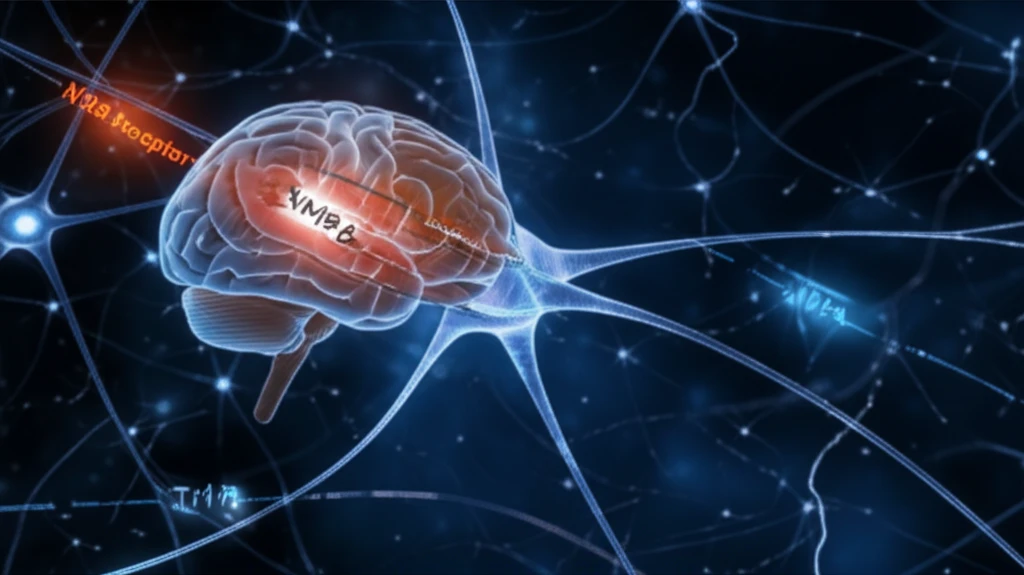
Unlocking Brain Power: How BDNF and TrkB Impact Learning and Memory

"New research reveals the intricate dance between brain-derived neurotrophic factor (BDNF) and its receptor, TrkB, offering insights into enhancing cognitive function and treating neurological disorders. Explore how these molecules influence the NMDA receptor, a key player in memory formation."
Brain-derived neurotrophic factor (BDNF) is like a super fertilizer for your brain. It plays several roles in neuronal differentiation and cellular function. It works by activating a high-affinity receptor tyrosine kinase, known as TrkB. Think of TrkB as the lock that BDNF's key fits into, starting a cascade of events that influence how our brain cells develop and operate.
Both BDNF and TrkB are known to be very crucial in processes related to learning and memory. But the specifics of how TrkB interacts with and modulates signals from receptors like the NMDA receptor (NMDAR) haven't been clearly understood so far. NMDARs are critical for excitatory signals in the brain, which stimulate activity.
New research has been exploring the role of a signaling molecule called RasGrf1. RasGrf1 is a guanine nucleotide exchange factor, which means it helps to activate both Ras and Rac proteins in the brain. Previous studies identified RasGrf1 as a Trk binding partner that facilitates neurite outgrowth. RasGrf1 also binds to the NR2B subunit of the NMDAR and stimulates long-term depression (LTD).
The Brain’s Central Role
The brain is the center of the nervous system in vertebrate and most invertebrate animals, receiving information from the sensory nervous system. In humans, it processes, integrates, and coordinates sensory information, while the cerebrum, its largest part, consists of two cerebral hemispheres. Johns Hopkins Medicine likewise describes the brain as controlling thought, memory, emotion, touch, motor skills, vision, respiration, and other processes that regulate the body.
A Complex Integrated System
The brain regulates movement, memory, emotions, thoughts, body temperature, breathing, hunger, and many other functions. The Cleveland Clinic emphasizes that these functions depend on many complex brain parts working together. This complexity means that broad descriptions of brain function may not fully capture how individual regions and processes contribute to learning and memory.
A Developing Scientific Picture
Understanding of the brain has developed through efforts to relate its structures to sensation, movement, thought, and memory. The topic remains complex because the brain performs many coordinated functions through interconnected systems. Any historical account of BDNF and TrkB should therefore distinguish established observations from conclusions that remain under investigation.
The Dual Action of TrkB on NMDA Receptor Signaling: Uncoupling LTD and Stimulating Growth
Scientists are addressing a model where TrkB helps in learning and memory via two main processes. First, TrkB uncouples RasGrf1 from NR2B, which reduces NMDA signaling that is typically associated with LTD. Second, TrkB enhances neurite outgrowth and pERK activation by recruiting RasGrf1, boosting the signaling pathways related to learning and memory.
- Uncoupling LTD: TrkB activation disrupts the RasGrf1-NR2B complex, reducing NMDA signaling associated with long-term depression (LTD). This process involves the p38-MAPK pathway, which is typically activated during LTD. By uncoupling RasGrf1 from NR2B, TrkB helps to dampen this pathway, shifting the balance away from LTD.
- Enhancing Neuronal Growth: TrkB recruits RasGrf1, which then promotes neurite outgrowth and activates the pERK pathway. This is crucial for learning and memory.
- Tyrosine Phosphorylation: Activation of TrkB stimulates the tyrosine phosphorylation of RasGrf1, further enhancing neurite outgrowth. The phosphorylation of NR2B (Tyr1472) also increases, which helps retain NMDARs on the cell surface, improving their function.
An Active Research Field
Current research on BDNF and TrkB continues to examine how biological signaling may influence learning and memory. Findings should be interpreted carefully because mechanisms observed in experimental settings may not translate directly into everyday human outcomes. Reviews and newer studies can help clarify patterns, but they do not eliminate uncertainty.
Limits and Uncertainty
Evidence linking BDNF and TrkB to learning and memory should not be treated as proof that one pathway alone explains these abilities. Brain functions arise from complex interactions, and results may vary across experimental designs, populations, and contexts. Apparent failures or inconsistent findings therefore remain important for testing the boundaries of proposed mechanisms.
Comparing Biological Explanations
BDNF and TrkB can be considered as part of a broader network of processes involved in learning and memory rather than as isolated explanations. Comparisons should account for differences between molecular, cellular, behavioral, and clinical levels of analysis. Without subsection-specific evidence, no particular model can be identified as superior.
Implications for Future Therapies
Understanding the details of how TrkB changes NMDA signaling has broad implications for treating neurological disorders. By targeting these pathways, scientists may find new ways to improve cognitive functions, treat depression, and even promote recovery after brain injuries. The dual mechanism of TrkB offers a promising path for creating therapies that can fine-tune brain plasticity, promoting resilience and enhancing learning and memory.
An Integrated View
Taken together, BDNF and TrkB are best discussed as possible contributors to the biological processes supporting learning and memory. Their significance depends on how molecular signaling connects with cellular changes and observable behavior. A balanced interpretation should recognize both the promise of this framework and the limits of current evidence.
Questions Ahead
Future work may clarify when and where BDNF-TrkB signaling matters most for learning and memory. It may also help determine how findings from laboratory research relate to people in varied real-world conditions. Until those questions are resolved, proposed applications should be regarded as developing rather than established.
Complexity Beyond One Pathway
Research on brain signaling takes place within a system shaped by interacting biological and environmental factors. This makes it difficult to attribute learning or memory outcomes to a single molecule or receptor. Broader conclusions should therefore remain cautious and acknowledge the limits of simplified explanations.
From Mechanisms to People
The practical importance of BDNF and TrkB research ultimately lies in whether it improves understanding of human learning, memory, and brain health. Laboratory mechanisms do not automatically translate into effective interventions or better outcomes for every person. Responsible interpretation should keep human variability and unresolved evidence in view.